

The UAE has emerged as one of the most digitally advanced eCommerce markets in the Middle East, driven by high internet penetration, strong consumer spending, and rapid adoption of online-first buying habits. As of 2026, the country’s eCommerce market is valued at $12.42 billion, supported by 11 million+ online shoppers and a dense ecosystem of over 45,000 active eCommerce stores. What makes the UAE stand out is not just market size, but how deeply eCommerce is embedded into everyday consumer behavior, with online transactions accounting for half of total consumer spend.
This report breaks down the UAE eCommerce market using verified data sources to highlight its scale, growth trajectory, platform dominance, category demand, revenue distribution, and workforce structure. The goal is to provide a clear, numbers-backed view of how the market operates today and where momentum is building, without speculation or hype.
Top Picks From The Report
- The UAE ecommerce market is valued at $12.42 billion as of 2026.
- There are 11.04 million online shoppers in the UAE.
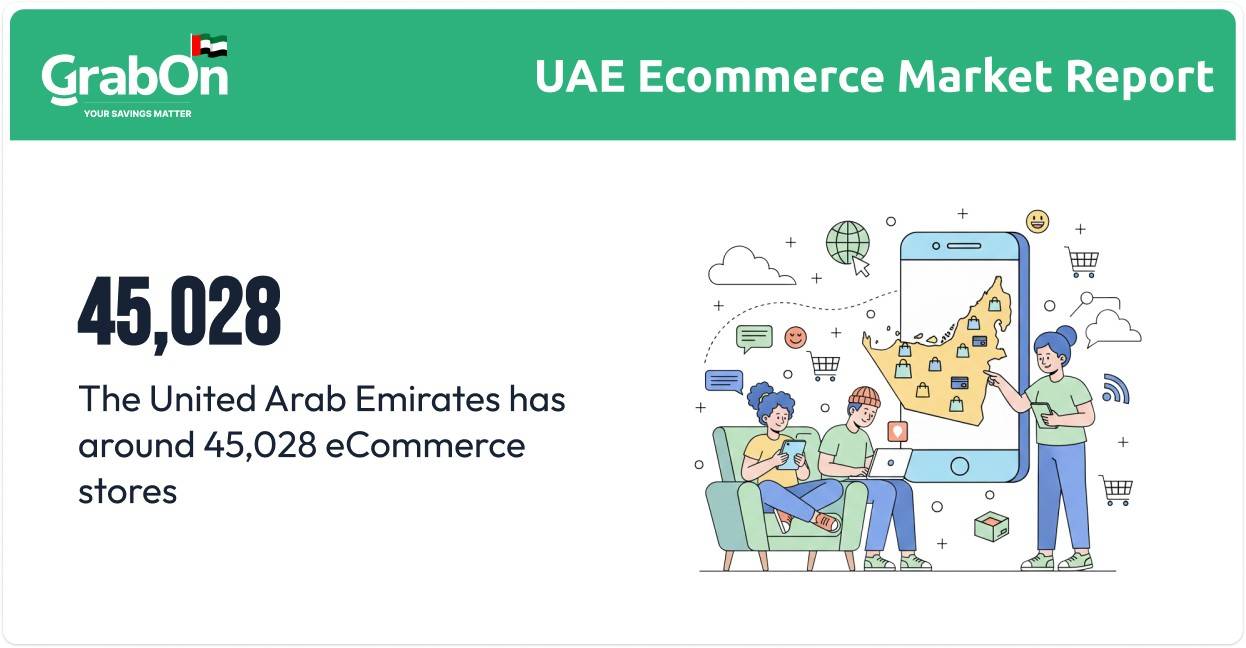
- The United Arab Emirates has around 45,028 eCommerce stores
- Apparel is the largest eCommerce category in the UAE, with nearly 8,000 stores.
UAE Ecommerce Market Size (2026 to 2030)
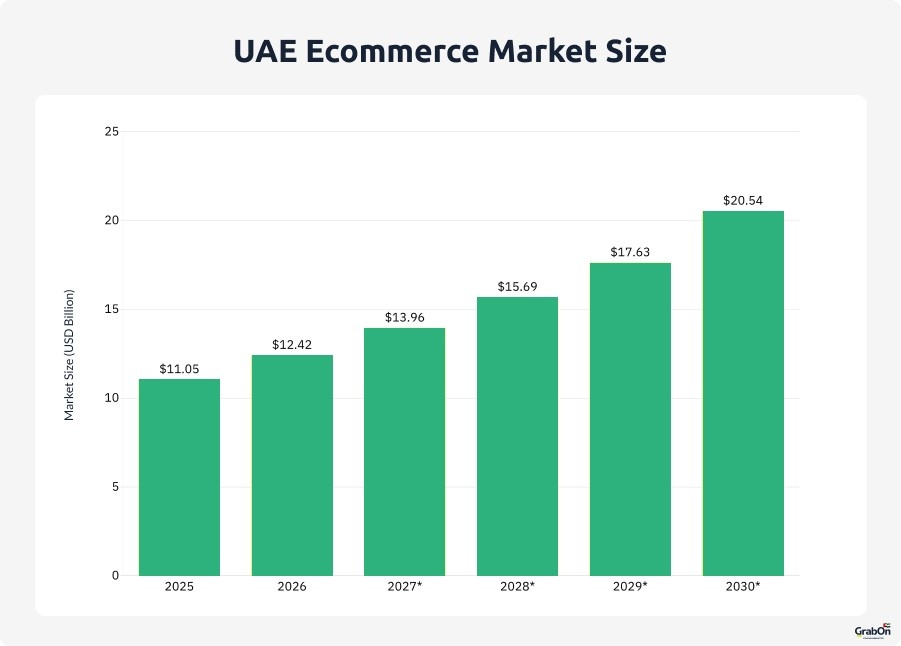
| Year | Market Size (USD Billion) |
| 2025 | $11.05 billion |
| 2026 | $12.42 billion |
| 2027* | $13.96 billion |
| 2028* | $15.69 billion |
| 2029* | $17.63 billion |
| 2030* | $20.54 billion |
*predicted values
The United Arab Emirates ecommerce market is valued at $12.42 billion as of 2026 and is expected to grow at a CAGR of 12.4% till 2030 to reach a valuation of $20.54 billion.
This growth reflects rising digital payment adoption, strong logistics infrastructure, and increasing consumer preference for online shopping across categories such as retail, travel, and food delivery. With high internet penetration and a digitally active population, the UAE continues to position itself as one of the most mature and fast-growing eCommerce markets in the Middle East.
Number of Online Shoppers in the United Arab Emirates
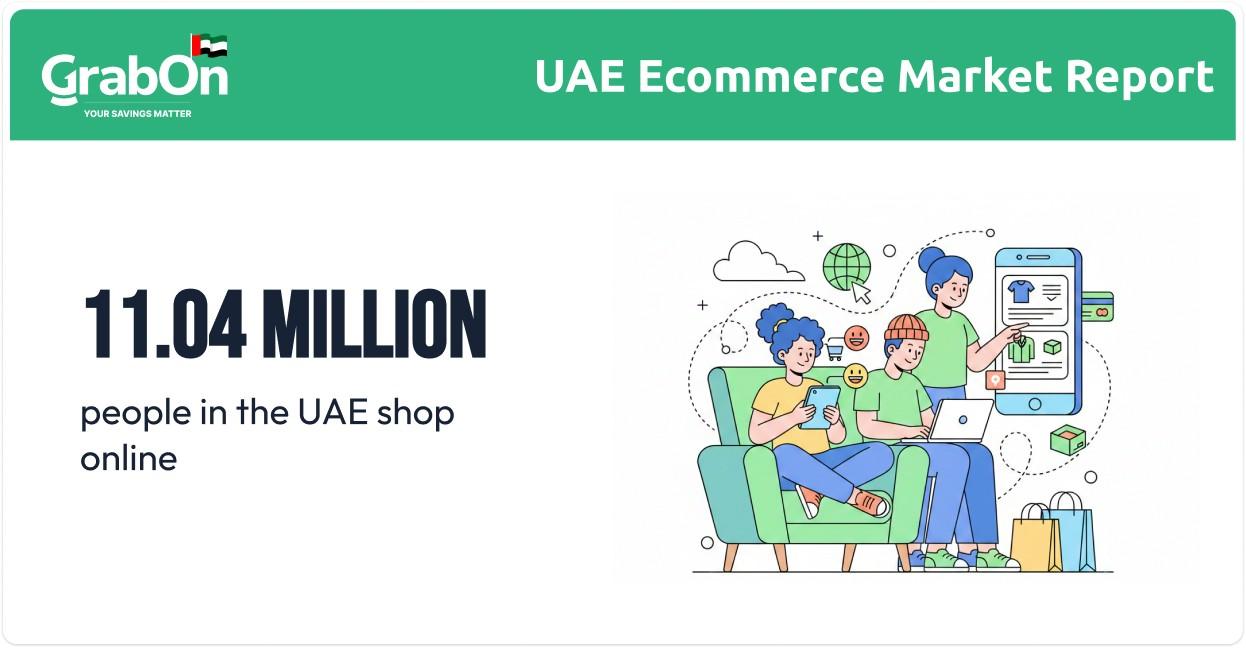
11.04 million people in the UAE shop online, which is equivalent to 96% of the region’s population. These are some of the best figures globally. 99% of the region’s population also actively accesses the internet as of 2026.
It is predicted that the UAE’s online shoppers penetration will increase to 98% and the region will have 12.9 million online shoppers by the end of 2030.
Source: Worldometers, DataReportal.
Top Ecommerce Platforms in the UAE
Noon is the UAE’s most used ecommerce platform with 9.06 million monthly visits as of January 2026. Amazon.ae follows closely at the second position with 8.01 million monthly visits during the same time period.
Carrefour UAE and Sharaf DG wind up on the third nd fourth spot with 2.3 million and 1.6 million monthly visits respectively.
Here is a table showing the most popular ecommerce stores in the UAE:
| Ecommerce Platform | Monthly Visits | Category |
| Noon | 9.06 million | General Ecom Marketplace |
| Amazon.ae | 8.01 million | General Ecom Marketplace |
| Carrefour UAE | 2.3 million | Online Grocery & Hypermarket Retail |
| Sharaf DG | 1.6 million | Consumer Electronics & Appliances Retail |
| Namshi | 853.1k | Fashion & Lifestyle Ecommerce |
| Mumzworld | 251.3k | Baby, Kids & Maternity Ecommerce |
Source: Semrush.
Ecommerce Share of Consumer Spending in the UAE
Ecommerce accounted for 42% of total consumer spend in 2022, rising to 50% in 2024, meaning one out of every two dirhams spent is now transacted online in UAE. This growth places the region well ahead of many other neighbouring markets. For comparison, Saudi Arabia’s eCommerce share increased from 23% in 2022 to 29% in 2024, highlighting how much more digitally mature the UAE market is.
The channel split behind this growth shows a gradual decline in face-to-face transactions and a corresponding rise in eCommerce. Domestic eCommerce spending in the UAE increased from 33% in 2022 to 39% in 2024, while cross-border eCommerce held steady at around 10–11%. At the same time, face-to-face domestic spending fell from 52% to 44%, confirming a sustained behavioral shift rather than a short-term spike.
Category-level data further explains where this shift is coming from. Airlines (95% eCommerce), travel agencies (92%), and food delivery and restaurants (85%) are now heavily digital-first. Fashion and retail sit in the middle, with 27% of spend online, while multi-category retail still sees the majority of transactions happen offline. Overall, the data shows that UAE eCommerce growth is being driven by high-frequency, service-led categories, while physical retail continues to coexist in traditional shopping segments.
Source: Google + Visa purchase volume data, UAE, Jan–Dec 2022–2024.
UAE’s Cellular Connection Penetration Fueling The Ecommerce Growth in The UAE
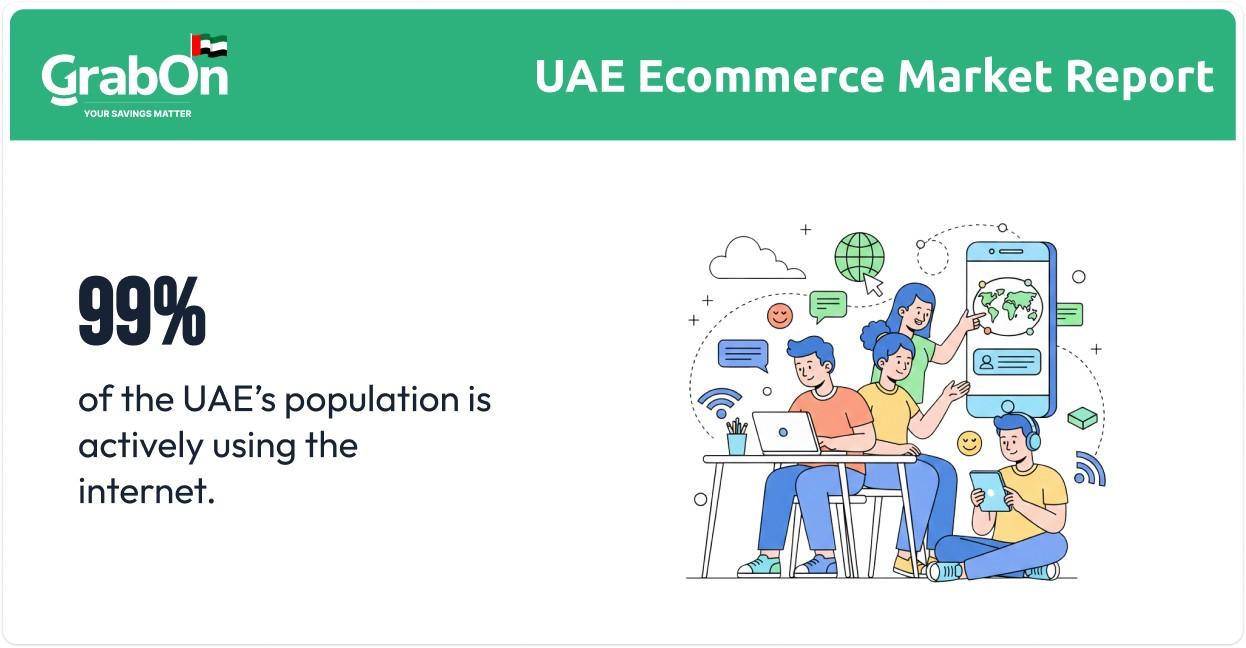
99% of the UAE’s population is actively using the internet. A total of 21.9 million cellular mobile connections were active in the United Arab Emirates in early 2025. This number is far higher than the country’s population, which clearly shows that many residents own more than one mobile connection, often separate numbers for personal use, work, business, or data-only plans.
While some of these connections may be limited to services such as voice and SMS and may not include internet access, the overall figure still highlights the massive scale of mobile adoption in the UAE. This widespread use of mobile devices is one of the key drivers behind the country’s rapid e-commerce growth, as it keeps consumers constantly connected and makes online shopping more accessible and convenient across the market.
Source: DataReportal.
UAE’s Social Media Adoption Is Another Important Reason For Ecommerce Growth in The Region
With 10.1 million social media users out of a population of roughly 11.5 million, social platforms in the UAE reach close to 9 out of every 10 residents. This level of penetration means that social media is no longer just a communication channel; it has evolved into a primary digital storefront for many consumers. On average, a single social media campaign in the UAE has the potential to reach nearly the entire addressable online population, a feat that few global markets can match.
This density significantly lowers customer acquisition costs for e-commerce brands. Instead of spreading budgets across multiple fragmented channels, businesses can drive discovery, engagement, and conversions within a tightly connected ecosystem. Even if only a fraction of social users convert into buyers, the absolute volume remains high due to the sheer scale of adoption. As a result, social commerce, influencer-led purchases, and mobile-first shopping journeys play a measurable role in pushing higher traffic and faster sales cycles across the UAE’s e-commerce market.
Source: Statista, Worldometer.
Number of Ecommerce Stores in the UAE
The United Arab Emirates has around 45,028 eCommerce stores, placing it 42nd globally in terms of the total number of online stores.
Source: Builtwith
Most In-Demand Ecommerce Product Categories in the UAE
| Category | Share of stores | Number of Stores |
| Apparel | 17.7% | 7,968 |
| Home & Garden | 14.6% | 6,557 |
| Beauty & Fitness | 11.5% | 5,192 |
| Food & Drink | 8.4% | 3,800 |
| Business & Industrial | 6.4% | 2,878 |
| Computers | 4.7% | 2,103 |
| Health | 4.1% | 1,842 |
| Consumer Electronics | 3.8% | 1,711 |
| Autos & Vehicles | 3.5% | 1,599 |
| Travel | 2.9% | 1,328 |
| Others | 22.4% | 10,050 |
Apparel is the largest eCommerce category in the UAE, with nearly 8,000 stores. Home & Garden follows closely, with over 6,500 stores, driven by furniture, home décor, and household essentials that perform well in an online-first market.
Beauty & Fitness accounts for more than 5,100 stores, supported by repeat purchases and strong social commerce influence. Food & Drink, with around 3,800 stores, shows steady adoption despite logistical complexity, indicating growing consumer comfort with online grocery, specialty foods, and direct-to-consumer brands.
Business & Industrial and Computers together represent about 5,000 stores, highlighting consistent demand from B2B buyers and tech-focused consumers. Health, Consumer Electronics, and Autos & Vehicles each contribute between 1,500 and 1,800 stores, suggesting mature but competitive segments with higher operational or regulatory barriers.
Travel has the smallest share among the listed categories, with just over 1,300 stores, reflecting the dominance of large platforms and aggregators. Overall, the split shows a market led by lifestyle and home-focused categories, while complex or platform-consolidated sectors remain smaller in store count.
Source: Builtwith.
Most Popular Ecommerce Technologies in the UAE
| eCommerce Technology | Usage Share |
| WooCommerce Checkout | 38.56% |
| Shopify | 27.27% |
| Wix Stores | 12.45% |
| Cart Functionality | 7.62% |
| Squarespace Add to Cart | 3.15% |
| Ecwid | 1.91% |
| Rest | 9.04% |
WooCommerce Checkout is the most widely used eCommerce technology in the UAE, accounting for 38.56% of all online stores. Shopify follows as the second most used platform with a 27.27% share, making it the preferred hosted solution for many merchants. Together, WooCommerce and Shopify power 65.83% of UAE eCommerce websites, clearly dominating the market.
Wix Stores comes next with 12.45%, largely used by small businesses that prioritize ease of setup over advanced commerce features. Platforms grouped under Cart Functionality (7.62%) are those that rely on custom or lightweight checkout systems rather than full platforms. Squarespace Add to Cart (3.15%) and Ecwid (1.91%) cater to niche use cases such as content-led sites and social commerce. The remaining 9.04%, grouped as “Rest,” includes platforms like Magento, OpenCart, SellersCommerce, Webflow Commerce, and AVADA, which are typically used by technically mature or enterprise-focused teams but have limited overall adoption.
Source: Builtwith.
Revenue Statistics of Ecommerce Stores in the UAE
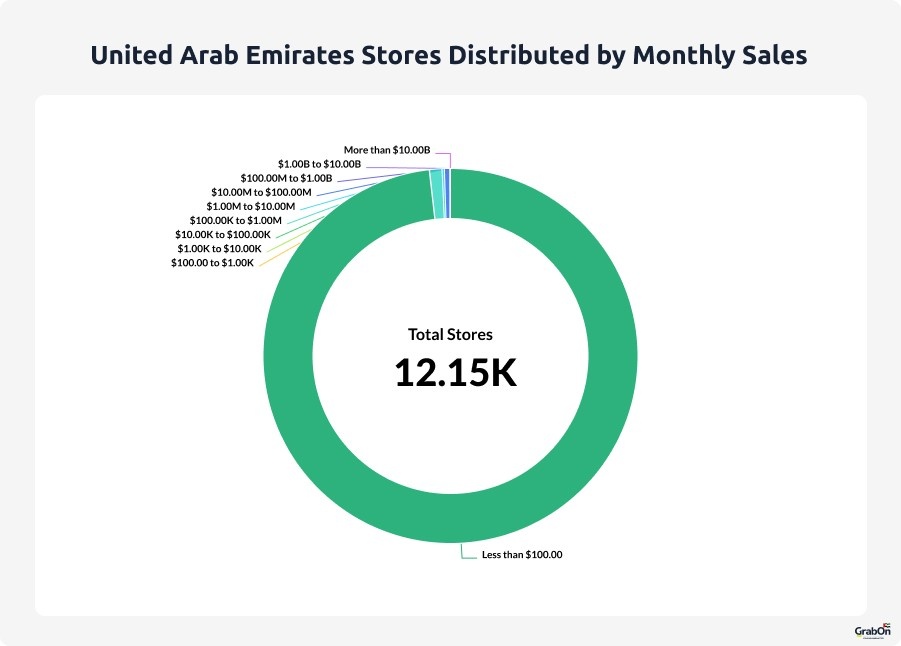
The UAE eCommerce market is highly skewed toward very low-revenue stores. Over 98% of online stores generate less than $100 in monthly sales, indicating a large base of inactive, early-stage, or experimental stores. Meaningful revenue generation is concentrated among a very small group, with only around 2% of stores crossing the $100K monthly sales mark.
Businesses earning over $1 million per month represent a tiny fraction of the market, showing that most eCommerce revenue is driven by a limited number of large players rather than the long tail of small stores.
| Monthly Sales Range | Share of Stores (%) |
| Less than $100 | 98.18% |
| $100 to $1K | 0.02% |
| $1K to $10K | 0.02% |
| $10K to $100K | <0.01% |
| $100K to $1M | 1.06% |
| $1M to $10M | 0.21% |
| $10M to $100M | 0.45% |
| $100M to $1B | 0.03% |
| $1B to $10B | 0.02% |
| More than $10B | 0.02% |
In the above table: K = Thousand, M = Million, and B = Billion.
Source: Aftership.
Workforce of the UAE Ecommerce Stores
The UAE eCommerce market is heavily dominated by small teams. Nearly 9 out of 10 online stores operate with fewer than 10 employees, showing that most businesses are lean, founder-led, or small-scale operations. As employee size increases, the share of stores drops sharply, with companies employing more than 100 people making up only a small fraction of the market.
Large enterprises with over 1,000 employees represent a very limited portion, indicating that high-volume or enterprise-scale eCommerce is concentrated among a few players.
Source: Aftership.

I go the core of any topic and combine the best so that users don’t have to look elsewhere once they are on my blog.