
The UAE has established itself as one of the most connected nations in the world, with smartphones serving as the primary gateway to the internet for the majority of its population. With 22.1 million mobile connections serving a population of 11.4 million, the UAE’s mobile landscape tells a story of exceptional digital adoption and sophisticated consumer behavior. This report examines smartphone usage patterns in the UAE through verified data on device penetration, operating systems, manufacturer preferences, and mobile internet speeds.
Number of Smartphone Users in the UAE
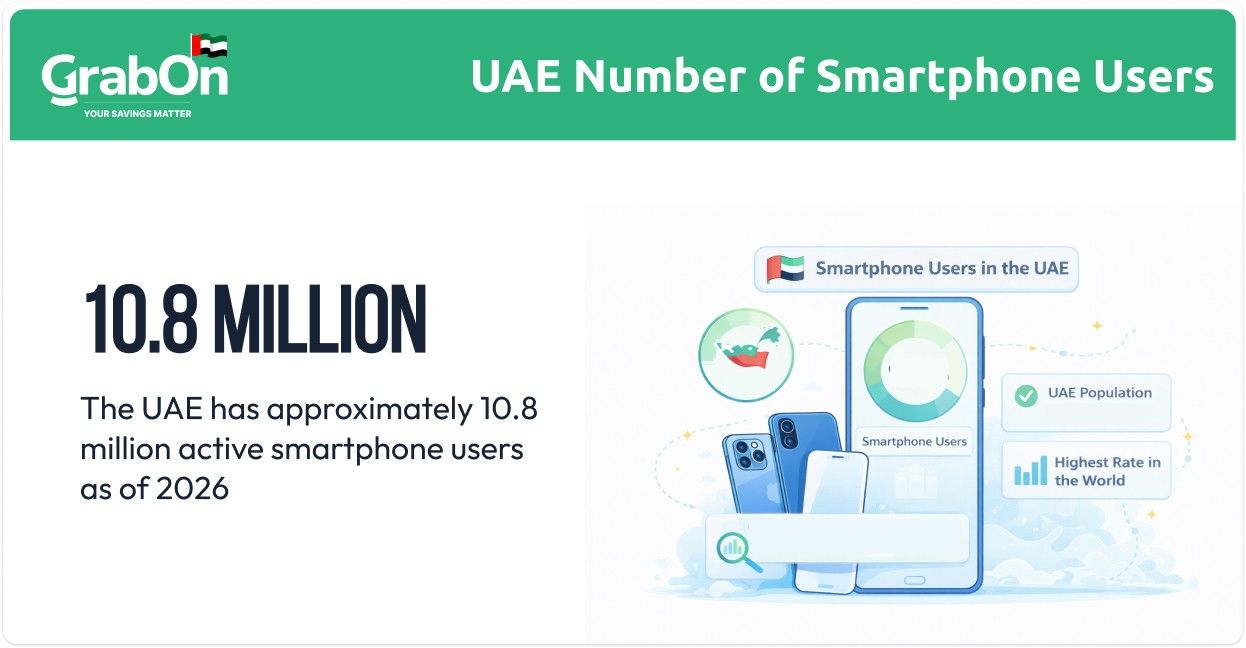
The UAE has approximately 10.8 million active smartphone users as of 2026. This represents 95% of the country’s total population of 11.4 million, making it one of the highest smartphone adoption rates globally.
Smartphone Penetration in the UAE
The UAE has achieved remarkable smartphone penetration, with 199 mobile subscriptions per 100 people as of 2026. This figure indicates that most residents maintain multiple mobile connections for different purposes.
Breaking down the mobile landscape further, there were 22.1 million cellular mobile connections active in the UAE as of early 2026, representing 195% of the total population of 11.4 million. This penetration rate positions the UAE among the world’s most connected nations, where mobile devices have become an essential part of daily life rather than a luxury.
The country’s large expatriate workforce, which represents a significant portion of the population, often maintains connections both in the UAE and their home countries.
All mobile connections in the UAE are classified as broadband connections, meaning they operate on 3G, 4G, or 5G networks. This universal broadband availability eliminates the digital divide that many other countries still experience, where users on older network technologies face limited functionality.
Mobile Operating System Market Share in the UAE
| Operating System | Market Share in the UAE |
| Android | 81.06% |
| iOS | 18.8% |
| Samsung | 0.12% |
| Unknown | 0.01% |
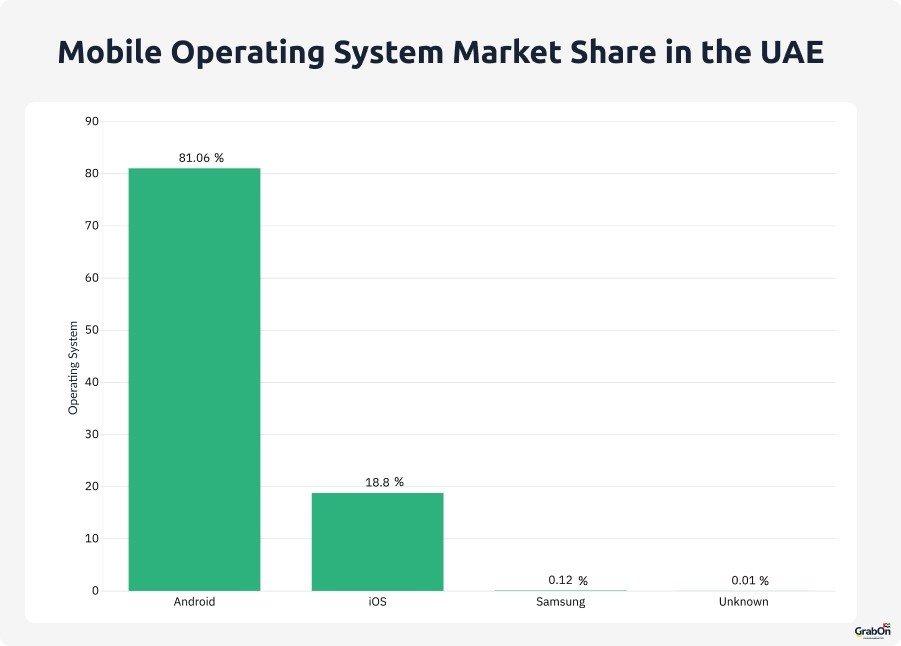
Android dominates the UAE’s mobile operating system landscape with an overwhelming 81.06% market share as of January 2026. This positions Android as the platform of choice for more than 8 out of every 10 smartphone users in the country.
iOS holds the second position with 18.8% market share, representing a strong but significantly smaller user base compared to Android. The near 4:1 ratio between Android and iOS users indicates clear consumer preferences driven by factors including device pricing, ecosystem preferences, and the availability of mid-range Android options that appeal to the UAE’s diverse demographic.
The remaining market share is negligible, with Samsung’s proprietary OS accounting for just 0.12%, while unknown operating systems, Linux, and Nokia platforms collectively represent less than 0.02% of the market. This concentration of the market between two dominant players simplifies app development and marketing strategies for businesses targeting UAE consumers.
The Android majority is particularly significant for e-commerce and mobile-first services. With 96% of internet users in the UAE accessing the internet via mobile phones, and Android commanding over 80% of that space, businesses must prioritize Android optimization to reach the broadest possible audience. This is especially relevant considering that mobile phones account for 75.3% of all web traffic in the UAE.
The iOS user base, while smaller in percentage, represents a valuable demographic. iOS users globally tend to have higher average spending on apps and in-app purchases, and this pattern likely holds in the UAE market as well. The 18.8% iOS share translates to approximately 2.1 million iOS users among the 11.1 million internet users in the country.
Mobile Vendor Market Share in the UAE
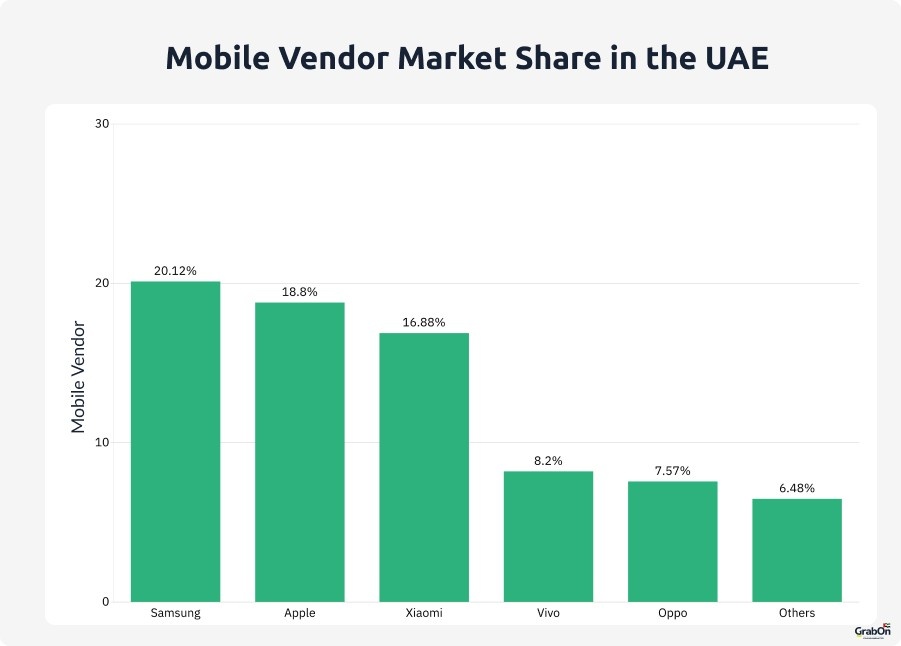
| Mobile Vendor | Market Share in the UAE |
| Samsung | 20.12% |
| Apple | 18.8% |
| Xiaomi | 16.88% |
| Vivo | 8.2% |
| Oppo | 7.57% |
| Others | 6.48% |
Samsung leads the UAE smartphone market with a 20.12% share, making it the most popular device manufacturer in the country. This leadership position reflects Samsung’s strong brand presence, diverse product lineup spanning budget to premium segments, and extensive retail distribution across the UAE.
Apple follows closely in second place with 18.8% market share, consistent with its iOS operating system share. This near-parity between the top two vendors demonstrates the UAE market’s sophistication, where premium devices from both ecosystems find substantial demand despite significant price differences.
Chinese manufacturers have captured significant ground in the UAE market. Xiaomi holds 16.88% market share, positioning it as the third-largest vendor. This success stems from Xiaomi’s value proposition of delivering high-specification devices at competitive prices, appealing to cost-conscious consumers without compromising on features.
Vivo and Oppo, both owned by BBK Electronics, collectively account for 15.77% of the market (8.2% and 7.57% respectively). Their combined presence makes the BBK Electronics group a formidable force in the UAE, nearly matching Apple’s market share when considered together.
Unknown or smaller brands represent 6.48% of the market, indicating some room for emerging manufacturers or niche players. However, the dominance of established brands suggests high barriers to entry and strong consumer preference for recognized names.
The vendor distribution reveals several insights about UAE consumer behavior. The market supports both premium and value segments simultaneously, with Samsung and Apple commanding premium positions while Xiaomi, Vivo, and Oppo serve the mid-range segment. This diversity reflects the UAE’s demographic mix, which includes both high-income professionals and cost-conscious workers.
Mobile Internet Performance in UAE
The UAE claims the world’s fastest mobile internet speeds, with a median mobile download speed of 614.42 Mbps as of early 2026. This achievement places the UAE at the top of global mobile internet speed rankings, reflecting the country’s substantial investment in telecommunications infrastructure and early adoption of 5G technology.
To provide context for this exceptional performance, the UAE’s mobile internet speed increased by 54.2% year-over-year, gaining 215.91 Mbps compared to January 2024 when speeds stood at 441.89 Mbps. This rapid improvement demonstrates ongoing infrastructure enhancements and network optimization by UAE telecom operators.
The two major mobile operators in the UAE, e& (formerly Etisalat) and du, have deployed extensive 5G networks across the country. Both operators offer median upload speeds above 10 Mbps, with e& averaging 11.5 Mbps and du averaging 10.1 Mbps. These upload speeds support emerging use cases like live streaming, video calls, and cloud-based work applications.
Fixed broadband speeds in the UAE average 300.65 Mbps, which, while impressive globally, actually lag behind mobile speeds. This unusual situation where mobile internet outperforms fixed connections has occurred in only a handful of markets worldwide and underscores the UAE’s commitment to wireless infrastructure development.
The practical implications of these speeds are significant for smartphone users. Download times for high-definition content, app updates, and large files are measured in seconds rather than minutes. This speed enables seamless streaming of 4K video content, lag-free mobile gaming, and instantaneous cloud synchronization, fundamentally changing how residents use their smartphones.
These exceptional mobile internet speeds contribute directly to the UAE’s high rate of mobile-first behavior. When mobile connections deliver speeds that exceed many countries’ fixed broadband offerings, users naturally gravitate toward their smartphones as primary internet devices. This explains why 75.3% of all web traffic in the UAE comes from mobile phones.
Smartphone Usage Patterns in UAE
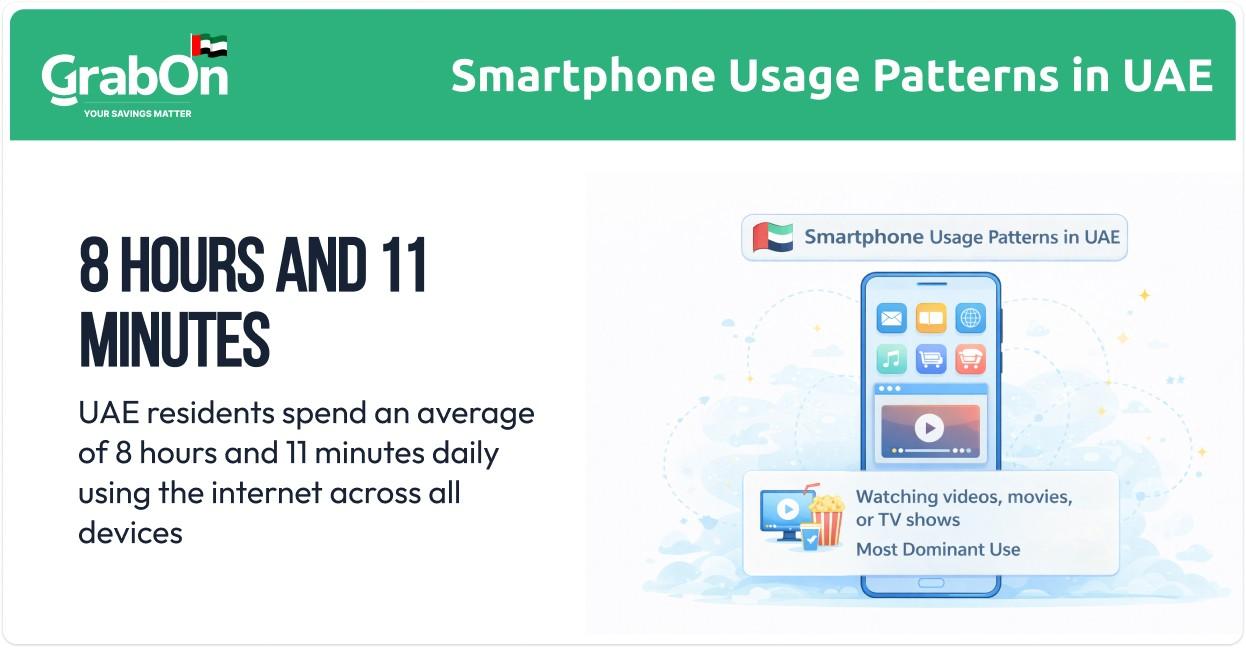
UAE residents spend an average of 8 hours and 11 minutes daily using the internet across all devices, significantly above the global average. Within this total, mobile devices account for the majority of internet time, reflecting the country’s mobile-first digital culture.
The 96% of internet users who access the internet via mobile phones represents 10.8 million people out of the total 11.1 million internet users in the UAE. This near-universal mobile internet adoption means that any digital strategy targeting UAE consumers must prioritize mobile optimization or risk missing almost the entire addressable market.
Social media consumption represents a major use case for smartphones in the UAE. With 2 hours and 58 minutes spent daily on social media platforms, and the majority of this time occurring on mobile devices, social media has become a primary driver of smartphone usage. The UAE’s 11 million social media users are predominantly mobile users.
Mobile commerce has become deeply integrated into UAE consumer behavior. The e-commerce market’s growth to $12.42 billion in 2026 is largely mobile-driven, with the 11.04 million online shoppers in the UAE conducting most transactions via smartphones. The shift toward mobile shopping is evidenced by e-commerce accounting for 50% of total consumer spend in 2024, up from 42% in 2022.
Specific activity patterns reveal how UAE residents use their smartphones. Finding information on diverse topics leads usage at 64.8%, followed by staying in touch with friends and family at 63.1%. Entertainment consumption, particularly watching videos, movies, or TV shows, accounts for 55.8% of usage. These top three activities collectively illustrate the smartphone’s role as an all-in-one tool for information, communication, and entertainment.
Mobile payments and banking have achieved strong adoption in the UAE, facilitated by the country’s advanced digital infrastructure. The high proportion of e-commerce transactions completed on mobile devices indicates trust in mobile payment security and comfort with digital financial services.
Smartphone Impact on E-Commerce Growth
The relationship between smartphone penetration and e-commerce growth in the UAE is direct and measurable. With 75.3% of web traffic coming from mobile phones, the country’s e-commerce platforms have necessarily evolved to become mobile-first experiences.
The 11.04 million online shoppers in the UAE represent 96% of the population, and the overwhelming majority access shopping platforms via smartphones. This mobile shopping behavior drives platform development, with major e-commerce players like Noon (9.06 million monthly visits) and Amazon.ae (8.01 million monthly visits) investing heavily in mobile app experiences.
Category-level data shows which e-commerce sectors benefit most from mobile usage. Food delivery and restaurants see 85% of spending occur online, with most orders placed via mobile apps. Airlines and travel agencies achieve even higher digital penetration at 95% and 92% respectively, with mobile bookings dominating these sectors.
The UAE’s exceptional mobile internet speeds eliminate traditional friction points in mobile commerce. Fast-loading product pages, seamless checkout processes, and quick payment confirmations create a smooth online mobile shopping experience that drives conversion rates. When download speeds exceed 600 Mbps, even image-heavy e-commerce sites load instantly on smartphones.
Cross-border e-commerce, which accounts for 32% of total online sales in the UAE, is similarly mobile-driven. UAE consumers use smartphones to browse international retailers, compare prices across borders, and complete purchases from overseas vendors, with 58% of UAE shoppers purchasing from international sellers.
Future Outlook for Smartphone Usage in the UAE
Smartphone usage in the UAE shows no signs of slowing down. With internet penetration already at 99% and mobile connections at 195% of the population, growth will come from increased usage intensity rather than user acquisition.
The number of mobile connections is projected to continue growing modestly, increasing from 21.9 million in late 2025 as eSIM adoption expands and IoT devices proliferate. eSIM technology makes it easier for consumers to maintain multiple mobile identities on a single device, potentially pushing the connections-to-population ratio even higher.
5G coverage will expand beyond urban centers to reach remaining rural areas, ensuring universal access to the highest network speeds. This expansion will enable new smartphone use cases, including augmented reality applications, real-time translation services, and bandwidth-intensive mobile gaming experiences.
The e-commerce market’s projected growth from $12.42 billion in 2026 to $20.54 billion by 2030 will be predominantly mobile-driven. As e-commerce penetration increases from 50% to potentially 60% or more of total consumer spending, smartphones will facilitate most of these transactions.
Social commerce integration will deepen, with social media platforms increasingly becoming direct shopping channels. The UAE’s 11 million social media users already spend significant time on platforms like Instagram, Facebook, and TikTok, and these platforms are evolving to enable in-app purchasing without leaving the social environment.
AI integration into smartphone operating systems and applications will create more personalized user experiences. From predictive text and voice assistants to automated photo organization and smart recommendations, AI will make smartphones more intuitive and valuable for UAE users.
Conclusion
The UAE’s smartphone landscape in 2026 reflects a mature, highly connected market where mobile devices serve as the primary gateway to digital services. With 199 mobile subscriptions per 100 people, the world’s fastest mobile internet speeds at 614.42 Mbps, and 96% of internet users accessing the web via mobile phones, the UAE has achieved a level of mobile connectivity that few nations match.
Android’s 81.06% market share and Samsung’s 20.12% vendor leadership reflect consumer preferences shaped by value, ecosystem, and brand trust. The strong presence of Chinese manufacturers like Xiaomi, Vivo, and Oppo demonstrates market openness to diverse brands, while Apple’s 18.8% share confirms demand for premium devices.
The 8 hours and 11 minutes of daily internet usage, with the majority occurring on smartphones, illustrates how deeply mobile devices are embedded in UAE residents’ daily routines. From e-commerce transactions worth $12.42 billion to 2 hours and 58 minutes of daily social media engagement, smartphones power the UAE’s digital economy.
As the country moves toward 2030, smartphone usage will continue to evolve rather than simply grow. With penetration already near-universal, the focus shifts to richer experiences, faster speeds, more sophisticated applications, and deeper integration of mobile services into every aspect of life in the UAE.
Frequently Asked Questions
How many people use smartphones in the UAE?
With 21.9 million mobile connections serving a population of 11.4 million, and 96% of the 11.1 million internet users accessing the web via mobile phones, approximately 10.8 million people actively use smartphones in the UAE.
What is the most popular smartphone brand in UAE?
Samsung leads with 20.12% market share, making it the most popular smartphone brand in the UAE. Apple follows closely at 18.8%, while Xiaomi holds third place with 16.88%.
How fast is mobile internet in the UAE?
The UAE has the world’s fastest mobile internet with median download speeds of 614.42 Mbps as of early 2026. This speed increased by 54.2% year-over-year, gaining 215.91 Mbps from the previous year.
What percentage of UAE residents use Android vs iOS?
Android dominates with 81.06% market share, while iOS accounts for 18.8% of the market. This represents approximately 8.97 million Android users and 2.08 million iOS users among the 11.1 million internet users.
How much time do UAE residents spend on their phones daily?
UAE residents spend an average of 8 hours and 11 minutes daily using the internet across all devices, with the majority of this time spent on smartphones. Social media alone accounts for 2 hours and 58 minutes daily.
Is the UAE a mobile-first market?
Yes, the UAE is definitively a mobile-first market. Mobile phones account for 75.3% of all web traffic, 96% of internet users access the web via mobile, and e-commerce has reached 50% of total consumer spending with most transactions occurring on mobile devices.
Sources: DataReportal, Ookla, GSMA Intelligence, Statista, Mordor Intelligence, International Telecommunication Union (ITU), Builtwith, Semrush

I go the core of any topic and combine the best so that users don’t have to look elsewhere once they are on my blog.