


The UAE ecommerce market is valued at $12.42 billion as of 2026 and is expected to grow at a CAGR of 12.4% through 2030, reaching a valuation of $20.54 billion.
This post covers the current valuation, growth trajectory, segment-level sizing, and forecast comparisons of the UAE ecommerce market from multiple credible sources. It is written for anyone making investment, market entry, or expansion decisions around UAE ecommerce.
UAE Ecommerce Market Size
The UAE ecommerce market is valued at $12.42 billion as of 2026 and is projected to reach $20.54 billion by 2030, growing at a compound annual growth rate (CAGR) of 12.4%.
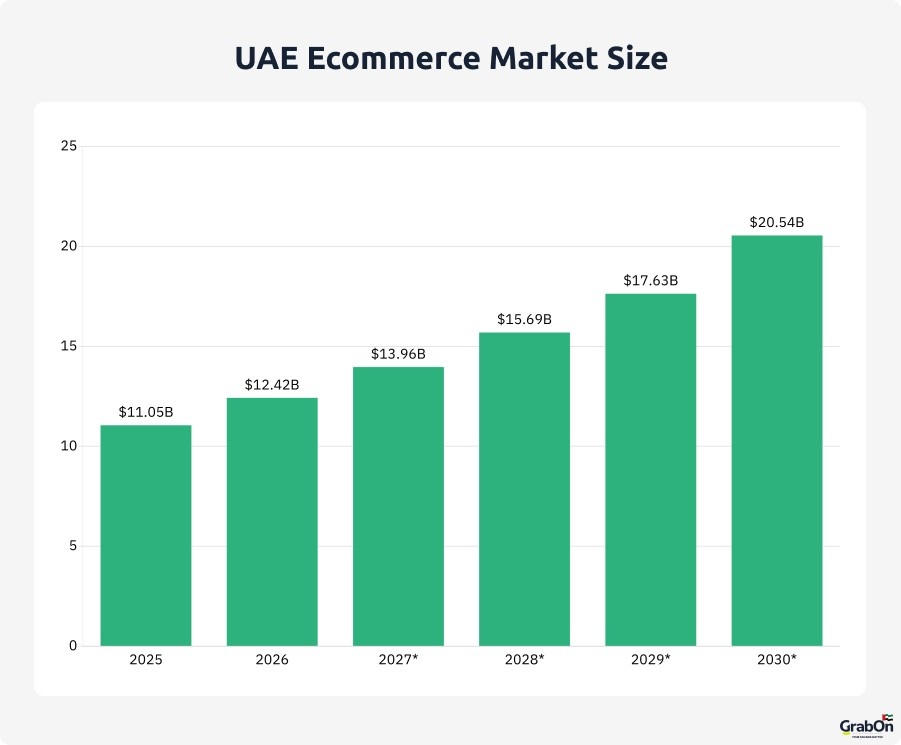
| Year | Market Size |
| 2025 | $11.05 billion |
| 2026 | $12.42 billion |
| 2027* | $13.96 billion |
| 2028* | $15.69 billion |
| 2029* | $17.63 billion |
| 2030* | $20.54 billion |
*Predicted values based on a 12.4% CAGR projection from base year 2025 ($11.05 billion). Source: Nexdigm bottom-up estimation.
This growth is driven by rising digital payment adoption, strong logistics infrastructure, and increasing consumer preference for online shopping across categories such as retail, travel, and food delivery. With internet penetration above 99% and over 11 million online shoppers, the UAE remains one of the most mature and fast-growing ecommerce markets in the Middle East.
Market Size by Business Model (B2B vs B2C vs C2C)
The UAE ecommerce market is not just a B2C story. While consumer-facing transactions account for the largest share, B2B ecommerce is growing faster, and C2C platforms add secondary-market liquidity.
B2C transactions account for roughly 68% of total UAE ecommerce value. This segment includes platforms like Noon, Amazon.ae, Carrefour UAE, and Namshi. The 68% figure is based on 2025 estimates from Mordor Intelligence and Nexdigm. Applied to the $12.42 billion total market in 2026, B2C ecommerce is worth approximately $8.4 billion.
B2B ecommerce is the faster-growing segment. Mordor Intelligence projects B2B to grow at a 17.43% CAGR through 2031. This is driven by government-backed procurement digitization, free zone logistics, and platforms like Tradeling (owned by Dubai Airport Free Zone Authority) that connect regional suppliers with verified business buyers. Applied to the current market, B2B represents roughly $3.7 billion in 2026.
C2C platforms like Dubizzle, which records around 16 million monthly visits, facilitate secondary-goods transactions. This segment represents resale and peer-to-peer liquidity rather than net new economic activity.
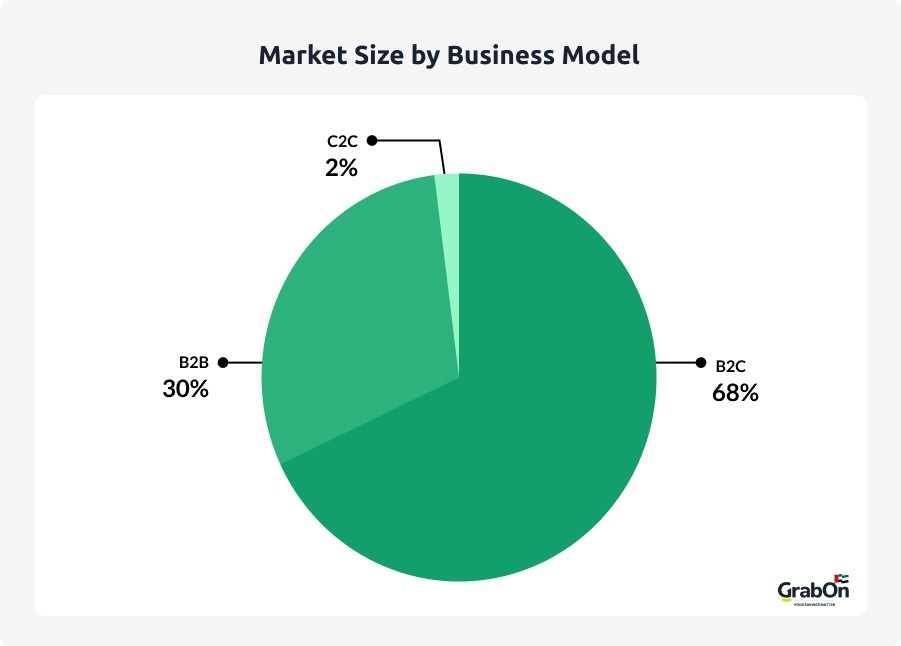
| Segment | Estimated Share (2026) | Estimated Value (2026) | Growth Rate |
| B2C | 68% | $8.4B | 11-12% CAGR |
| B2B | 30% | $3.7B | 17.43% CAGR |
| C2C | 2% | $0.3B | Moderate |
Source: Mordor Intelligence, Nexdigm.
Market Size by Product Category
The composition of UAE ecommerce spending varies depending on whether you measure by revenue share or by number of stores. Below is the breakdown by revenue contribution.
Electronics accounts for 20% to 33% of total ecommerce revenue, depending on the source and year. ECDB (eCommerce DB) estimates electronics at 33.3% of revenue, while other sources place it closer to 20%. The range reflects differences in whether big-ticket items like smartphones and laptops are measured at full transaction value or adjusted for returns.
Fashion and apparel represents 27% to 30% of ecommerce revenue. EZDubai and Euromonitor data from 2024 placed fashion as the top category by value, consistent with the 8,000 active apparel stores operating in the UAE.
Groceries and food account for roughly 17% of ecommerce revenue, with the food and beverage category growing at a 15.2% CAGR through 2030. The quick commerce sub-segment (ultra-fast delivery under 30 minutes) was valued at approximately $162 million in 2025.
Beauty and personal care is projected to cross $1 billion in online sales by the end of 2025, supported by repeat purchases and strong social commerce influence.
| Category | Revenue Share (%) | Estimated Value (2026) | Growth Trend |
| Electronics | 20-33% | $2.5B – $4.1B | Stable, high AOV |
| Fashion / Apparel | 27-30% | $3.4B – $3.7B | Strong, top category by store count |
| Groceries / Food | 17% | $2.1B | 15.2% CAGR through 2030 |
| Beauty / Personal Care | 8-10% | $1.0B+ | Crossing $1B milestone in 2025 |
| Other categories | 15-20% | $1.9B – $2.5B | Mixed |
Sources: ECDB, EZDubai/Euromonitor, Ramsha Home, Adat.ae.
UAE Social Commerce Market Size
The UAE has 11 million active social media users (99% of the population), and purchases increasingly originate inside platforms rather than on standalone ecommerce sites.
The UAE social commerce market is projected at $15.41 billion in GMV in 2026, growing at 11.1% annually and expected to reach $23.19 billion by 2031. TikTok leads platform reach at 12.5 million users aged 18+, with TikTok Shop now operational in the UAE. Instagram Reels drive roughly 70% of social commerce product discovery for Dubai-based brands, and 75% of UAE consumers trust influencer recommendations over traditional advertising when making purchase decisions.
Market Size by Emirate
Ecommerce activity in the UAE is concentrated in two emirates, Dubai and Abu Dhabi. The remaining five emirates contribute a much smaller share due to lower population density and higher last-mile delivery costs.
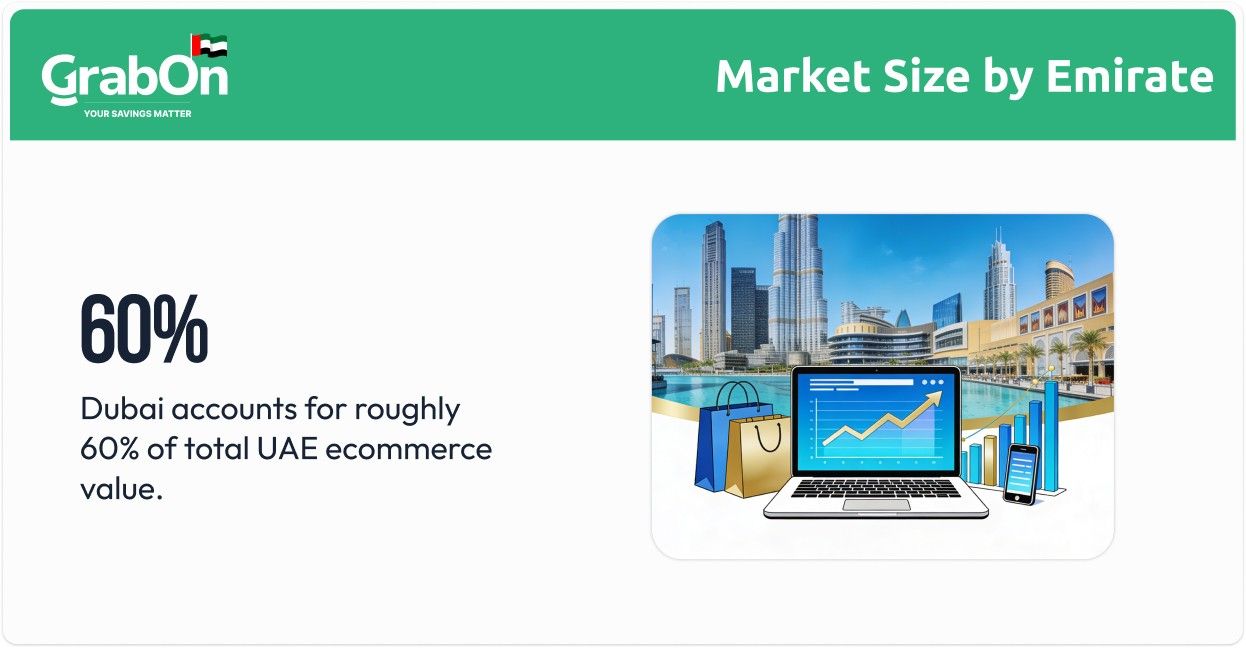
Dubai accounts for roughly 60% of total UAE ecommerce value. The emirate has 90% internet penetration across 3.6 million residents, more than 100 fulfillment centers, and ecommerce contributed 12% of Dubai’s non-oil GDP in 2024. Dubai CommerCity, the region’s first dedicated ecommerce free zone, further supports this concentration by offering warehousing, logistics, and licensing under a single umbrella.
Abu Dhabi is the second-largest ecommerce market in the UAE. With GDP per capita exceeding $70,000, the emirate sees higher average order values, particularly in the luxury segment where platforms like Ounass report an average order value of around $550. Noon operates a mega-fulfillment hub in Abu Dhabi’s KEZAD industrial zone.
Sharjah and the Northern Emirates remain under-monetized for ecommerce. Last-mile delivery costs in these areas range from AED 15 to AED 25 per order, which can consume 15% to 25% of the basket value in lower-density zones. By comparison, the same delivery in dense urban areas like Dubai Marina or Downtown costs 3% to 5% of basket value.
| Emirate | Share of Ecommerce Value | Key Infrastructure |
| Dubai | 60% | 100+ fulfillment centers, Dubai CommerCity free zone |
| Abu Dhabi | 25-30% | KEZAD fulfillment hub, high luxury AOV |
| Sharjah and Northern Emirates | 10-15% | Limited, constrained by last-mile costs |
Source: Mordor Intelligence.
UAE vs Regional Ecommerce Markets
The UAE punches well above its weight in regional ecommerce. Despite representing only about 1.3% of the MENA population, the UAE accounts for roughly 22% of the region’s total ecommerce value in 2026.
Saudi Arabia is the larger market in absolute terms at an estimated $31.29 billion in 2026, projected to reach $54.87 billion by 2031 at a CAGR of 11.92%. However, Saudi Arabia has a population more than three times that of the UAE (36+ million vs 11.5 million), which means the UAE has significantly higher ecommerce spending per capita. The UAE generates roughly $1,080 in ecommerce value per person compared to Saudi Arabia’s $869 per person.
The total MENA ecommerce market is estimated at $57 billion in 2026. This figure is based on the EZDubai and Euromonitor projection of an 11% CAGR over the 2022 to 2026 period, growing from $37 billion in 2022. By 2029, MENA ecommerce is expected to reach $57.8 billion on a narrower retail-focused definition, or significantly higher when travel and food services are included.
| Market | 2026 Value | 2029-2031 Projected Value | Population | Per Capita Ecommerce |
| UAE | $12.42B | $17.63B (2029) | 11.5 million | $1,080 |
| Saudi Arabia | $31.29B | $54.87B (2031) | 36+ million | $869 |
| MENA Total | $57B | $57.8B+ (2029) | 400+ million | $143 |
The UAE’s disproportionate share is explained by three factors: the highest internet penetration in the region (99%), the highest GDP per capita among large MENA economies, and the most developed logistics and digital payments infrastructure.
Sources: Mordor Intelligence (Saudi Arabia, 2026), EZDubai/Euromonitor (MENA, 2026).
Key Growth Drivers Behind the Market Size
Internet penetration stands at over 99%, with 22.1 million cellular mobile connections active in 2026, far exceeding the country’s population of 11.5 million.
COVID-19 created a permanent behavioral shift. Ecommerce sales jumped 53% in 2020, reaching $3.9 billion and accounting for 10% of total retail sales that year. Source: U.S. International Trade Administration.
Cross-border ecommerce is significant. 58% of online purchases in the UAE come from overseas vendors. Cross-border transactions are projected to account for 32% of all ecommerce sales by 2025, up from 23% in 2019. Source: U.S. International Trade Administration, Adat.ae.
Digital payments are replacing cash. Card payments represent roughly 48% of online transactions, while digital wallet usage grew from 41% in 2020 to 53% in 2024. Buy-now-pay-later (BNPL) payments reached $2.45 billion in 2024. Source: EZDubai/Euromonitor, Nexdigm.
Government policy actively supports ecommerce growth. Dubai CommerCity free zones offer 100% foreign ownership and zero corporate tax for 50 years. The federal Operation 300bn initiative targets expanding the manufacturing and trade base. Source: Mordor Intelligence.
Ecommerce share of consumer spending reached 50% in 2024, meaning one out of every two dirhams spent by UAE consumers was transacted online. This is up from 42% in 2022. Source: Google and Visa purchase volume data.
Constraints on Market Size Growth
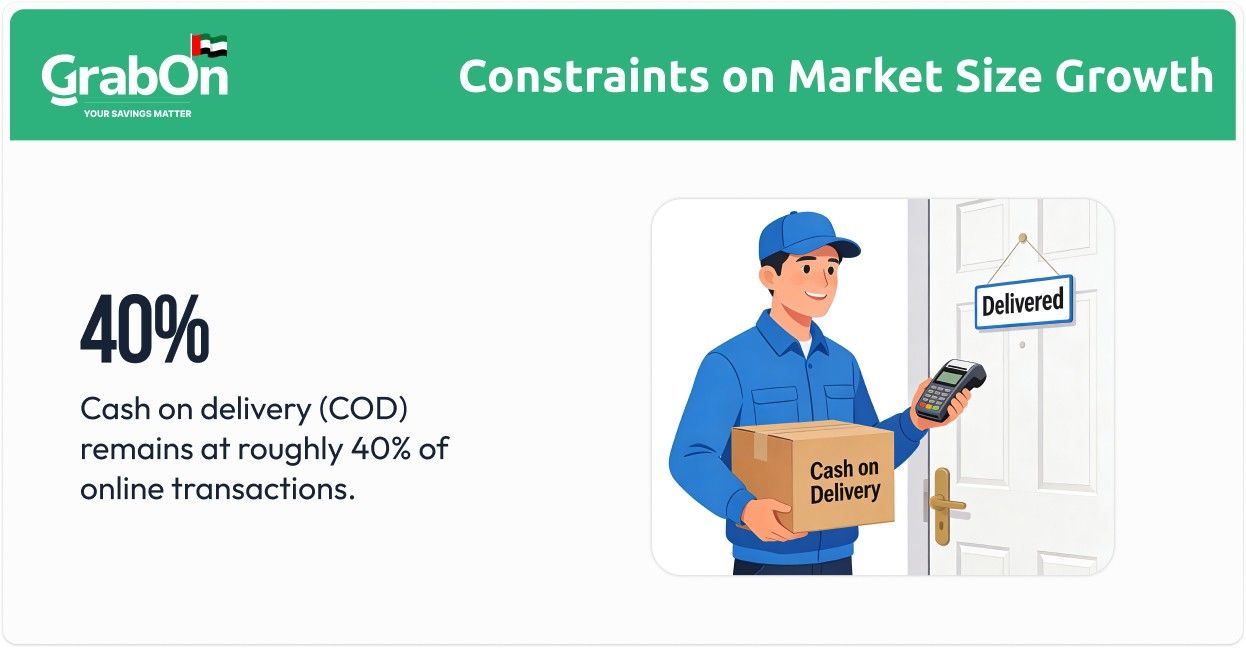
Cash on delivery (COD) remains at roughly 40% of online transactions. COD raises operational costs for sellers through higher return rates and cash handling logistics.
Last-mile delivery costs range from AED 15 to AED 25 per order. In remote zones outside Dubai and Abu Dhabi, this cost can consume 15% to 25% of the order’s basket value, compared to just 3% to 5% in dense urban hubs.
Counterfeit concerns remain a barrier to trust. Authorities seized AED 1.2 billion worth of counterfeit goods in 2024. As a result, 65% of shoppers now prefer purchasing from local or verified ecommerce sites for product authenticity.
Quick-commerce margin pressure is real. Micro-fulfillment hubs cost AED 2 million to AED 5 million each to set up and require 200 to 300 daily orders to break even. Competitive discounting from services like Noon Minutes and Careem Now has slashed average order values by 15% to 20% in the quick-commerce segment.
Why Market Size Estimates Differ
If you have read this far, you will have noticed that UAE ecommerce market size estimates range from $8.55 billion to $51.14 billion depending on the source. This is not because any source is wrong. The difference comes down to three variables.
First, scope. What counts as ecommerce? Statista measures only B2C physical goods sold through digital channels. It excludes travel bookings, food delivery, digital media, and healthcare. ResearchAndMarkets includes all of these, which is why its number is roughly six times larger.
Second, measurement. Some sources report gross merchandise value (GMV), which is the total transaction value before returns, cancellations, and platform fees are deducted. Others report net revenue, which is smaller. A market that looks like $30 billion on a GMV basis might look like $12 billion on a net revenue basis.
Third, base year and exchange rate. Reports using AED-denominated data convert to USD at different points in time. Since the AED is pegged to the USD at 3.6725, this creates minor variations, but it still adds inconsistency when comparing across sources that used different conversion timing.
Our anchor estimate of $12.42 billion for 2026 uses a bottom-up methodology that includes B2C and B2B transactions across physical goods, food delivery, and select digital services, but excludes travel bookings and media subscriptions. This places it in the mid-range of available estimates and aligns with the Mordor Intelligence ($12.30 billion for 2026) and Nexdigm ($11.05 billion for 2025) figures.
Source: Statista methodology note (B2C physical goods only, excludes eServices and digital media).

I go the core of any topic and combine the best so that users don’t have to look elsewhere once they are on my blog.