
The UAE retail market continues to be one of the most dynamic in the world. Backed by record tourism, rapid population growth, a maturing e-commerce ecosystem, and aggressive government investment in economic diversification, the sector is on track to cross $160 billion in 2026.
This post compiles the most important UAE retail statistics as of 2026.
What Is the Retail Market Size in the UAE?
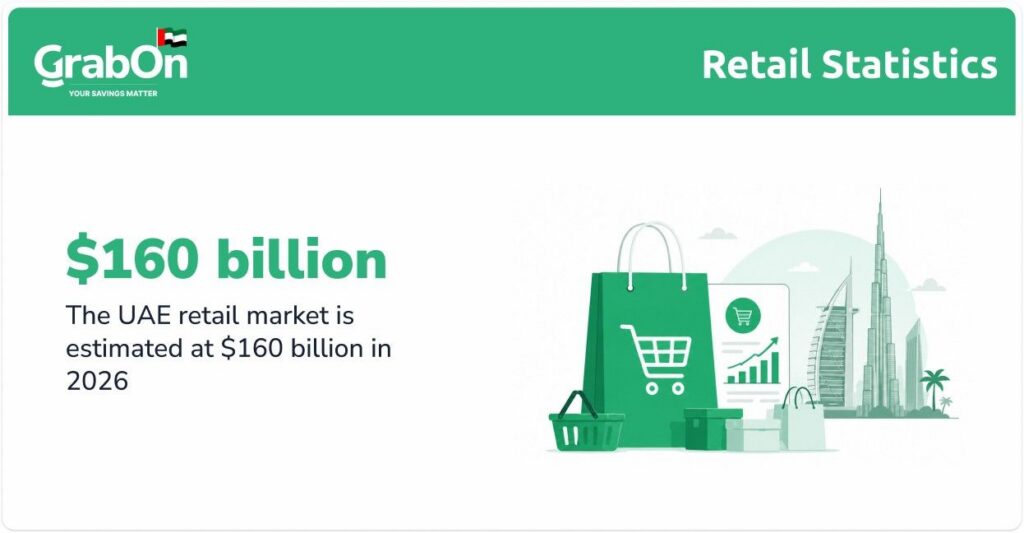
The UAE retail market is estimated at $160 billion in 2026, growing at a compound annual growth rate (CAGR) of 5.1%. The market has nearly doubled since 2019, driven by record tourism, population growth, luxury demand, and rapid e-commerce adoption.
Here is how the market has grown over the years:
| Year | Market Size |
| 2019 | $98 billion |
| 2020 | $88 billion |
| 2021 | $105 billion |
| 2022 | $125 billion |
| 2023 | $138 billion |
| 2024 | $145.3 billion |
| 2025 | $152.7 billion |
| 2026 | $160 billion |
| 2033 (projected) | $227 billion |
The post-pandemic recovery (2021 to 2022) delivered outsized growth as pent-up demand, Expo 2020, and the FIFA World Cup boosted spending. Growth has since normalized to the 5% range, which is still among the fastest in the global retail landscape.
Key Retail Sub-Markets in the UAE (2026)
The overall market is made up of several high-growth segments, each on its own trajectory:
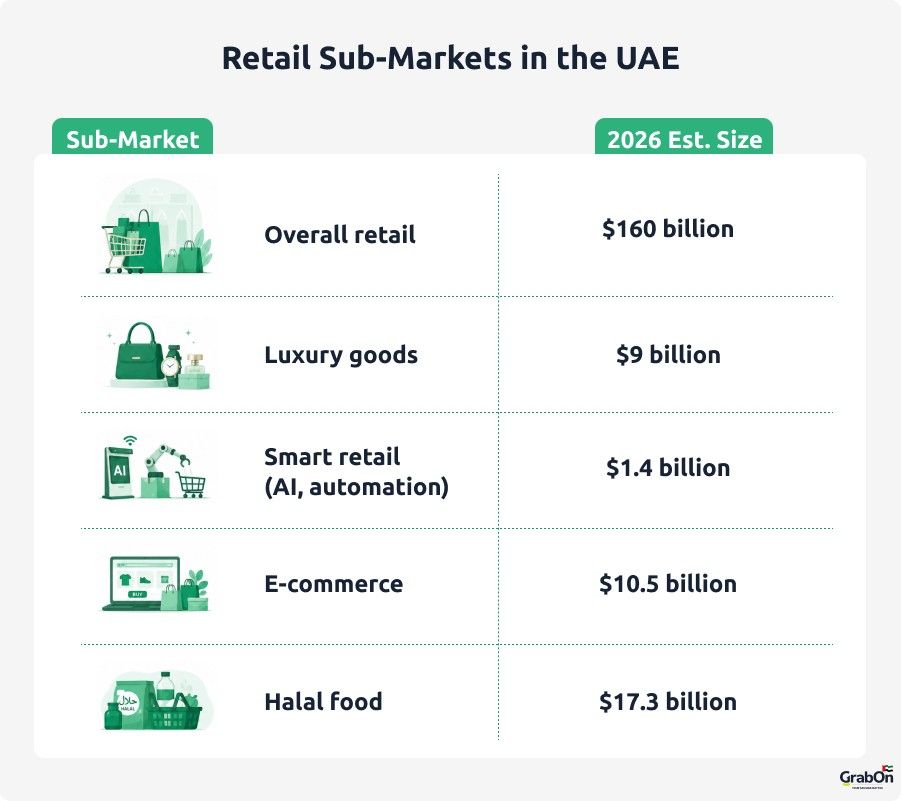
| Sub-Market | 2026 Est. Size | Projected Size | CAGR | Source |
| Overall retail | $160 billion | $227.1B by 2033 | 5.1% | IMARC Group |
| Luxury goods | $9 billion | $11.86B by 2031 | 5.7% | Mordor Intelligence |
| Smart retail (AI, automation) | $1.4 billion | $9.74B by early 2030s | 32.2% | Industry reports |
| E-commerce | $10.5 billion | $13.8B by 2029 | ~11% | EZDubai / WAM |
| Halal food | $17.3 billion | $22.27B by 2030 | 6.5% | Rowyal Research |
Smart retail is the fastest-growing sub-market by far. Valued at roughly $810 million in 2024, it is expected to grow more than 10x over the next decade as AI-powered personalization, automated inventory management, and computer vision become standard across UAE stores.
How Many Retail Shops Are There in the UAE?
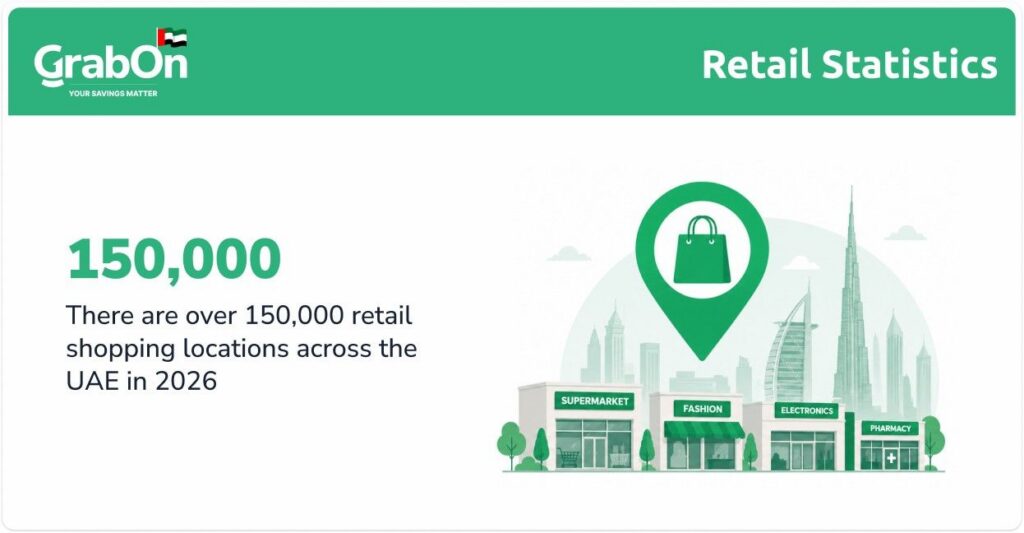
There are over 150,000 retail shopping locations across the UAE in 2026. Dubai accounts for the largest concentration, with over 60,000 retail locations.
The Department of Economic Development in Dubai lists over 2,100 licensed retail activity types, making it one of the most flexible retail licensing environments in the world.
Dubai alone now operates more than 40 malls, 15 lifestyle destinations, and 18 community retail centres under the Dubai Retail brand (part of Dubai Holding), covering over 13 million square feet of gross leasable area (GLA) and housing over 6,500 retailers.
An estimated 5 million additional square feet of new GLA is being added across the UAE in 2026 through projects like Al Khail Avenue, Reem Mall Phase 2, and Nad Al Sheba Mall.
| Region | Estimated Retail Locations (2026) |
| Dubai | 60,000 |
| Abu Dhabi | 35,000 |
| Sharjah & Northern Emirates | 40,000 |
| Other Emirates | 15,000 |
| Total UAE | 150,000 |
UAE Consumer Spending Overview
Total annual consumer spending across the retail economy is estimated to exceed AED 340 billion by the end of 2026, which is largely due to growth from both resident and tourist spending.
UAE consumer spending has continued its upward trajectory since the post-pandemic recovery. In 2023, total consumer spending rose 13% year-on-year, based on Majid Al Futtaim’s analysis of over 1.3 billion POS transactions totaling AED 278 billion.
Growth moderated to an estimated 5-6% in 2024 and 2025 as the base effect normalized, but absolute spending levels remain at all-time highs.
In Q3 2024, UAE consumers spent $3.7 billion on FMCG, technology, and durable goods alone, a 4.8% increase over the same period the prior year (NielsenIQ Retail Spend Barometer).
Retail Sector Performance (2023 Baseline)
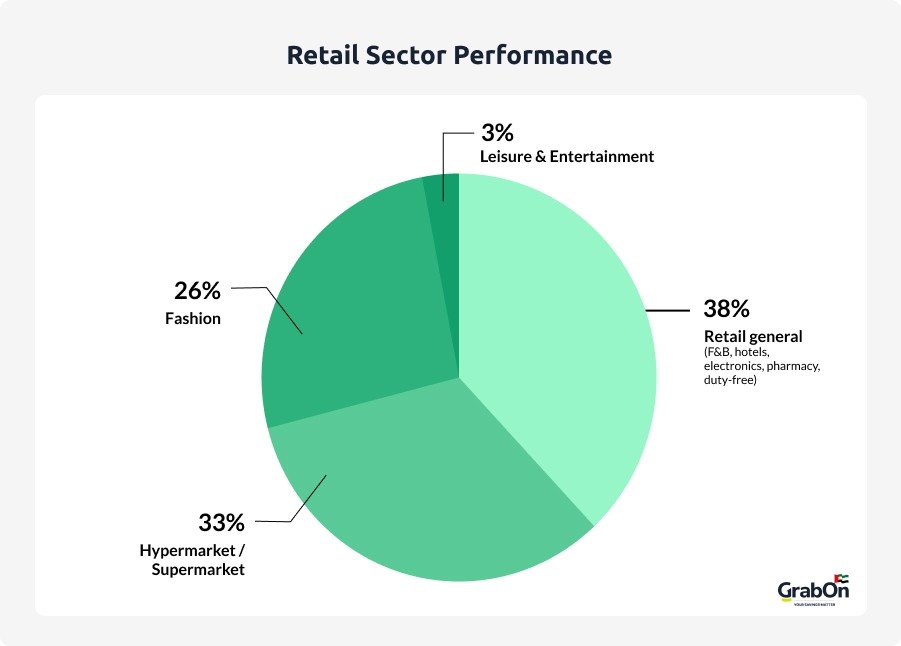
| Sector | Share of Retail Economy | YoY Growth (2023) |
| Retail general (F&B, hotels, electronics, pharmacy, duty-free) | 38% | +16% |
| Hypermarket / Supermarket | 33% | +3% |
| Fashion | 26% | +31% |
| Leisure & Entertainment | 3% | +15% |
| Total Retail Economy | 100% | +14% |
Source: Majid Al Futtaim POS data.
Who Are the Top Retailers in the UAE?
The UAE retail sector is shaped by a handful of large, diversified conglomerates that operate across grocery, fashion, luxury, entertainment, and electronics.
1. Majid Al Futtaim (MAF)
Founded in 1992. Revenue of approximately AED 35 billion in 2025. Operates Carrefour (390+ outlets across 12+ markets), VOX Cinemas (600+ screens), Ski Dubai, and multiple lifestyle brands. Employs 43,000 people. Owns 29 shopping malls and 7 hotels. Currently executing a AED 5 billion transformation of Mall of the Emirates (“Mall of New Possibilities”) and a AED 62 billion mixed-use master community with Dubai South.
2. LuLu Group International
The largest pan-GCC full-line retailer. Revenue hit a record $7.9 billion in 2025, up 4.1% year-on-year. Operates 267 stores as of end-2025 and plans to open 50 more between 2026 and 2028. E-commerce sales grew 38.6% in 2025, reaching 7.3% of total retail sales. Listed on the Abu Dhabi Securities Exchange in November 2024 in a $1.72 billion IPO. Private label products now make up 29.8% of total sales.
3. Landmark Group
One of the largest retail and hospitality conglomerates in the Middle East, Africa, and India. Founded in 1973. Operates over 2,200 outlets across 22 countries with 55,000+ employees. Home to brands like Centrepoint, Max Fashion, Home Centre, Splash, and Babyshop. Runs one of the region’s largest loyalty ecosystems.
4. Chalhoub Group
The Middle East’s largest luxury goods retailer and distributor. Partners with LVMH, Swarovski, L’Oreal, and dozens of other premium brands. Strong focus on CRM and loyalty programs for affluent consumers. Co-founded the “Unity For Change” sustainability alliance alongside LVMH, Emaar, MAF, and Aldar Properties.
5. Al Tayer Group
Specializes in luxury fashion and beauty. Operates Harvey Nichols, Bloomingdale’s, and automotive brands (Ford, Lincoln, Ferrari) in the UAE. Over 8,000 employees from 100+ countries.
6. Apparel Group
Over 2,200 stores across 14+ countries. Portfolio includes Tommy Hilfiger, Skechers, ALDO, Nine West, Tim Hortons, and Cold Stone Creamery. Won “Retail Company of the Year” at Images RetailME Awards 2025.
7. M.H. Alshaya Co.
A franchise powerhouse operating Starbucks, H&M, Mothercare, and Victoria’s Secret across the Middle East. Known for premium brand execution and omnichannel retailing.
Note: Revenue figures for private companies (Landmark, Chalhoub, Al Tayer, Apparel, Alshaya) are estimates based on industry reports and public disclosures. LuLu and MAF figures are from published financials.
Which Product Is in High Demand in the UAE?
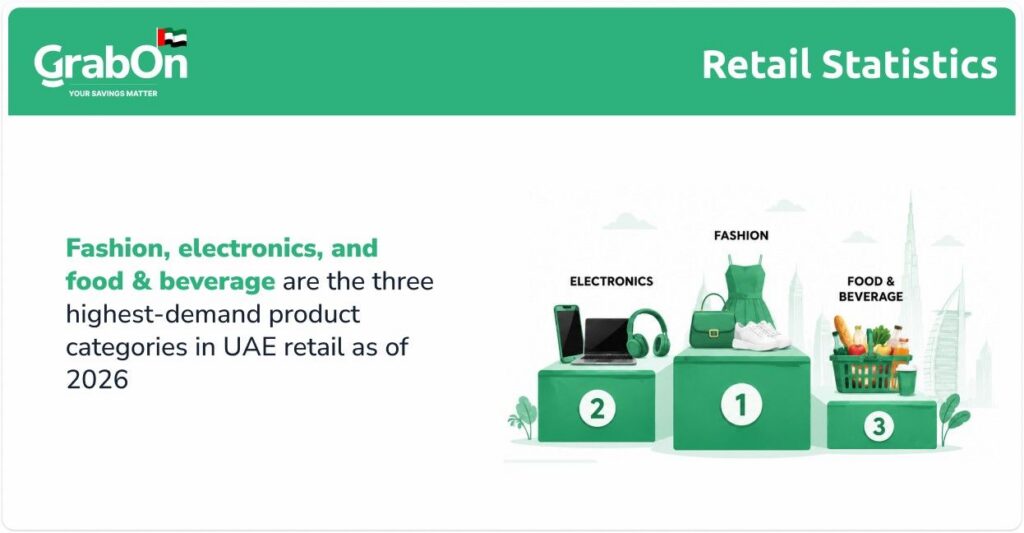
Fashion, electronics, and food & beverage are the three highest-demand product categories in UAE retail as of 2026. Fashion and accessories lead in growth rate, electronics lead in digital adoption, and F&B leads in absolute contribution to the retail general sector.
Fashion & Luxury
Fashion accounts for roughly 26% of UAE retail economy spending and has been the fastest-growing segment, with a 31% surge in 2023 driven by tourist spending and promotional events like the Dubai Shopping Festival. By 2026, fashion spending has continued to grow in the high single digits annually, driven by rising tourist volumes and the continued expansion of luxury brands into the market.
Tourist spending on fashion has risen sharply over recent years, from representing just 11% of total fashion spending in 2020 to 23% in 2023 and an estimated 26-28% in 2026. The luxury goods market is worth an estimated $9 billion in 2026.
Electronics & Smart Devices
Electronics saw a 33% spending surge in 2023, and the category continues to grow as flagship smartphone launches from Apple and Samsung drive annual upgrade cycles. Smart home device penetration is expected to reach 87.8% by 2029. In 2026, electronics remains one of the top online shopping categories.
Food & Beverage
F&B is the largest single contributor to retail general sector growth, accounting for 41% of growth in 2023. The halal food market alone is valued at $16.29 billion in 2025 and projected to reach $22.27 billion by 2030. The UAE imports over 410,000 tons of poultry annually, and demand continues to rise across both retail and hospitality channels.
High-Demand Product Categories
| Category | 2023 Growth (YoY) | 2026 Status |
| Fashion & Accessories | +36% | Steady high-single-digit growth, tourist-driven |
| Electronics | +33% | Stabilized, driven by smartphone cycles and smart home |
| Food & Beverage | +25% | Consistent mid-single-digit growth |
| Watches & Jewellery | +25% | Strong luxury demand, gold prices supporting |
| Cinemas | +33% | Stable, new multiplex openings adding capacity |
| Pharmacy & Health | +12% | Growing wellness and self-care trend |
| Grocery (online) | +19% | Accelerating, 7%+ of grocery now online |
UAE E-Commerce Statistics
By 2026, the UAE ecommerce market is estimated at approximately $12.42 billion with penetration growing from 5% of the retail economy in 2019 to an estimated 17% in 2026.
Mobile phones now account for over 75% of all online transactions in the UAE ecom market
The e-commerce market was valued at AED 32.3 billion ($8.8 billion) in 2024. It is projected to surpass AED 50.6 billion ($14.1 billion) by 2029.
E-Commerce Penetration Over Time
| Year | E-Commerce Penetration (% of Retail Economy) |
| 2019 | 5% |
| 2020 | 9% |
| 2021 | 9% |
| 2022 | 10% |
| 2023 | 12% |
| 2024 | 14% |
| 2025 | 15% |
| 2026 (est.) | 17% |
Source: Majid Al Futtaim POS data (2019-2023), industry projections (2024-2026).
Key E-Commerce Stats
- 58% of online purchases in the UAE come from overseas vendors (cross-border e-commerce).
- 61% of consumers prefer digital wallets for online payments (Dubai Economy & Visa, 2023).
- LuLu’s e-commerce sales grew 38.6% in 2025, reaching 7.3% of total retail sales.
- The UAE’s Digital Economy Strategy aims to double the digital economy’s GDP contribution from 9.7% to 19.4% by 2032.
About 43% of UAE consumers prefer splitting purchases equally between online and in-store. However, 60% still prefer buying fresh food and produce in physical stores, indicating the omnichannel model is here to stay.
Tourism and Its Impact on UAE Retail
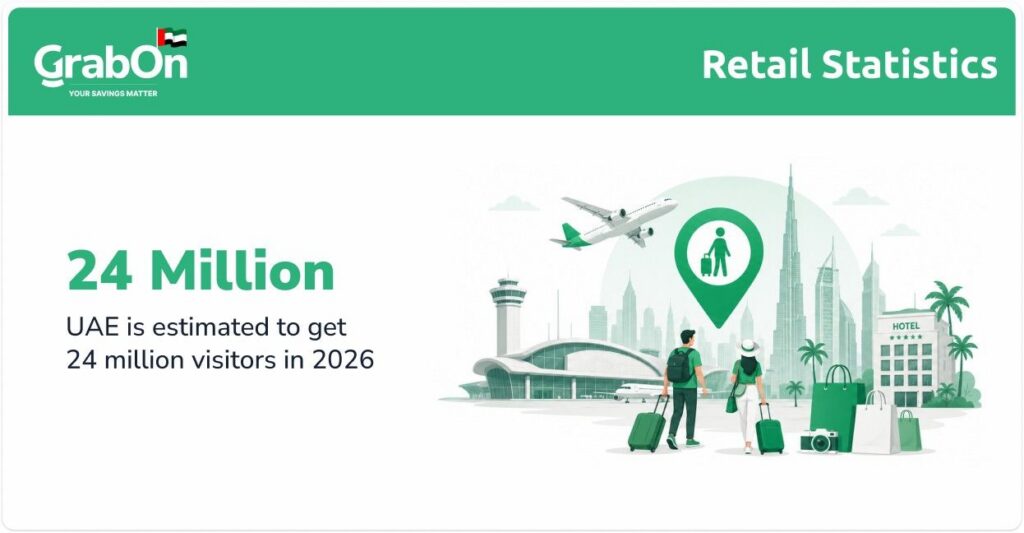
Tourism is one of the most powerful drivers of UAE retail spending. Dubai alone welcomed 19.58 million international visitors in 2025. The UAE is estimated to attract over 24 million international overnight visitors by the end of this year, supported by new hotel capacity, airline route expansion, and mega-events.
Tourism Stats That Matter for Retail
| Metric | 2026 Estimate |
| Dubai overnight visitors | 24 million |
| Hotel occupancy (Dubai) | 79% |
| Avg. stay (nights) | 3.9 |
| Tourist share of fashion spend | 26% |
Over half (53%) of international visitors come from Western Europe, South Asia, and the GCC. Chinese tourists represent one of the fastest-growing segments.
Dubai has been ranked the world’s most popular destination in TripAdvisor’s Travellers’ Choice Awards for multiple consecutive years. The combination of duty-free shopping, luxury malls, and year-round sunshine makes it a retail magnet.
UAE Real Estate and Retail
Dubai’s real estate market directly fuels retail growth. More residents mean more demand for groceries, dining, fashion, and entertainment. In 2023, Dubai recorded over 114,000 property transactions (up 18% YoY) valued at AED 370 billion (up 39% YoY). This momentum has continued through 2024 and 2025.
Property prices grew approximately 19% in 2023, making Dubai the second-fastest growing real estate market globally. By 2026, prices have continued to appreciate, though at a moderating pace as new supply enters the market.
Dubai Property Sales Trends
| Year | Volume Growth | Value Growth |
| 2020 | -11% | -10% |
| 2021 | +73% | +109% |
| 2022 | +18% | +76% |
| 2023 | +18% | +39% |
| 2024 | +15% | +20% |
| 2025 | +10% | +18% |
Apartments account for about 72% of transactions. Villa purchases have grown nearly 2.5x since 2020. Luxury home sales (above AED 10 million) jumped 68.4% in 2023 alone.
UBS’s Global Real Estate Bubble Index continues to rank Dubai as one of the world’s safest property markets, attracting wealthy migrants who in turn become high-spending retail consumers.
Top Retail Trends in UAE (2026)
1. Omnichannel Is the Baseline, Not the Strategy
The distinction between online and offline retail has effectively disappeared for major UAE retailers. Brands like Hugo Boss, LuLu, and Carrefour now offer unified shopping experiences where customers can browse online, try in-store, buy anywhere, and return anywhere. About 43% of consumers already prefer splitting their shopping equally between channels. In 2026, WhatsApp Commerce is a fully functioning sales channel with over 90% penetration among UAE adults.
2. AI is Reshaping Store Operations
76% of Middle Eastern retailers have invested in AI solutions. Applications span personalized product recommendations, predictive inventory management, and computer vision for shelf monitoring and theft detection. The smart retail market is growing at 32.2% CAGR and is on track to reach $9.74 billion. Retailers who haven’t adopted AI-driven operations are already falling behind.
3. Luxury Retail Keeps Outperforming
Fashion Avenue at Dubai Mall now ranks 11th worldwide for retail rents, with a 9% year-on-year increase. The luxury goods market is worth an estimated $9 billion in 2026 and growing at 5.7% annually. Around 90% of luxury purchases still happen in physical stores, creating a major opportunity for brands that can bridge digital discovery with in-store experience.
4. Community and Convenience Retail Is Booming
There is strong demand for retail in residential communities, driven by the rapid expansion of new neighborhoods across Dubai, Abu Dhabi, and Sharjah. E-commerce brands are opening physical stores that double as showrooms and micro-fulfillment centers. LuLu’s express and mini-market format now makes up over 50% of new store openings.
5. Private Label and Value-Seeking Behavior Persist
Despite high overall spending, consumers remain price-conscious. In the Majid Al Futtaim Happiness Lab survey, 47% of respondents preferred discounted items, 20% would switch to cheaper brands, and 52% closely tracked price fluctuations. Average grocery basket sizes continue to trend smaller even as trip frequency grows. LuLu’s private label products now account for 29.8% of total sales and are a key margin driver.
6. Arabic-Language E-Commerce Is Converting Better
Arabic-language search queries convert at significantly higher rates than English for categories like grocery, fashion, home goods, and local services. Retailers are investing in Arabic SEO and Arabic-first mobile experiences. This is a measurable shift from even two years ago when most UAE e-commerce was English-dominant.
7. Malls Are Lifestyle Destinations, Not Just Shopping Centres
Mall footfall grew 11% in 2023 and the trend has continued. More consumers are visiting malls specifically for entertainment, dining, and experiences rather than just shopping. Majid Al Futtaim’s AED 5 billion “Mall of New Possibilities” overhaul of Mall of the Emirates, adding wellness, cultural, and entertainment concepts alongside retail, is the clearest signal of where the industry is heading.
UAE Inflation and Retail Pricing (2026)
The UAE has maintained one of the lowest inflation rates in the region. After averaging 3.3% in 2023 and dropping to an estimated 2.8% in 2024, inflation in 2026 is estimated at around 2.3 to 2.5%, further supporting consumer purchasing power.
Housing remains the largest component of the consumer basket (40.7%) and continues to see above-average price increases due to strong demand from population growth and immigration.
Inflation by Consumer Spending Category (2023 Baseline)
| Category | Basket Weight | Avg. 2023 Inflation |
| Housing, water, electricity, gas | 40.7% | 5.7% |
| Furnishings & household equipment | 3.5% | 8.1% |
| Insurance & financial services | 1.3% | 6.4% |
| Food & beverages | 11.7% | 4.6% |
| Clothing & footwear | 5.0% | 4.0% |
| Restaurants & accommodation | 6.1% | 3.7% |
| Recreation, sport & culture | 2.4% | 2.7% |
| Education | 8.2% | 2.0% |
| Transport | 9.3% | -5.4% |
In 2026, food and transport inflation have moderated further, while housing costs remain the primary pressure point for residents.

I go the core of any topic and combine the best so that users don’t have to look elsewhere once they are on my blog.