
Quick Answer
|
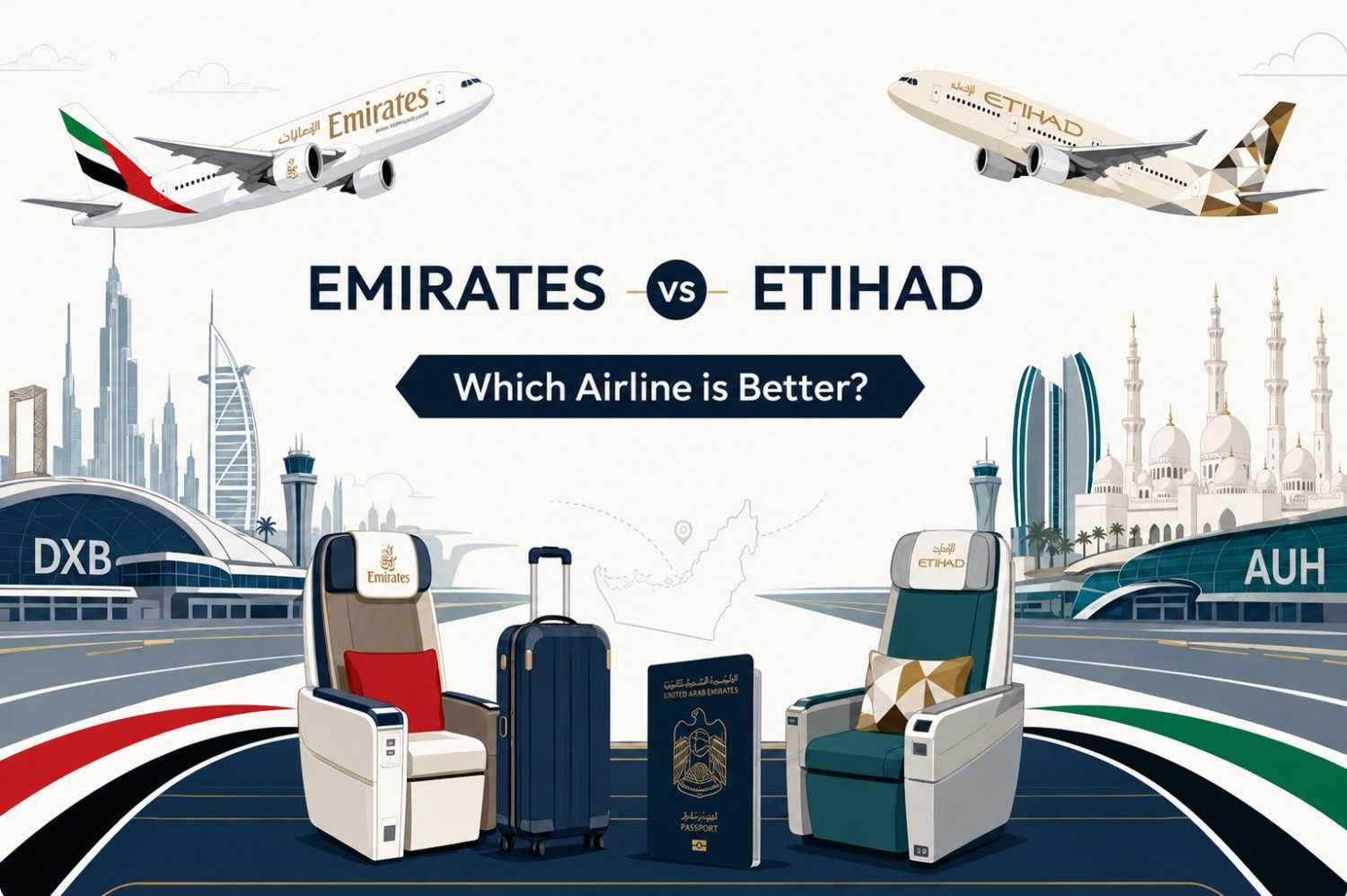
Emirates flies bigger, Etihad flies quieter. Emirates has the world’s largest widebody network out of Dubai, backed by the A380 and a fleet that is now over 260 aircraft strong. Etihad, out of Abu Dhabi, has newer cabins, tighter privacy, and one of the most exclusive suites in commercial aviation.
If you are choosing between the two for your next trip out of the UAE, the decision usually comes down to four things: where you are flying, which class you are booking, how much you value loyalty perks, and whether you would rather fly out of DXB or AUH. This guide breaks down all of it, with real 2026 numbers.
Emirates vs Etihad: 2026 Comparison Table
| Factor | Emirates | Etihad |
| Hub | Dubai International (DXB) | Zayed International, Abu Dhabi (AUH) |
| Founded | 1985 | 2003 |
| Fleet size (2026) | Around 260 aircraft | Around 110 to 124 aircraft |
| Destinations | Over 140 across more than 70 countries | Around 106, growing by 13 new routes in 2026 |
| Flagship aircraft | Airbus A380 (largest operator in the world) | A380 (returning on select routes), A350-1000, 787 Dreamliner |
| Loyalty programme | Emirates Skywards | Etihad Guest |
| Alliance | None (bilateral codeshares) | None (20+ codeshare partners) |
| Signature product | A380 Onboard Shower Spa and First Class Suites | The Residence, a three-room private suite on the A380 |
| Wi-Fi | Free Starlink Wi-Fi rolling out fleet-wide | Free chat messaging for all members, paid Wi-Fi via Viasat |
| Entertainment | ICE, widely regarded as the industry benchmark | E-BOX, strong but smaller content library |
| 2026 safety ranking (AirlineRatings) | 8th globally | 10th globally |
Emirates vs Etihad: Brand Overview
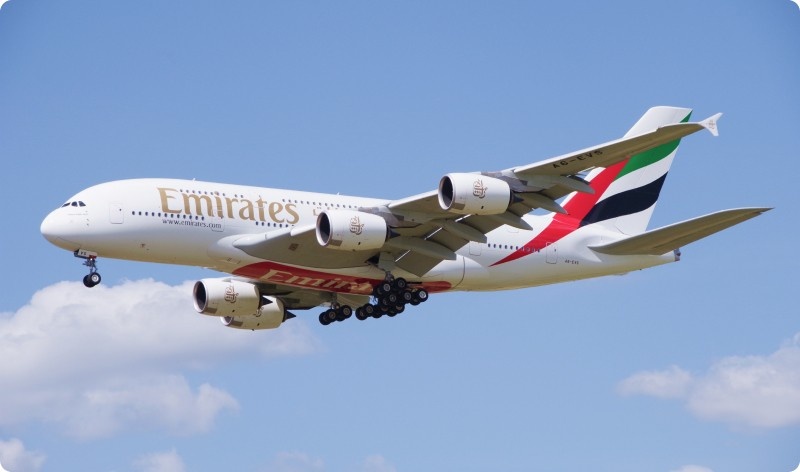
Emirates is Dubai’s flag carrier and the airline that made the A380 a global icon. Founded in 1985 and based in Al Garhoud, Dubai, it built its entire model around scale: connect the world through one hub, run the biggest planes, and win on frequency and choice. The fleet currently stands at 261 aircraft flying to 148 destinations, and the airline is not part of any global alliance.
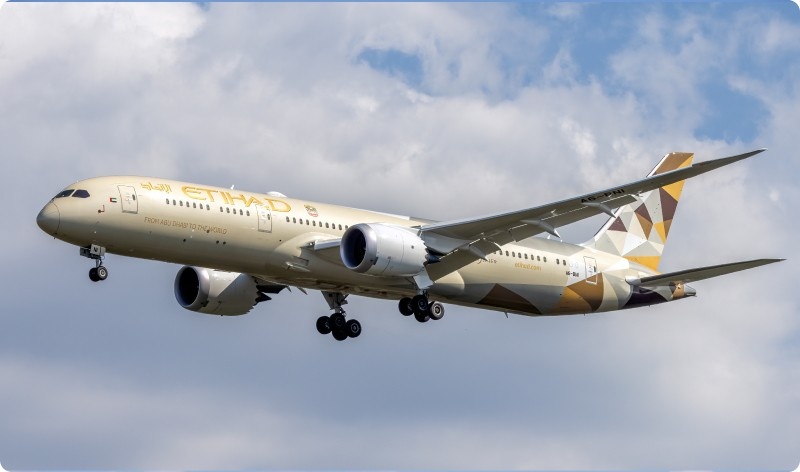
Etihad is Abu Dhabi’s flag carrier, younger by nearly two decades. It has built a boutique premium product: a quieter hub, a younger fleet dominated by the 787 and A350, and a privacy-first cabin design. The airline flies to around 106 destinations across six continents from Zayed International Airport, and in 2026, it is adding 13 new routes across China, the US, Europe, and the wider Middle East.
How We Evaluated Emirates vs Etihad
We looked at live 2026 fare data on both airlines’ official booking engines, current fleet and route figures, published baggage and cabin policies, and the latest independent safety and service rankings from AirlineRatings and Skytrax. We also factored in loyalty programme changes both carriers rolled out earlier this year, since these directly affect how much value you get from flying either one regularly.
Emirates vs Etihad: Fleet and Network
Emirates operates the world’s largest widebody fleet (A380s and 777s) and easily wins on sheer scale, connecting you to almost any global destination with high frequency.
Etihad plays a boutique game. They operate a younger, leaner fleet (A350s, 787s, and select A380s) focused on modern efficiency and direct routes rather than massive volume.
Winner: Emirates. More destinations, more frequencies, and by far the bigger widebody fleet. If your route is niche, Emirates is more likely to fly it, or connect you through Dubai to something that does.
Emirates Business Class vs Etihad Business Class 2026
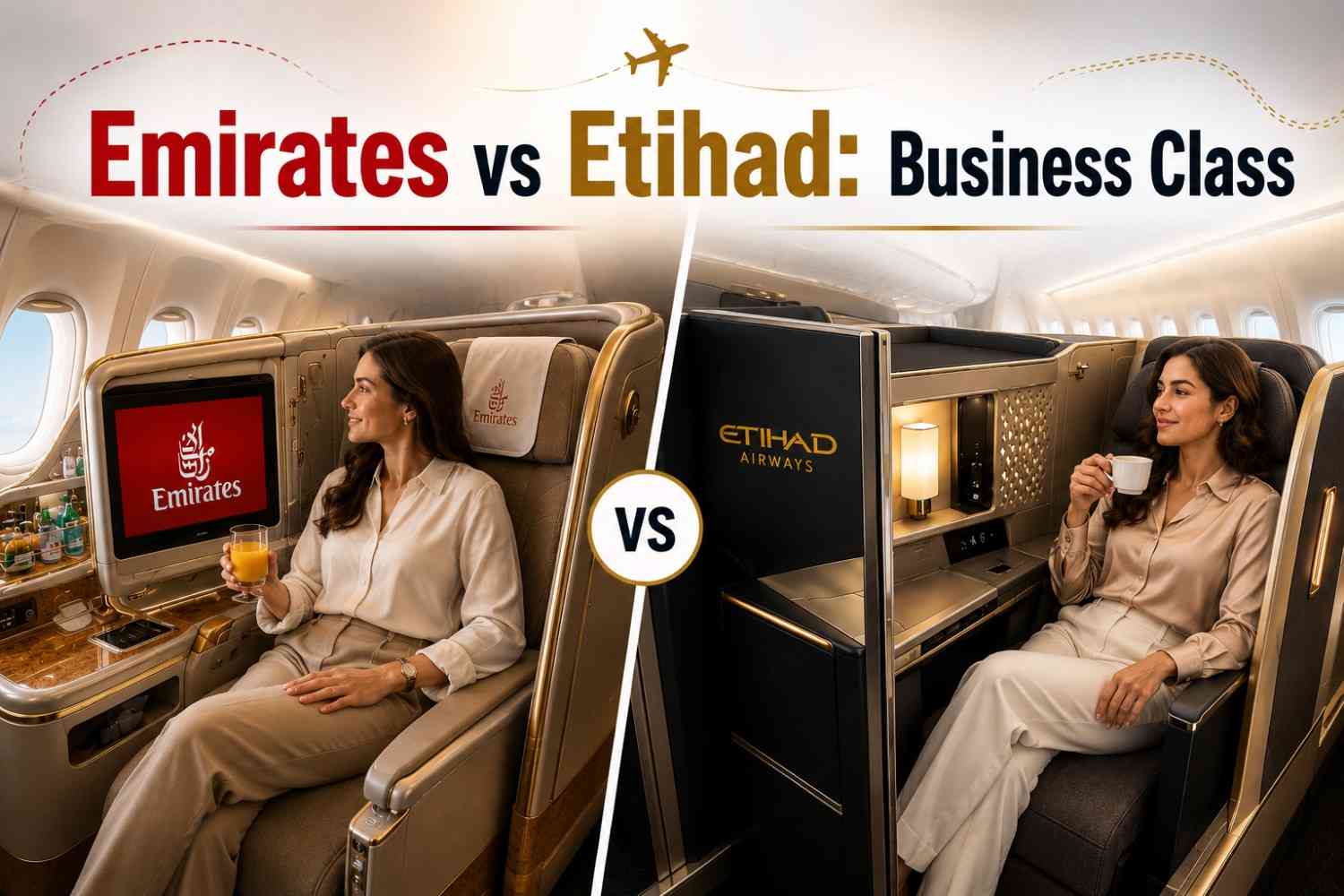
Etihad currently leads in privacy. Their newer A350 and 787 aircraft feature closing privacy doors, and they boast the exclusive three-room “Residence” on the A380.
Emirates wins on glamour with mood lighting, gold accents, and the famous A380 bar. However, some older 777s still lack direct aisle access (a $5 billion retrofit will fix this starting in August 2026).
Winner: Etihad, for now. It offers a more private, more consistent seat across a younger fleet. Emirates wins back ground once its 777 retrofit rolls out in full, so this one is worth revisiting later in the year.
Economy Class
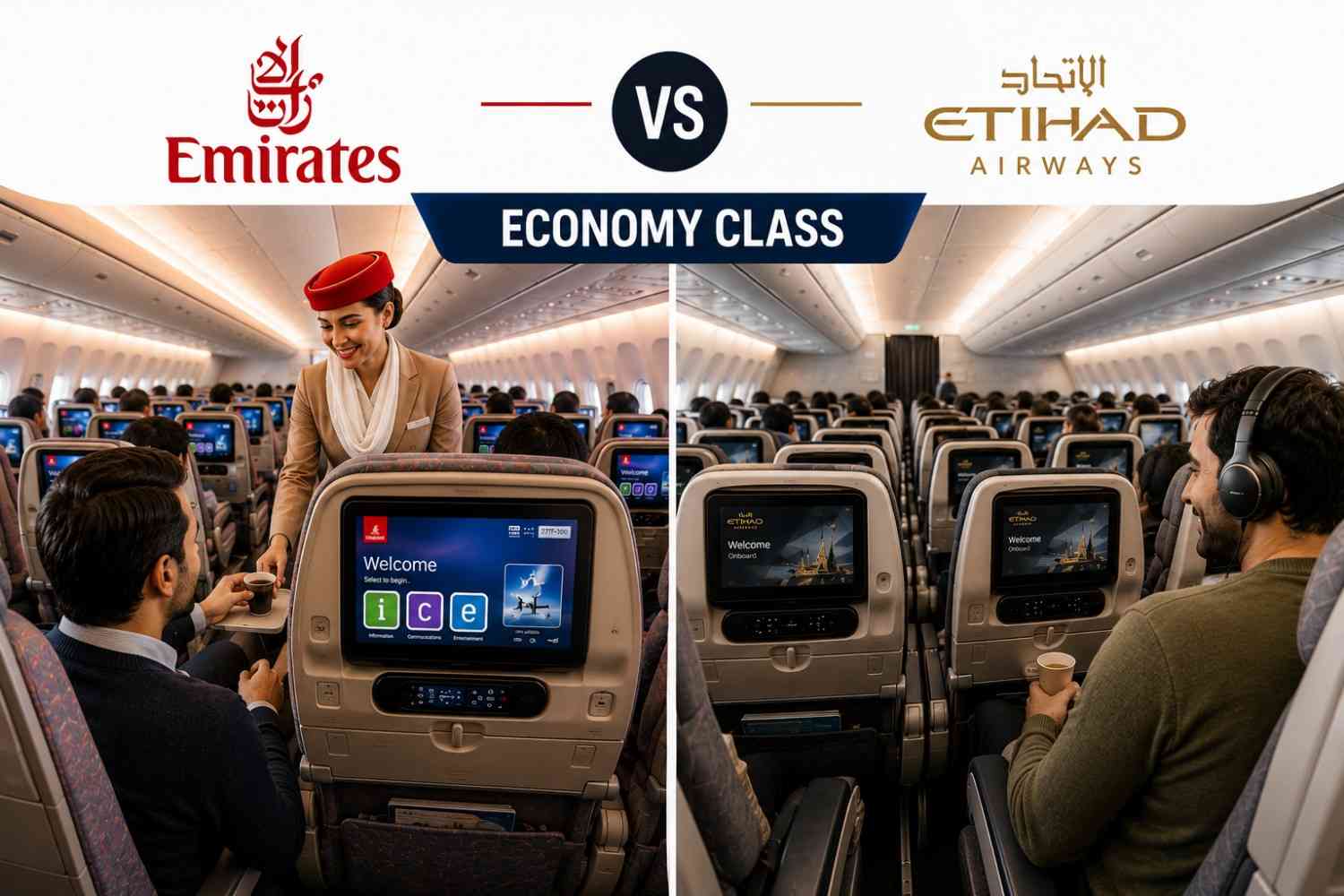
Emirates provides a roomier feel on the A380, standard legroom of 32 – 34 inches, and the distinct advantage of a dedicated Premium Economy cabin.
Etihad provides 31 – 33 inches of legroom but excels with its “Economy Space” upgrade (36 inches). They are also highly family-friendly and provide complimentary Warner Bros. World child activity packs.
Winner: Tie. Emirates has the edge in raw shoulder room on the A380 and a dedicated premium economy cabin. Etihad’s Economy Space seats are a smart middle option if you want extra legroom without booking Business.
Emirates vs Etihad: Entertainment and Wi-Fi
Emirates is the undisputed leader here. Their ICE system is the industry benchmark, and they are actively rolling out free, fleet-wide Starlink Wi-Fi through 2027.
Etihad offers the reliable E-BOX system. While the content library is smaller, they generously provide free chat messaging (WhatsApp, Messenger) for all loyalty members.
Winner: Emirates. ICE remains the bigger, better stocked system, and free Starlink Wi-Fi across the fleet is a genuine upgrade Etihad has not matched yet.
Emirates vs Etihad: Loyalty Programmes
Emirates Skywards: Best for loyal, direct flyers, though a March 2026 overhaul devalued partner redemptions by up to 76%.
Etihad Guest: Currently the fastest route to elite status, with tier thresholds temporarily slashed by 25% until March 2027. Premium cabin redemptions remain top-tier.
Winner: Etihad Guest, if you are starting fresh in 2026. Status is easier to reach right now, and the redemption sweet spots for Etihad’s own premium cabins are still excellent. Skywards is better if you already fly Emirates often and stick to their own network.
Emirates vs Etihad: Safety and On-Time Performance
Both airlines are considered among the safest in the world. Emirates announced a $5 billion A380 retrofit that hit the fleet in August 2026. In AirlineRatings.com’s 2026 World’s Best Airline list, Emirates and Etihad both featured in the top 10, ranking eighth and tenth respectively.
On punctuality, the gap is narrow. Cirium’s 2026 On-Time Performance Review put Emirates and Etihad within half a point of each other, at roughly 80.7% and 81.1% respectively, both trailing Qatar Airways.
Winner: Etihad, by a nose, on the strength of its 2026 safety title. In practice, both airlines are extremely safe, and this factor should not be a dealbreaker either way.
Emirates vs Etihad: Baggage Allowance
Emirates: Consistently generous. Standard Economy fares include 20-35 kg of checked luggage, plus a 7 kg cabin bag.
Etihad: Matches Emirates closely (23-35 kg for standard Economy), but be warned: their absolute cheapest “Basic” fares often exclude checked baggage entirely.
Winner: Tie. Both airlines sit in the same generous bracket for a full-service Gulf carrier. Check your specific fare code before you fly, since the cheapest tickets on either airline can shave your allowance down.
Emirates vs Etihad: Pricing
Etihad tends to undercut Emirates on comparable fares, especially in Business Class. On the ground, real fares back this up: round-trip Economy fares from the UAE to London on Etihad ranged between AED 3,080 and AED 5,060 for August 2026 travel, which sits comfortably within typical Gulf carrier pricing for the route. You can frequently find active Etihad coupons to reduce your base fare.
Emirates rarely wins on headline price, but it wins on flexibility. Emirates now offers one free date change on all reservations made after April 2026, which can offset a slightly higher fare if your travel dates are not locked in. Always check for verified Emirates promo codes before locking in your flight.
Winner: Etihad, for direct ticket price. Emirates pulls ahead if you value fare flexibility more than the upfront cost.
UAE Residents vs. Global Transit Passengers
For global transit passengers, the debate usually centers on stopovers, comparing the Dubai Stopover against the Etihad Free Stopover program (which frequently offers up to two free hotel nights).
However, for UAE residents, the decision is logistical. Residents prioritize secure airport parking, luxury airport transfers, and direct point-to-point routes, making ground logistics and the choice of hub just as important as the in-flight experience.
The Airport Debate: DXB vs Zayed International (Terminal A)
Historically, Emirates has won the “better airport” argument simply by operating out of Dubai International (DXB). However, Etihad’s recent move to the state-of-the-art Zayed International Airport (Terminal A) completely neutralizes this advantage.
Terminal A brings faster biometric processing, sprawling new premium lounges, and an uncrowded, airy feel that contrasts with DXB’s peak-hour bustle. When weighing DXB vs AUH transit, Zayed International now offers one of the most frictionless airport experiences in the Middle East.
The Dubai-Abu Dhabi Shuttle Bus
A primary barrier for Dubai residents considering Etihad is the 75-minute drive down the E11 to AUH. To solve this, Etihad provides a complimentary luxury coach service connecting Dubai directly to Zayed International Airport. The air-conditioned shuttles align with flight schedules and run 24 hours a day.
Flying to the US: The CBP Preclearance Advantage
If you are determining the best UAE airline for US flights, Etihad holds a massive structural advantage: the US Customs and Border Protection (CBP) Preclearance facility in Abu Dhabi.
For UAE expats flying to destinations like New York, Chicago, or Boston, this means you clear US immigration and customs inspections before you board your flight. You land in the United States as a domestic passenger, entirely bypassing stateside arrival queues. Emirates cannot match this, meaning DXB passengers must clear customs upon arrival in the US.
Emirates vs Etihad: Pros and Cons
Emirates
| Pros | Cons |
| Largest network, over 140 destinations | Business class experience varies by aircraft age |
| Biggest A380 fleet in the world | Skywards partner redemptions got weaker in March 2026 |
| ICE entertainment and free Starlink Wi-Fi rollout | Generally pricier fares than Etihad |
| Free date change on new bookings | No dedicated flight nanny service |
Etihad
| Pros | Cons |
| Newer fleet with more consistent privacy in Business | Smaller network than Emirates |
| The Residence, aviation’s most exclusive suite | E-BOX entertainment library smaller than ICE |
| Easier loyalty status through March 2027 | Fewer A380 routes than Emirates |
| Generally lower fares, especially in Business | Cheapest fares can drop free checked baggage |
Emirates vs Etihad: Recommendations by Use Case
- Widest route choice: Emirates. If you are flying somewhere off the beaten path, Dubai’s network is more likely to get you there directly or with one easy connection.
- Best Business Class privacy: Etihad. The closing doors on A350 and 787 cabins beat Emirates’ older 777 seats, at least until the August 2026 retrofit lands fleet-wide.
- Ultra-luxury for a special trip: Etihad. The Residence remains the most exclusive suite in commercial aviation, and nothing on Emirates matches it.
- Families travelling long-haul in Economy: Etihad. It offers a flight nanny for long-haul economy passengers to give parents a break, something Emirates does not provide.
- Best value on price alone: Etihad, particularly in Business Class, where the gap versus Emirates tends to be widest.
- Frequent flyers chasing status fast: Etihad Guest, thanks to the reduced tier thresholds running through March 2027.
Emirates vs Etihad: Which to Choose?
Pick Emirates if network size, A380 spectacle, and in-flight entertainment matter most to you, and you do not mind paying a bit more for it. Pick Etihad if you want a quieter airport experience, a newer and more private Business Class seat, easier loyalty status right now, and fares that are usually kinder to your wallet. Both are UAE flag carriers built to compete with the best in the world, so you are not making a bad call either way. The right pick comes down to your route, your budget, and how much you value privacy over scale.
Before you book either airline, check GrabOn for the latest Emirates and Etihad promo codes and deals to bring your fare down further.
FAQs
What is the main difference between Emirates and Etihad?
Emirates and Etihad are entirely separate airlines operating from different hubs within the United Arab Emirates. Emirates is based in Dubai, boasting a massive wide-body fleet and an extensive global network. Etihad operates out of Abu Dhabi, offering a boutique, understated luxury experience with a slightly smaller route map and premium cabin privacy.
Is Emirates cheaper than Etihad?
Pricing between Emirates and Etihad depends on your specific route, travel dates, and promotional sales. While base fares might look similar, Etihad’s basic economy tickets often exclude checked baggage and seat selection. This means final costs can increase, making it essential to compare the total all-in price, including luggage requirements.
Is the Etihad Economy better than the Emirates Economy?
Both airlines offer excellent economy experiences. Emirates provides wider seats on its flagship A380s, an industry-leading inflight entertainment system, and a vibrant cabin atmosphere. Etihad offers a quieter, relaxed environment with sleek Economy Smart Seats featuring adjustable headrests and a boutique, understated overall feel.
Does Emirates or Etihad have a better Business Class?
The better business class depends on aircraft type and your personal privacy preferences. Etihad guarantees direct aisle access and lie-flat beds on all widebody flights, with newer A350s featuring sliding privacy doors. Emirates offers an onboard bar on its A380 flights, though some older Boeing 777s still have a 2-3-2 seating layout.
Who has better legroom: Emirates or Etihad?
Standard economy legroom is similar on both airlines, ranging between 31 and 34 inches depending on the aircraft. However, Etihad has an advantage if you pay for an upgrade, as its Economy Space seats provide 36 inches of legroom. Emirates only offers Preferred seats with better cabin locations.
Does Emirates or Etihad have a better baggage allowance?
Emirates generally offers a more generous baggage policy, typically including a checked bag on most standard economy fares. Depending on the route, passengers can check between 30 and 35 kg. Conversely, Etihad’s lowest Basic Economy fares exclude checked baggage entirely, though higher-tier economy tickets can offer up to two 23 kg bags.

Shaoni is a whimsical wordsmith, who writes with her imagination and creativity. She enjoys exploring and learning new things and cuddling with her cats.