


The way people shop in the UAE is changing fast. Shoppers are no longer choosing only between online and offline stores. Many now use a mix of both, using their phones to discover products, compare prices, find deals, and complete purchases.
This blog looks at the latest UAE shopping trends and consumer behaviour, covering how shoppers use digital tools, social media, mobile shopping, payment methods, and AI while making buying decisions. It also explores how factors like discounts, convenience, brand loyalty, and changing lifestyles are shaping the future of retail in the UAE.
How UAE Shoppers Split: In-Store vs Online vs Click-and-Mortar
43% of UAE shoppers now combine digital tools with physical stores
43% of UAE shoppers used Click-and-Mortar methods, which means they either used digital features while shopping in a store or started their journey online and finished in a physical shop. The figure was 4 percentage points above the global average of 39%.
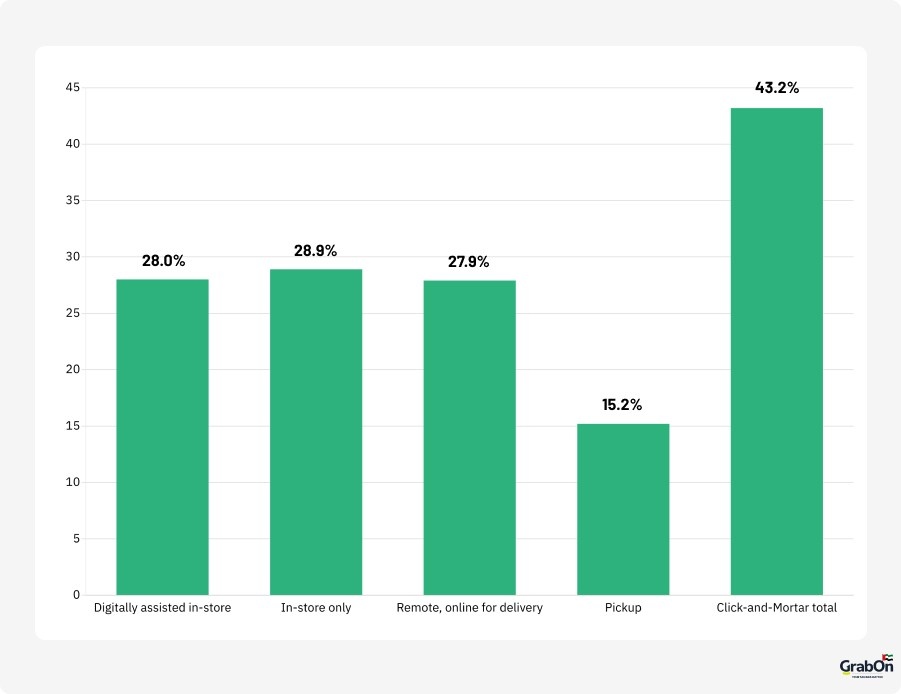
| Shopper type | Share of UAE consumers |
| Digitally assisted in-store | 28.0% |
| In-store only | 28.9% |
| Remote, online for delivery | 27.9% |
| Pickup | 15.2% |
| Click-and-Mortar total | 43.2% |
Click-and-Mortar is the sum of digitally assisted in-store and pickup shoppers, which is 28.0% plus 15.2%, or 43.2%.
Click-and-Mortar adoption over the years
Click and mortar stood at 47% in 2024, fell to 38% in 2025, and recovered to 43% in 2026. Over the same period, merchants reduced the average number of digital features they offered by one, even as consumers used more features. This gap between consumer demand and merchant supply is the clearest risk for UAE retailers.
| Year | Digitally assisted | Pickup | In-store | Remote | Click-and-Mortar |
| 2024 | 32% | 15% | 22% | 32% | 47% |
| 2025 | 28% | 10% | 25% | 37% | 38% |
| 2026 | 28% | 15% | 29% | 28% | 43% |
71% of UAE consumers use a digital feature every time they shop
71% of UAE consumers rely on a digital feature during their most recent shopping trip, and nearly 9 in 10 retail shoppers depend on these tools.
The average UAE shopper uses about 14 different digital features. Click-and-Mortar shoppers report satisfaction about 56% higher than in-store-only shoppers who avoid digital features, and online-only shoppers report a 63% increase.
UAE shoppers expect online and offline channels to work as one
53% of UAE consumers have used or want to use cross-channel features at the shop they use most, yet only 56% of UAE merchants offer them and 28% plan to. In retail point-of-sale data, about 43% of shoppers prefer an equal split between online and in-store shopping for certain products. The split changes by category, with fresh food the clearest case where shoppers still favour the store.
| Product category | Stated channel preference |
| Personal care | 52% prefer an equal online and in-store mix |
| Clothing and fashion | 52% prefer an equal online and in-store mix |
| Packaged food and beverage | 50% prefer an equal online and in-store mix |
| Household cleaning | 47% prefer an equal online and in-store mix |
| Fresh food and produce | 60% prefer to buy in store |
Mobile Phones Are Now the Main Shopping Channel
67% of UAE shoppers used a phone for their most recent retail purchase
As of 2026, 67% of UAE consumers used a mobile phone as part of their most recent retail purchase. This was a 23% rise since 2022 and placed the UAE ahead of Saudi Arabia at 66% and Singapore at 65%. The smartphone has become the main entry point to UAE shoppers across both physical and digital channels.
UAE shoppers window shop on their phones 17 days a month
The typical UAE consumer browses or researches products on a phone 17 days a month, well above the global average, and carries out about 1.5 mobile shopping activities a day. This browsing is not idle. It builds the wish lists and price comparisons that decide where and when a purchase finally happens.
37% of all online purchases in the UAE are made using a smartphone
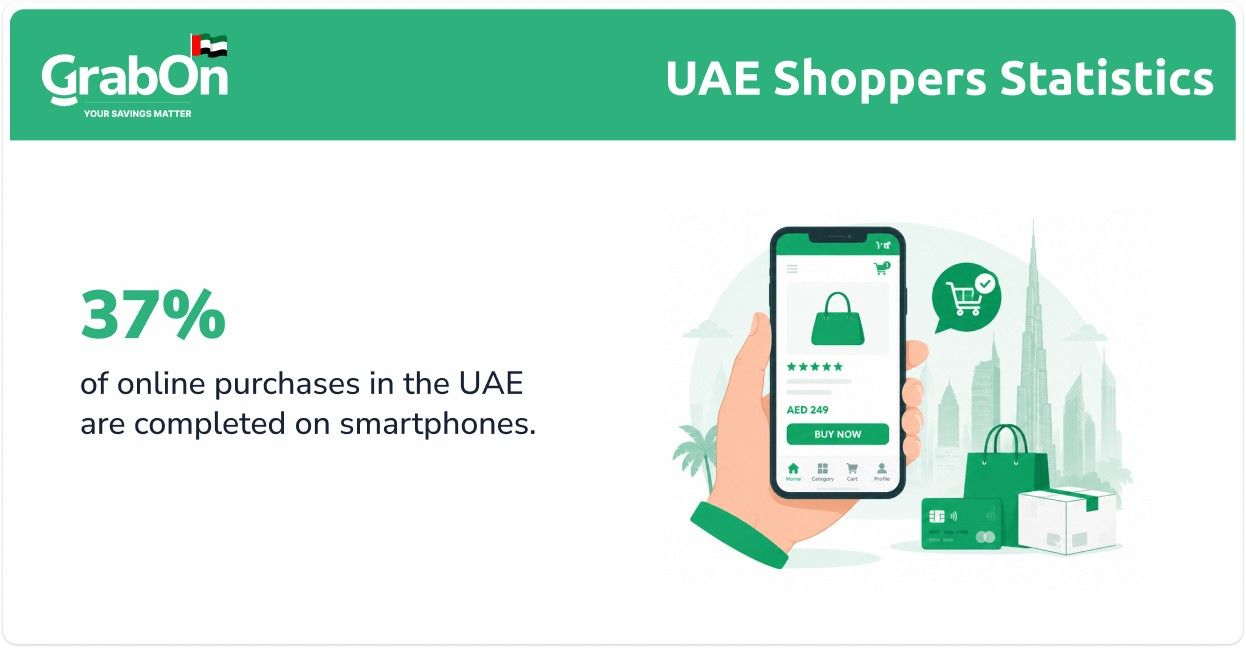
37% of online purchases in the UAE are completed on smartphones, the highest share of the markets studied, ahead of Singapore at 34.8%, the United Kingdom at 27.6% and Brazil at 24.4%. The gap between this figure and the 67% who used a phone in some way shows how much of mobile activity is research and comparison rather than the final transaction.
Biometric checkout and one-click payment run above the global norm
32% of UAE shoppers used biometric authentication, such as a fingerprint or face scan, in their most recent online retail purchase. One in three UAE shoppers used one-click checkout through a third party. These habits show that UAE shoppers adopt faster checkout methods quickly when merchants offer them.
Millennials drive mobile shopping while older shoppers lag
73% of UAE millennials used a phone for their last purchase, followed closely by Generation Z and Generation X, while only 18% of baby boomers and seniors did the same. The mobile-first habit is strongest in the working-age groups that account for most UAE spending.
How UAE Shoppers Behave on Social Media and in Social Commerce
68% of UAE shoppers have bought a product through Facebook
68% of UAE shoppers have purchased a product through Facebook, 67% through Instagram, 57% through TikTok and 41% through YouTube. On the supply side, 82% of UAE businesses sell through Facebook, 75% through Instagram and 73% through TikTok, while Amazon remains the most popular marketplace for both shoppers and businesses.
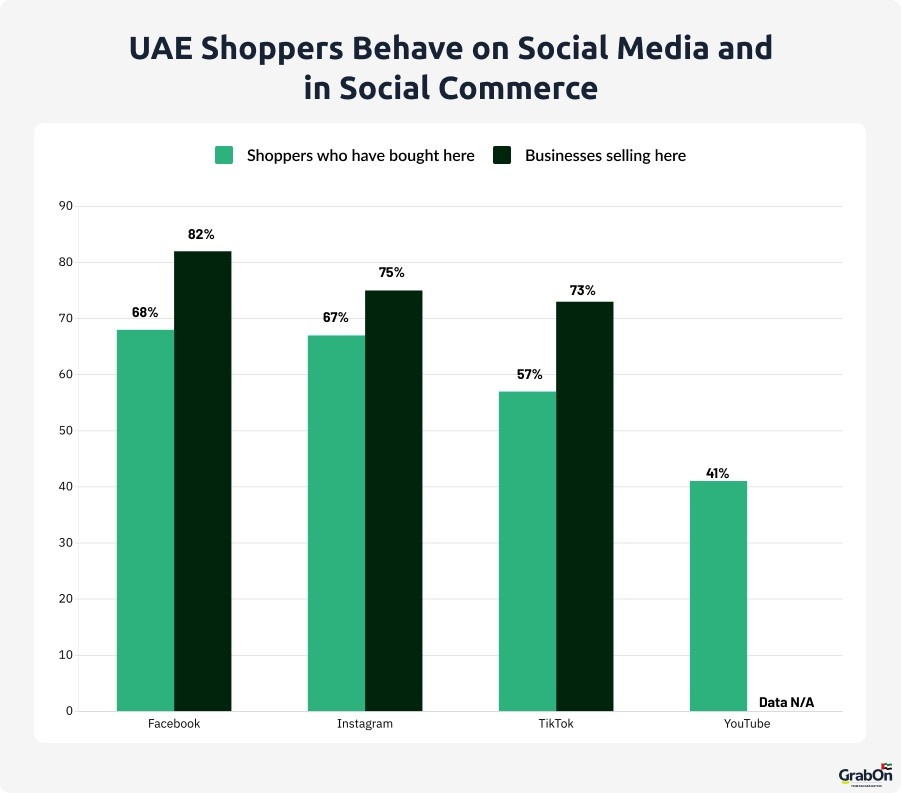
| Platform | Shoppers who have bought here | Businesses selling here |
| 68% | 82% | |
| 67% | 75% | |
| TikTok | 57% | 73% |
| YouTube | 41% | Data N/A |
78% of UAE shoppers use social networks to research brands
Around 78% of UAE consumers use social networks for brand research before they buy. The UAE has more than 11 million active social media users, and many hold several accounts. A typical shopper may see a product on TikTok or Instagram and buy it through social commerce in the same session, which turns short-form video and influencer content into direct sales channels rather than awareness tools alone.
TikTok reaches the whole adult population
TikTok has over 12.5 million adult users in the UAE as of 2026, and its advertising reach was equivalent to more than the entire adult population.
UAE social media users spend about 2 hours and 50 minutes a day on these platforms. The audience skews male across most platforms, with men making up roughly two thirds of users, and the largest age group is 25 to 34 year olds.
Social media is expected to overtake traditional e-commerce channels
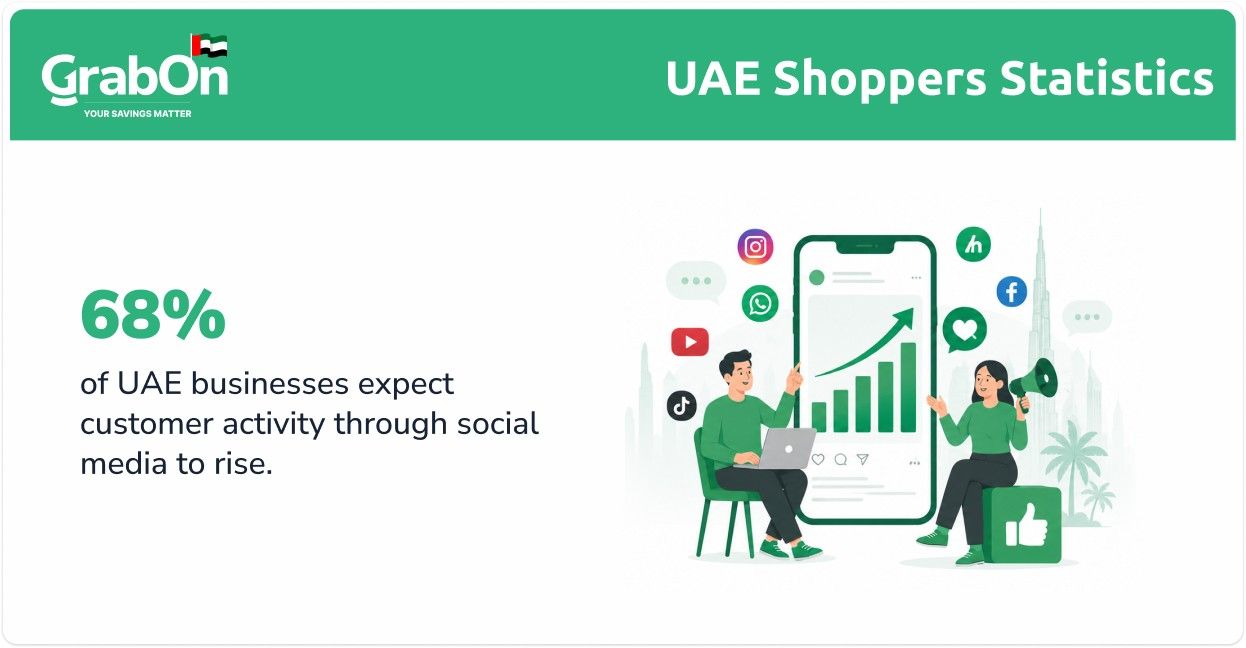
Businesses expect the shift to continue. In the DHL study, 68% of UAE businesses expect customer activity through social media to rise, ahead of apps at 65%, online marketplaces at 64% and AI assistants at 59%. Industry analysis points to UAE shoppers favouring social media over traditional e-commerce channels before 2030.
How UAE Shoppers Behave During Sales and Deal Seasons
77% of UAE shoppers feel satisfaction when they get something for less
Deal hunting is emotional as well as practical in the UAE. Independent research by Amazon and HarrisX found that 77% of UAE shoppers feel a sense of satisfaction when they get something they want for less, and 47% find scoring a great deal more exciting than going on a spontaneous weekend trip.
A third of shoppers plan their buying around sale events
29% of UAE shoppers time their purchases around sale events, and 36% actively research prices and use tools to make sure they get the best deal. 33% are more likely to buy a product only when it is on sale. This shows shoppers buying with planning and precision rather than on impulse.
Shoppers prefer longer sales and dislike missing out
73% of UAE shoppers prefer extended sale events because they get more time to decide, and 75% say it feels good to grab a deal before a product sells out. 73% also agree that digital memberships make shopping more convenient, with exclusive discounts, free delivery and faster delivery the most valued perks.
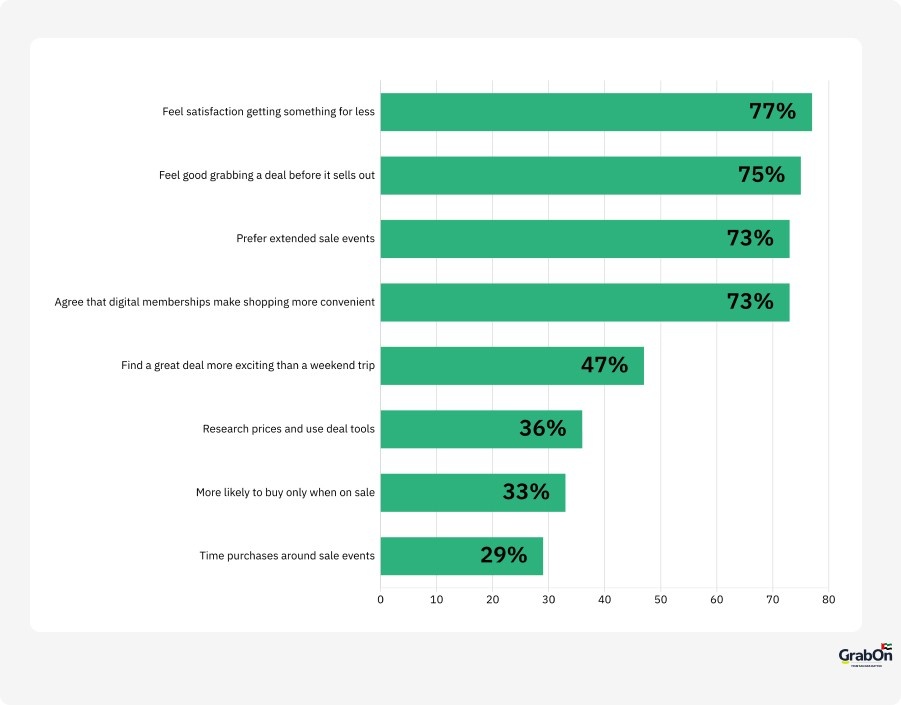
| Deal-season behaviour | Share of UAE shoppers |
| Feel satisfaction getting something for less | 77% |
| Feel good grabbing a deal before it sells out | 75% |
| Prefer extended sale events | 73% |
| Agree that digital memberships make shopping more convenient | 73% |
| Find a great deal more exciting than a weekend trip | 47% |
| Research prices and use deal tools | 36% |
| More likely to buy only when on sale | 33% |
| Time purchases around sale events | 29% |
White Friday 2025 pushed shopping app installs up 38%
Sale events also drive a measurable surge in mobile activity. During White Friday 2025, UAE shopping app installs rose 38% year on year and total in-app conversions rose 68%, with a 95% jump on iOS and a 45% rise on Android. Remarketing activity grew 75% and the share of paying users rose 28% on Android and 11% on iOS. The data points to shoppers entering the sale with a clear intent to buy.
| White Friday 2025 metric | Year-on-year change |
| Shopping app installs | +38% |
| Total in-app conversions | +68% |
| Conversions on iOS | +95% |
| Conversions on Android | +45% |
| Remarketing activity | +75% |
Price Sensitivity and Value-Seeking Behaviour
Customers are buying smaller packets and shopping more frequently
The same pattern appears in food. Market researchers report that UAE shoppers are buying smaller packets of food, beverages and dairy and shopping more often, driven by sensitivity to cost of living and pack volume.
Online purchases of fast moving consumer goods now make up nearly 7% of total volume, more than 43% of UAE households buy these goods online, and the frequency of online grocery purchases rose from 12 to 16.3 times a year in a single year.
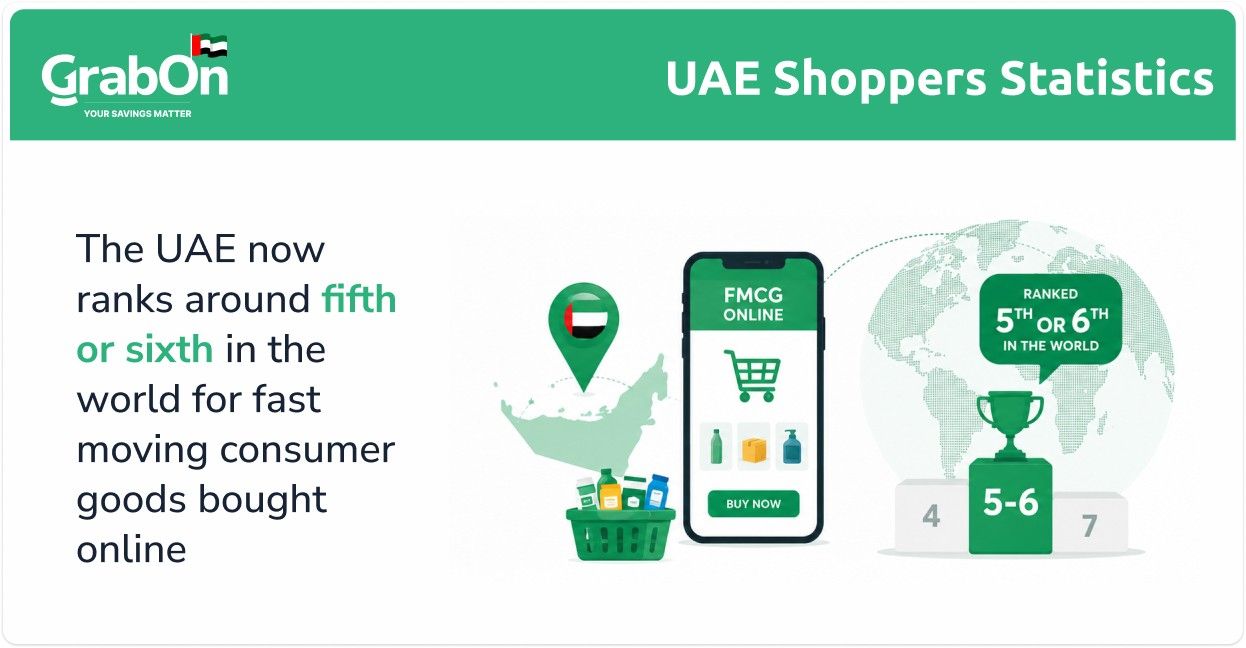
The UAE now ranks around fifth or sixth in the world for fast moving consumer goods bought online.
Almost half of UAE shoppers seek out discounts
Discounts shape choice across the basket. Majid Al Futtaim’s consumer research found that 47% of shoppers preferred to buy discounted items, 20% would switch to a cheaper brand, and 52% consistently watch for price changes, which was 3 percentage points higher than the year before.
| Price-conscious behaviour | Share of UAE shoppers |
| Watch for price changes consistently | 52% |
| Prefer to buy discounted items | 47% |
| Would switch to a cheaper brand | 20% |
Supply chain shocks feed price sensitivity
Price sensitivity is also shaped by external shocks. After disruption around the Strait of Hormuz, fuel prices rose above 114 USD a barrel and consumer goods prices increased across the UAE over a three month period. Retailers said stable prices and better availability would return only gradually as cheaper shipments worked through inventory, which keeps shoppers alert to price and value in the meantime.
Brand Loyalty, Quality and Personalisation
72% of UAE shoppers will pay more for quality
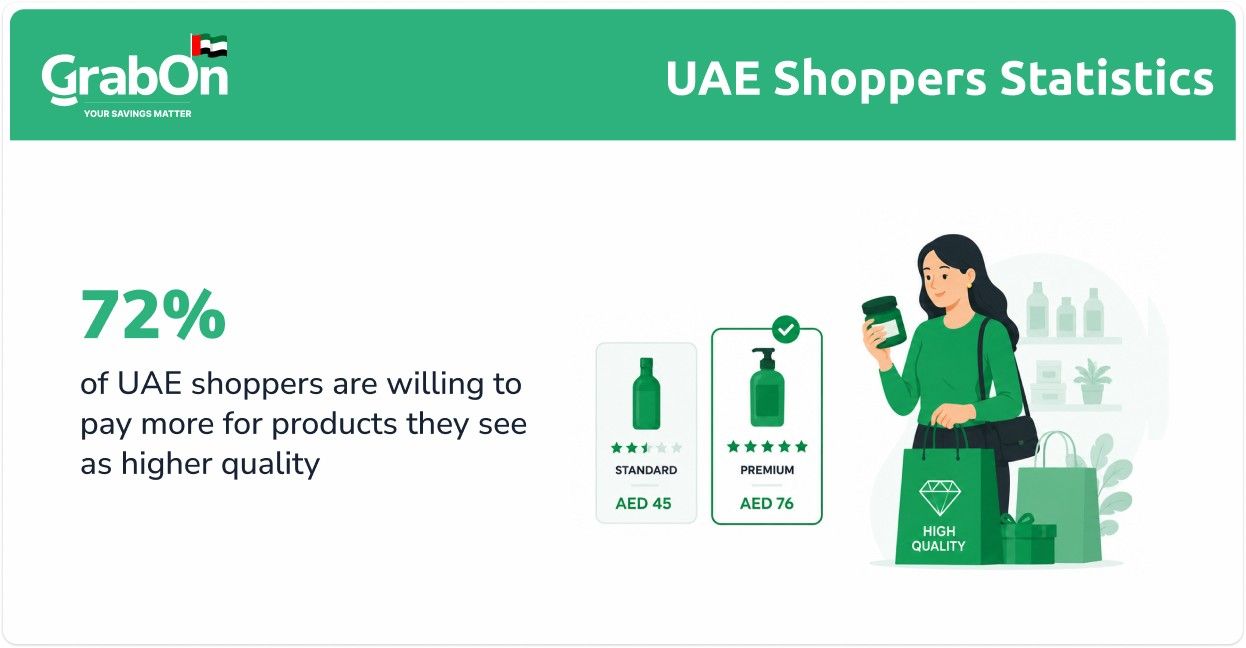
Value seeking does not mean shoppers always choose the cheapest option. 72% of UAE shoppers are willing to pay more for products they see as higher quality, and about 34% say they would buy from their favourite brands no matter the cost. Quality and reliability build loyalty even in a highly promotional market.
65% expect brands to treat them as individuals
65% of UAE customers expect brands to connect with them personally and treat them as individuals, which is 9 percentage points higher than the global average. Among Emiratis, exclusive rewards appeal to 69%, and nearly half say a personal shopping advisor makes them spend more. Personalisation is now an expectation rather than an extra.
Shoppers want loyalty rewards that work across channels
67% of UAE consumers want reward or loyalty programmes they can use both in store and online, and 73% of shoppers say digital memberships make them more likely to shop with the same retailer again. Loyalty in the UAE depends on a consistent experience across every channel a shopper uses.
How UAE Grocery and Food Shoppers Behave
Only 45% of grocery shoppers regularly use digital features, against 89% in retail
Grocery is the clearest gap between demand and supply. About 89% of general retail shoppers use digital features, but only around 45% of grocery shoppers do, mainly because grocers offer fewer of them. Retail shoppers use about 17 features on average, while grocery shoppers use about 10.
55% of grocery shoppers buy entirely in store
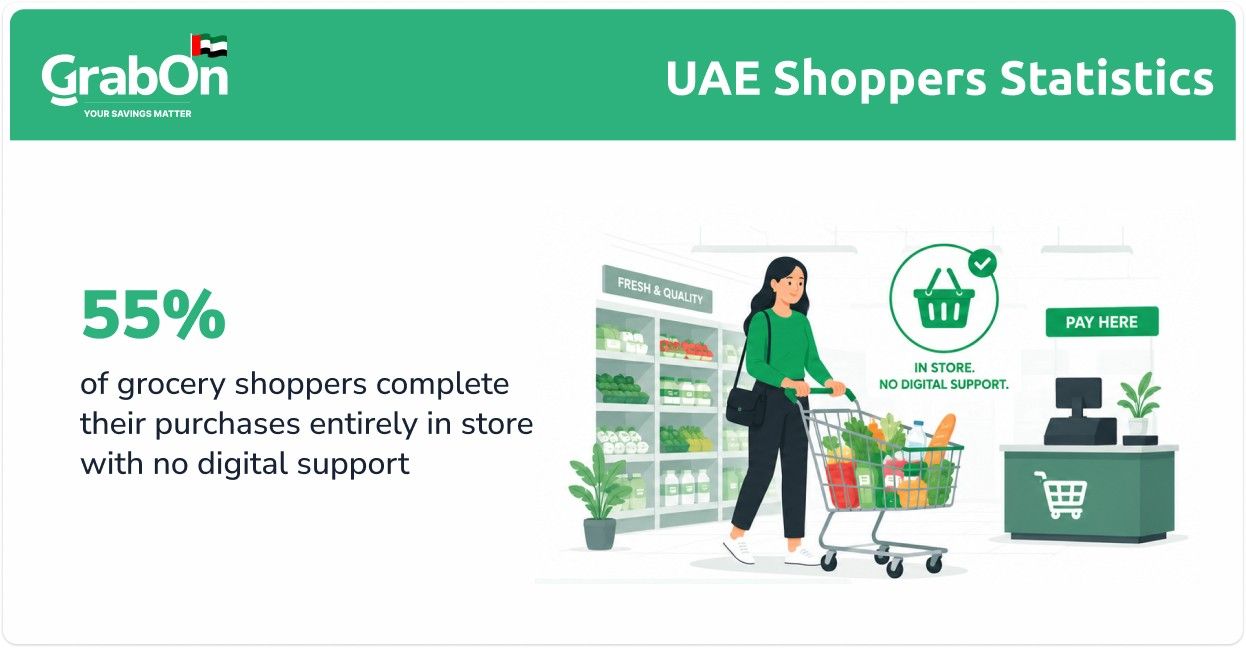
55% of grocery shoppers complete their purchases entirely in store with no digital support, compared with just 11% of retail shoppers. Grocery shoppers report satisfaction about 29% lower than retail-only shoppers, and grocers are nearly twice as likely as retail-only merchants to fail to provide the digital features customers want.
| Shopper type | Digitally assisted in-store | Remote | Pickup | In-store only |
| Retail shoppers | 21% | 43% | 25% | 11% |
| Grocery shoppers | 25% | 14% | 6% | 55% |
49% of grocery shoppers cannot find price-matching when they want it
49% of grocery shoppers want to use price-matching features and cannot find them, against just 24% of retail shoppers. Demand for the right digital tools in grocery is strong but unmet, which is the main reason grocery satisfaction lags retail.
Fresh, local and traceable food is gaining ground
Food shoppers increasingly weigh origin and freshness alongside price. Fresh chicken now makes up about 30% of total poultry consumption and has grown about 5% over two years, while frozen has stayed flat.
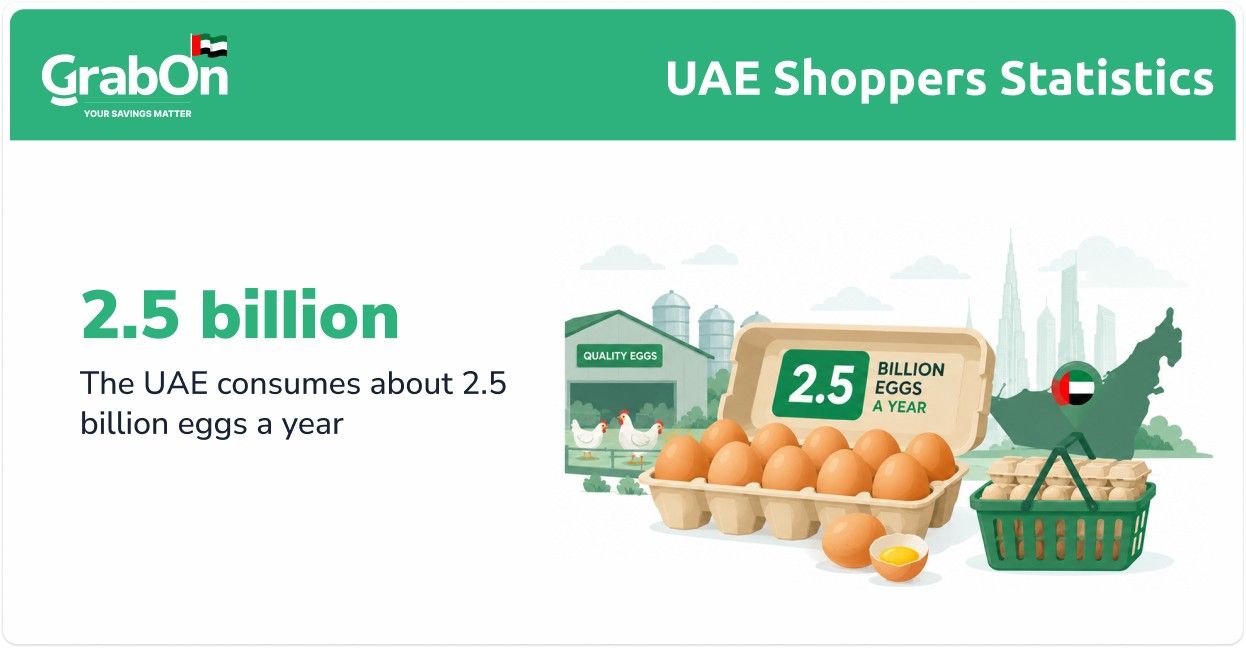
The UAE consumes about 2.5 billion eggs a year and more than half are produced locally, a share growing about 10% over two years. Premium eggs such as cage-free and free-range make up about 8 to 10% of the market and are growing about 16% a year. Shoppers cite freshness, traceability and food safety as reasons for choosing local produce.
Demographic Differences in UAE Shopping Behaviour
61% of parents use digital shopping features, against 33% without children
Parents are the most digitally active shoppers in the UAE. 61% of parents with children at home use digital features while shopping, compared with 33% of those without children. Parents also engage in about 50% more digital shopping activity days than the average consumer. The need to save time drives this behaviour, since the average UAE household has about five people.
| Household | Digitally assisted | Pickup | Click-and-Mortar | In-store | Remote |
| With children | 33% | 18% | 51% | 20% | 29% |
| Without children | 22% | 11% | 33% | 41% | 26% |
Millennials and Gen Z lead while older shoppers stay traditional
Around 80% of millennial and Generation Z shoppers build digital features into how they buy. Click-and-Mortar behaviour is most common among bridge millennials, more than half of whom shop this way. By contrast, 41% of Generation X and 87% of baby boomers and seniors prefer traditional in-store shopping with no digital help.
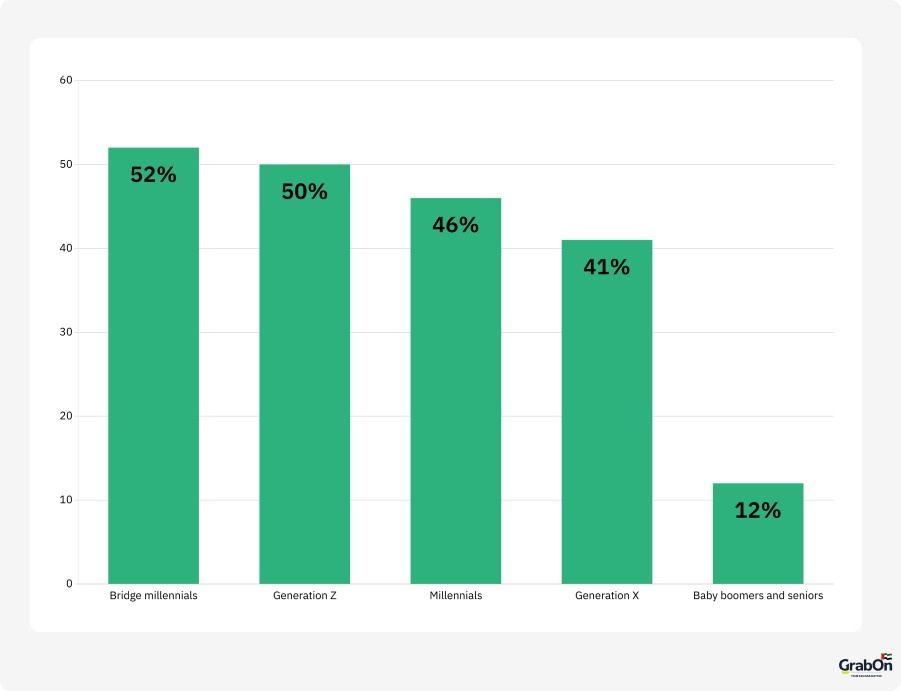
| Generation | Click-and-Mortar share |
| Bridge millennials | 52% |
| Generation Z | 50% |
| Millennials | 46% |
| Generation X | 41% |
| Baby boomers and seniors | 12% |
Middle-income shoppers use digital features the most
Digital shopping is not limited to the wealthiest. Middle-income shoppers show the highest Click-and-Mortar share at 52%, ahead of high-income shoppers at 42% and low-income shoppers at 40%. Demand for a feature-led experience runs across all income groups.
Emirati and expat shoppers buy differently
The UAE market holds two broad approaches. Emiratis often respond to Arabic and culturally tailored marketing and lean towards prestige and local relevance, while expats, who make up about 88.5% of Dubai’s population, bring brand preferences from home and split by nationality and budget.
Both groups are mobile-first and expect high service levels. Women influence about 80% of household purchase decisions in Dubai even though they make up about 31% of the population.
Payments and Checkout Behaviour
61% of UAE shoppers prefer digital wallets for online payments
Payment choice shapes where UAE shoppers buy. A Dubai Economy and Visa study found that 61% of UAE consumers prefer digital wallets for online payments, and wallet usage rose from 41% of consumers in 2020 to 53% in 2024.
The ability to use a preferred payment method is the single most used digital feature, reported by 75% of all UAE consumers and 82% of grocery shoppers.
Fast and secure checkout decides where shoppers buy
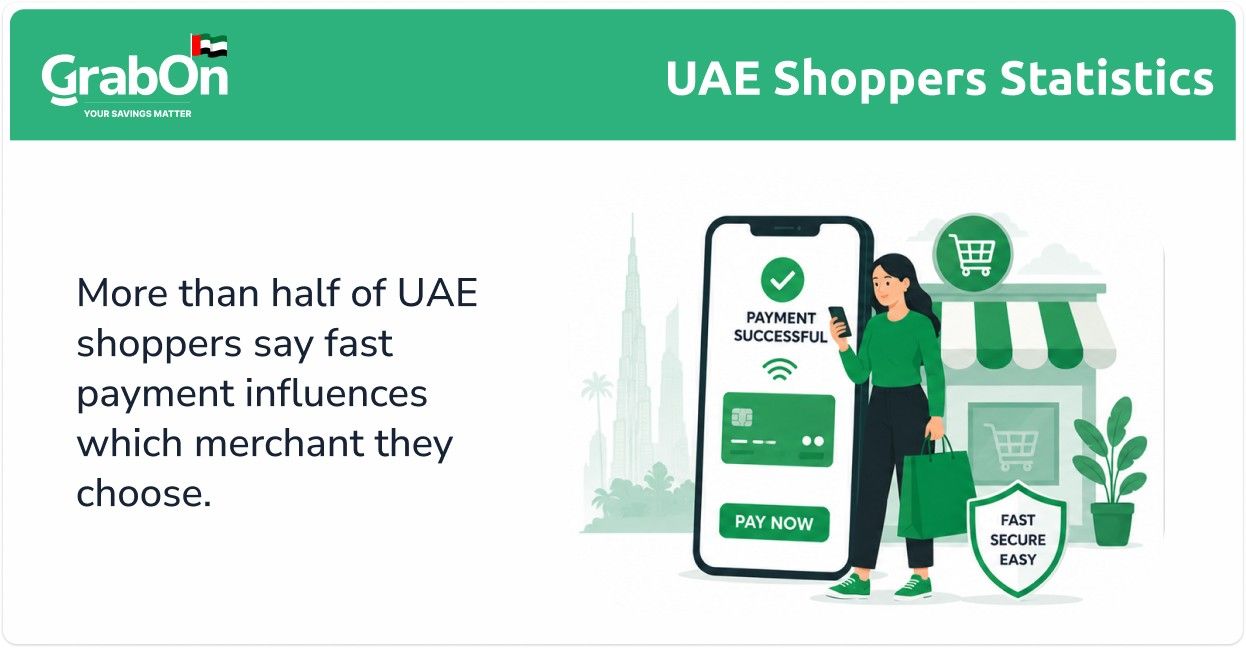
More than half of UAE shoppers say fast payment influences which merchant they choose, and stored payment credentials now dominate digital checkout. At the same time, concern about data security is the main reason some shoppers hold back from saving payment details, so speed and security have to advance together.
The Rise of AI in UAE Shopping
51% of UAE online shoppers already use AI shopping tools
Artificial intelligence is moving into everyday UAE shopping. 51% of UAE online shoppers already use AI-powered chat tools while shopping, and 91% of UAE e-commerce businesses have built some form of AI into their platforms, among the most advanced rates of the 29 markets DHL surveyed.
Shoppers expect to lean on AI assistants more in future
37% of UAE consumers expect to increase their shopping through AI assistants and chat tools over the next five years, while 59% of UAE businesses expect customers to rely on AI assistants for browsing and buying. Almost one in three consumers globally said they would be comfortable letting AI make or carry out a purchase for them within five years.
Retailers are using AI to personalise offers
UAE retailers are already applying AI to behaviour. One large grocery cooperative launched an AI-enabled loyalty programme that reads shopping behaviour to deliver personalised offers, replacing long printed leaflets. Younger shoppers in particular treat AI as a tool that saves time and reduces stress when choosing what to buy.
How the Pandemic Reshaped UAE Online Shopping
73% of UAE consumers are shopping more online after the pandemic
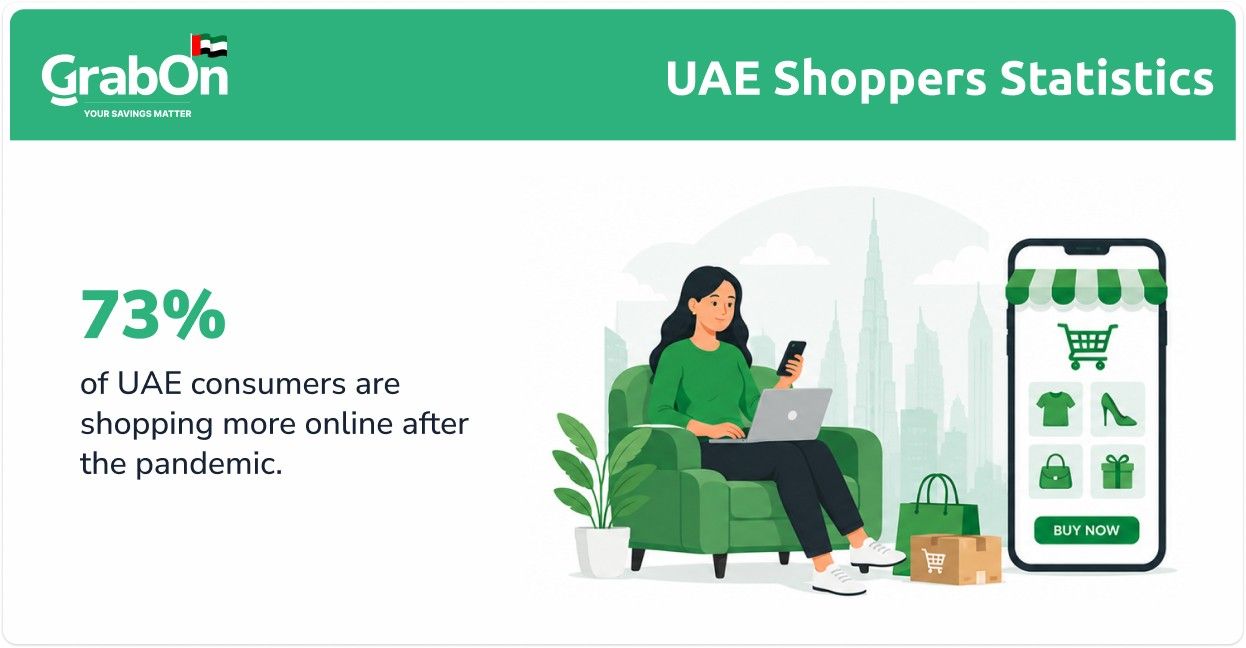
The pandemic permanently lifted online shopping in the UAE. 73% of UAE consumers are shopping more online than before the pandemic.
73% shop more online for groceries, 66% for clothing and more than 60% bought medicine online, while 70% started banking online.
| Activity moved online during the pandemic | Share of UAE consumers |
| Shopping more online overall | 73% |
| Groceries online | 73% |
| Banking online | 70% |
| Clothing online | 66% |
| Medicine online | > 60% |
Social platforms became discovery engines during the pandemic
The pandemic also turned social media into a place to find new sellers. 72% of UAE consumers discovered new sellers through Facebook and 56% through Instagram, while 57% said a secure checkout was essential to a good shopping experience. These habits did not reverse and now underpin today’s social commerce.
E-commerce penetration more than doubled
E-commerce penetration in the UAE retail economy rose from 5% in 2019 to 12% in 2023, more than doubling, with around 70% of those sales made on mobile phones.
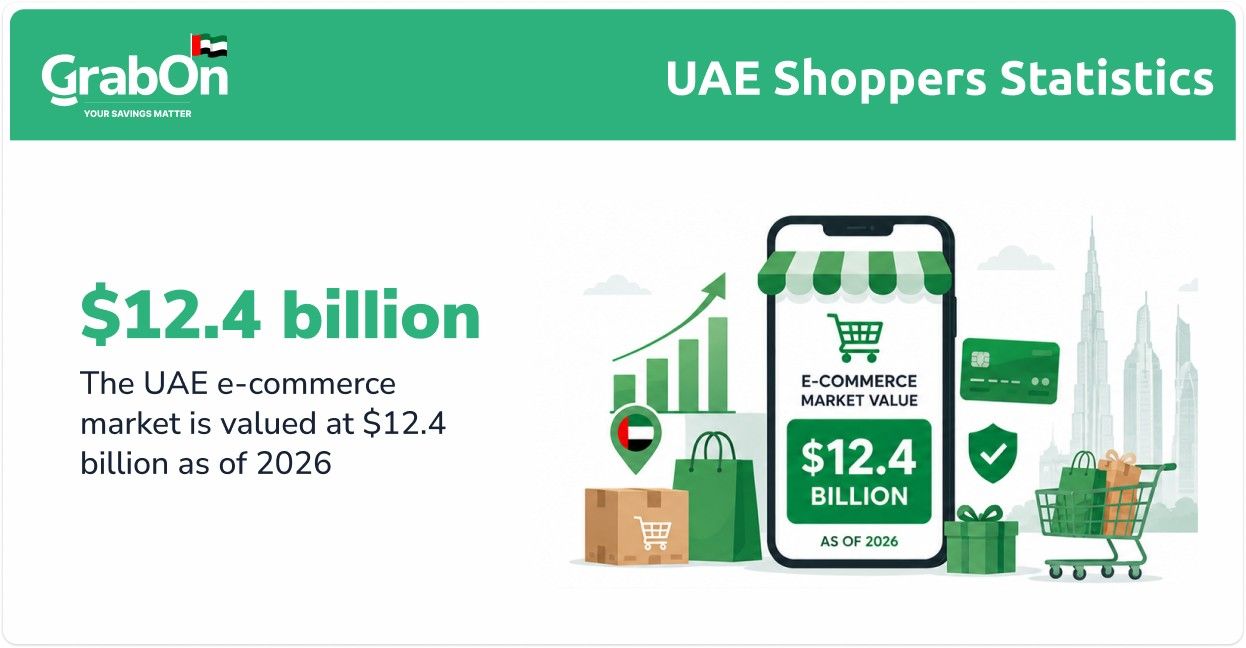
The UAE e-commerce market is valued at $12.4 billion as of 2026 and is expected to pass $20.54 billion by 2030.
How UAE Shoppers Behave Around Occasions and Seasons
Valentine’s Day online spending rose 188% over a decade
Occasions shift both spending and channels. Mastercard’s Love Index found that UAE shoppers spent about 90% more on Valentine’s gifts and experiences than ten years earlier, online Valentine’s transactions rose 188% over the decade, spending on flowers rose 982% and jewellery rose 17%.
Contactless payment volume grew 136% in 2020 against the year before, as celebrations and gifting moved home during lockdown.
Festivals and shopping seasons concentrate spending
Large retail events anchor the calendar. In 2023 the final quarter, helped by COP28 and seasonal sales, made up 27% of all retail economy spending for the year, while fashion spending rose 31% across the year, lifted by the Dubai Shopping Festival and promotional sales. Mall footfall rose 11% over the year.
Holiday shoppers plan earlier and chase value
A four-market Mastercard survey for the 2025 holidays, which included UAE shoppers, found that six in ten consumers put value for money first, more than a quarter started shopping up to three months early and nearly eight in ten waited for major sale days.
86% compared prices across retailers and 79% planned to use loyalty points and rewards to complete purchases. Trending categories included specialty foods such as Dubai chocolate, beauty products and fashion accessories.
Sources Of Data in This Post
- PYMNTS Intelligence and Visa Acceptance Solutions, 2024 Global Digital Shopping Index: UAE Edition, fielded September to December 2023.
- PYMNTS Intelligence and Visa Acceptance Solutions, 2025 Global Digital Shopping Index: UAE Edition, fielded October to December 2024.
- DHL, E-Commerce Trends Report 2026, based on 29,000 shoppers and 5,800 businesses across 29 countries, reported June 2026.
- Majid Al Futtaim, State of the UAE Retail Economy, full-year 2023 data and Happiness Lab survey, January 2024.
- Worldpanel by Numerator, comments at the Future Food Forum, reported by Khaleej Times, September 2025.
- Amazon and HarrisX, independent UAE deal-season research, reported by Khaleej Times, July 2025.
- AppsFlyer, White Friday 2025 performance data, reported by Khaleej Times, December 2025.
- Mastercard, UAE online shopping study, November 2020.
- Mastercard, Love Index, February 2021.
- Mastercard and The Harris Poll, Shopper Snapshot for the 2025 holidays, covering the United States, Canada, the United Kingdom and the UAE, November 2025.
- Gulf News and Al Ain Farms, UAE poultry and egg consumption, March 2026.
- Khaleej Times, Strait of Hormuz and UAE grocery prices, June 2026.
- Verkeer, Understanding Consumer Behaviour in the UAE’s Online Market, citing PYMNTS, PwC, Statista, Fast Company Middle East and Data Reportal, updated December 2025.
- DataReportal, Digital 2026 United Arab Emirates, social platform reach and time-spent data.
- Dubai Economy and Visa, digital payments study, 2023.
- Population and connectivity baselines provided by the author: 11.4 million population, around 11.4 million internet users, about 10.8 million smartphone users and 11 million social media users.

I go the core of any topic and combine the best so that users don’t have to look elsewhere once they are on my blog.