


Everyone tells you Dubai is tax-free, but they forget to mention the additional fees you have to pay before you even get your apartment keys.
That’s the gap this guide fills. You’ll get the headline numbers: rent, groceries, salaries, but also the costs that catch new arrivals off guard: agency commissions, Ejari fees, DEWA deposits, and the municipality charge tucked into every electricity bill. By the end, you’ll know exactly what a single person or a family of four spends here in 2026, how Dubai stacks up against Abu Dhabi, Riyadh, and the world’s priciest cities, and where you can trim the bill without trimming your lifestyle.
Quick Take: Dubai’s Cost of Living in 2026
- A single person spends AED 4,106 ($1,118) a month, excluding rent. A family of four spends AED 14,432 ($3,929) a month, excluding rent.
- A one-bedroom apartment in the city centre averages AED 8,409/month; outside the centre, that drops to AED 5,381/month.
- Mercer’s Cost of Living ranking puts Dubai at 15th globally, the most expensive city in the Middle East, ahead of Abu Dhabi (43rd) and Riyadh (90th).
- Petrol runs about AED 3.26 a litre, roughly a third of what you’d pay in London or Hong Kong.
- Before you sign a lease, budget an extra 12–13% of your annual rent for commission, deposits, and registration fees that never show up in the listing price.
- Salaries are quoted gross and untaxed. There’s no personal income tax in the UAE, so your take-home pay is your full pay.
How Does Dubai Compare to Other Global Cities?
Mercer’s Cost of Living ranking tracks over 200 cities every year, and Dubai has been climbing it steadily. It now sits in 15th place worldwide, its highest ranking yet, driven mainly by rents that have risen for more than 20 straight quarters.
| City | Global Rank (Mercer) | How It Compares to Dubai |
| Hong Kong | 1 | Notably pricier, especially housing |
| Singapore | 2 | Pricier, particularly on cars and rent |
| Zurich | 3 | Pricier across nearly every category |
| Geneva | 4 | Pricier, driven by high housing and living expenses |
| Basel | 5 | Pricier on goods, services, and accommodation |
| Bern | 6 | Pricier across general living costs and rent |
| New York | 7 | Pricier, especially rent |
| London | 8 | Pricier on rent and everyday goods |
| Nassau | 9 | Pricier, influenced by high import and island living costs |
| Los Angeles | 10 | Pricier, driven by high housing and transport costs |
| Dubai | 15 | — |
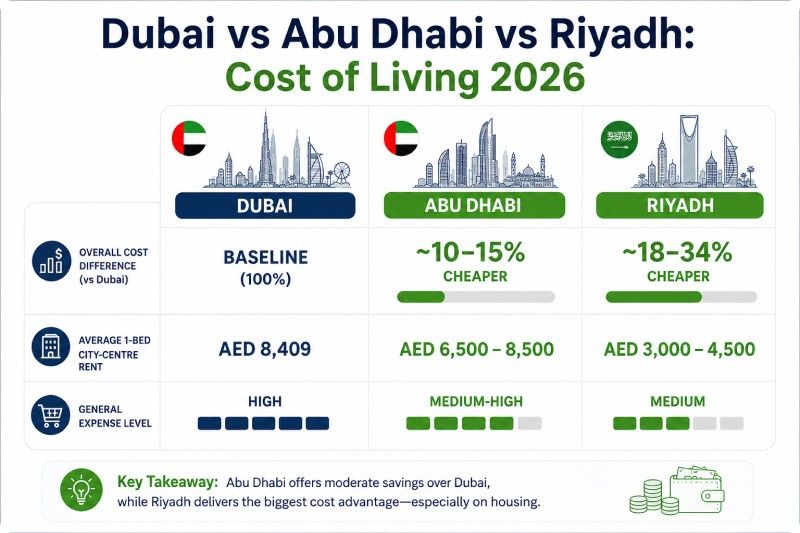
| Abu Dhabi | 43 | Roughly 10% to 15% cheaper than Dubai |
| Riyadh | 90 | Roughly 20% to 34% cheaper than Dubai |
The pattern holds even when you drop Mercer’s basket-of-goods methodology and look at raw Numbeo data: Dubai is about 27% less expensive than Los Angeles on everyday costs, though rent runs roughly 20% lower too, so the “Dubai is cheaper than the West” reputation is real, but it’s not cheap in absolute terms, and it’s noticeably pricier than its Gulf neighbours.
Takeaway: If your only frame of reference is Hong Kong, Singapore, or New York, Dubai will feel like a bargain. If you’re comparing it to Riyadh or Abu Dhabi, budget for a real premium, mostly in housing.
Real Estate Value in Dubai: What Your Money Buys
Dubai’s price-per-square-foot still looks generous next to Asia’s financial capitals. A widely cited comparison of what $1 million buys in prime residential property: roughly 78 sq/m of flat in Dubai versus 32 sq/m in Singapore and just 22 sq/m in Hong Kong. That’s two to three times more space for the same budget.
If you’re buying rather than renting, the sticker price isn’t the whole story. Property purchases in Dubai carry:
- DLD transfer fee: 4% of the purchase price, payable to the Dubai Land Department
- Trustee/registration fee: A few thousand dirhams depending on property value
- Agency commission: Typically 2% of the purchase price.
- Annual service charges: Billed per square foot, covering building maintenance, easy to overlook when comparing a Dubai purchase to a rent-controlled market back home
For buy-vs-rent price benchmarks by building and neighbourhood, we looked at Numbeo’s property investment data for Dubai for the most current data.
Rent in Dubai: What You’ll Actually Pay
Here’s what Numbeo’s July 2026 data shows for monthly rent across property types:
| Property Type | Average Monthly Rent |
| 1-bed apartment, city centre | AED 8,409 |
| 1-bed apartment, outside centre | AED 5,381 |
| 3-bed apartment, city centre | AED 16,577 |
| 3-bed apartment, outside centre | AED 11,231 |
Both apartment rents and villa rents have climbed since last year. So, if you’re working from a two-year-old quote, throw it out and get a current one.
The Costs Nobody Mentions Until You’re Signing
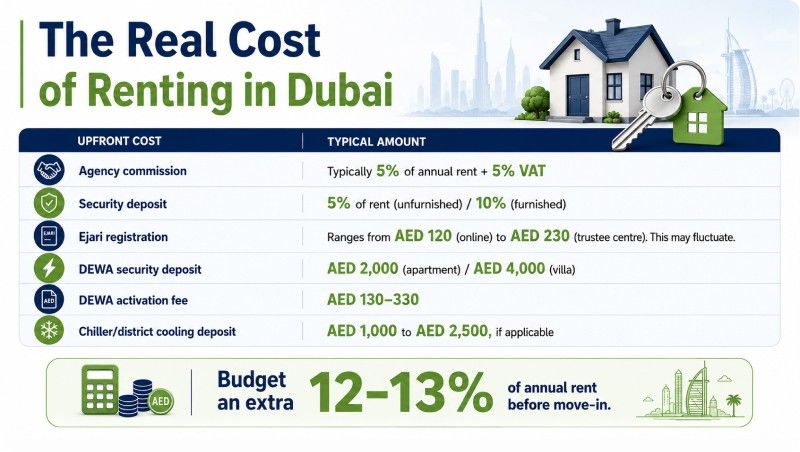
The rent figure above is not what leaves your account. Before you get keys, you also pay for:
| Upfront Cost | Typical Amount |
| Agency commission | Typically 5% of annual rent + 5% VAT |
| Security deposit | 5% of rent (unfurnished) / 10% (furnished) |
| Ejari registration | Ranges from AED 120 (online) to AED 230 (trustee centre). This may fluctuate. |
| DEWA security deposit | AED 2,000 (apartment) / AED 4,000 (villa) |
| DEWA activation fee | AED 130–330 |
| Chiller/district cooling deposit | AED 1,000 to AED 2,500, if applicable |
Add it up, and a first-time tenant typically pays 12% to 13% of the annual rent on top of the rent itself before move-in. On an AED 80,000 one-bedroom, that’s close to AED 10,500 in commission, deposits, and registration, separate from the rent cheques.
One more line item that hides inside your utility bill rather than your lease: Dubai Municipality charges a housing fee equal to 5% of your annual rent, billed monthly through DEWA. It’s calculated off your Ejari-registered rent, so if you’re paying AED 100,000 a year, expect roughly AED 417 added to your DEWA bill every month, indefinitely.
Takeaway: When you’re comparing a Dubai offer to a job elsewhere, don’t just multiply the monthly rent by 12, add 13% for setup costs and 5% annually for the housing fee, or your budget will be short from month one.
Rent by Popular Dubai Neighbourhood
Rent varies enormously by area, and proximity to a metro line, school, or your office usually explains most of the swing.
- Dubai Marina / JBR: Waterfront living with dense dining and retail. A 1-bed here typically lands at AED 75,000 to AED 140,000 a year.
- Jumeirah Lakes Towers (JLT): A favourite with singles and families for its two metro stations, lower prices than Marina, and a mix of towers from budget to branded-residence luxury. One-bedroom units here can range from roughly AED 50,000 to 70,000/year for smaller units up to AED 90,000 to 100,000/year for larger or duplex layouts.
- Downtown Dubai: Premium pricing tied to Burj Khalifa and Dubai Mall proximity; expect city-centre rents at the top of the range or above it.
- Jumeirah Village Circle (JVC) / Dubai South: The budget-conscious choice, often 30% to 50% cheaper than prime areas, at the cost of a longer commute.
- Business Bay: Mid-to-high pricing with strong connectivity to DIFC and Downtown.
If you’re weighing Dubai against a neighbouring emirate, Abu Dhabi runs roughly 10% to 15% cheaper across the board, and Sharjah can save you 20% to 30% on housing specifically.
Utility Bills in Dubai
DEWA (Dubai Electricity and Water Authority) handles your electricity, water, and cooling connection. For a 915 sq ft apartment, basic utilities average AED 871/month, with a realistic range of AED 541 to AED 1,500 depending on season. Summer A/C use can push bills 50% to 100% above winter levels.
Telecom is billed separately and isn’t small:
| Utility | Monthly Cost |
| Basic utilities (915 sq ft apartment) | AED 871 (range: 541 – 1,500) |
| Mobile plan (calls + 10GB+ data) | AED 201 (range: 100 – 300) |
| Home broadband (60 Mbps+, unlimited) | AED 347 (range: 230 – 450) |
A practical way to shave 20% to 30% off your DEWA bill: keep the A/C at 24°C rather than lower, use ceiling fans to circulate air instead of dropping the temperature further, and seal window and door gaps so cooled air doesn’t leak out.
Tip: Before you activate or recharge a plan, explore these Etisalat offers, since bundled data offers and cashback on recharges are updated regularly and rarely show up on the standard pricing page.
Groceries, Dining Out & Everyday Costs
This is the part most cost-of-living guides skip, and it’s the part that actually shapes your week. Here’s what Numbeo’s July 2026 Dubai data shows for a basic grocery basket:
Groceries:
| Item | Average Price |
| Milk (1 litre) | AED 6.76 |
| Bread, fresh white (1 lb loaf) | AED 4.93 |
| Eggs (12, large) | AED 12.78 |
| Chicken fillets (1 lb) | AED 14.82 |
| Rice, white (1 lb) | AED 4.12 |
| Apples (1 lb) | AED 4.39 |
| Tomatoes (1 lb) | AED 2.31 |
Where you shop moves these numbers a lot; budget chains like Carrefour and Lulu run noticeably cheaper than premium supermarkets like Waitrose or Spinneys, often by 20% to 40% on the same items.
Dining out:
| Meal | Average Price |
| Inexpensive restaurant meal | AED 45 |
| Mid-range meal for two (3 courses, no drinks) | AED 300 |
| Fast-food combo meal | AED 35 |
| Cappuccino | AED 22 |
| Domestic draft beer (1 pint) | AED 50 |
Worth mentioning: Dubai currently holds the No. 1 spot globally for the most expensive domestic draft beer on Numbeo’s price rankings. Alcohol carries a steep excise tax here, so if a few pints out are part of your routine, budget for it specifically.
Entertainment Costs in Dubai
Leisure spending is where a Dubai budget quietly balloons, mostly because the city’s entertainment options sit at every price point from a AED 35 movie ticket to a AED 2,500 day at a waterpark.
| Category | Type/Format | Cost | Notes |
| Cinema | Standard screening (weekday) | AED 35 to AED 45 | VOX Cinemas; prices climb on weekends and blockbuster openings |
| Cinema | IMAX | AED 75 to AED 95 | Widescreen, premium sound |
| Cinema | 4DX | AED 90 to AED 120 | Only at Mall of the Emirates and Dubai Festival City |
| Streaming | Amazon Prime / StarzPlay | Often bundled free | Check what’s included in your home internet plan before paying separately |
| Fitness | Budget gym chains | AED 99 – 300/month | Basic equipment, minimal amenities |
| Fitness | Mid-range (e.g., Fitness First) | AED 250 – 450/month | Classes, better equipment |
| Fitness | Premium clubs | AED 500+/month | Pools, spa access included |
Booking weekday matinees instead of weekend evening slots is the simplest way to cut your per-ticket cost in half. Movie nights add up fast if you’re going regularly, so check VOX Cinemas Coupons before booking; ticket discounts and combo deals on snacks are refreshed often enough to be worth the two-minute check.
General Expenses vs Other Cities
| City | Single-Person Monthly Cost (excl. rent) | 1-Bed Rent, City Centre |
| Dubai | AED 4,131 ($1,125) | AED 8,409 |
| Abu Dhabi | ~AED 3,700 to AED 4,000 | AED 6,500 to 8,500 |
| Riyadh | ~AED 3,400 (18% to 34% lower than Dubai) | AED 3,000 to 4,500 |
| Hong Kong | AED 3,959 ($1,078) | AED 8,120 |
| Singapore | AED 4,253 ($1,158) | AED 9,982 |
| Zurich | AED 6,159 ($1,677) | AED 9,168 |
| New York | AED 5,999 ($1,633) | AED 16,308 |
Data from Numbeo (updated 2026). Riyadh and Abu Dhabi figures are estimates derived from Numbeo’s city comparison tool, which doesn’t publish a single fixed monthly figure the way it does for Dubai.
Transportation: Car Ownership vs Public Transport
Car Ownership
Fuel is genuinely cheap here, AED 3.26 a litre, against a global average north of AED 4.70. A new Toyota Corolla (the UAE’s most common car) starts around AED 82,300; financed over 60 months with a 20% deposit, that’s roughly AED 1,200/month before insurance, Salik toll charges, and parking.
Public Transport
| Option | Cost |
| Single Nol card ride | AED 3 to AED 7.50 (depending on zones crossed) |
| Monthly public transport pass | AED 350 (All-zones pass) |
| Taxi starting tariff | AED 5 to AED 12 (varies by street hail vs dispatch) |
| Taxi, per kilometre | AED 2.14 |
The Nol card is your key to the Metro, buses, and trams. A monthly pass at around AED 350 beats car ownership decisively if your commute sits along a Metro line. JLT alone has two Metro stations, which is part of why it’s one of the more commutable neighbourhoods for people working Downtown or in DIFC. For anything the Metro doesn’t reach, Careem operates across the city at transparent rates.
Takeaway: If your daily commute runs along the Metro’s Red or Green Line, skip the car entirely for your first year; an all-zones pass costs less than three weeks of fuel, parking, and Salik combined.
Cleaning & Domestic Help Costs
Hiring help for cleaning is common enough in Dubai that it’s practically a default, not a luxury. Rates run from about AED 25 to AED 40 an hour through on-demand apps, with most bookings requiring a 2 to 4 hour minimum. A full-time, live-in domestic helper typically costs AED 1,500 to AED 4,000 a month depending on live-in/live-out status, while a weekly 3-hour visit runs roughly AED 360 to AED 480 a month.
If you’re weighing which app to book through, our breakdown of the best cleaning apps in Dubai compares pricing and features across nine platforms, and for move-in cleans or quarterly deep cleans specifically, see our guide to home deep cleaning services in Dubai. Both list offers for various cleaning platforms as well, which is an easy way to knock a chunk off your cleaning bill.
Education Costs in Dubai
Free public schooling is reserved for Emirati nationals; every expat family pays for education, whether public or private.
Nursery and pre-school (ages 0 – 4): A private full-day preschool or kindergarten runs around AED 3,083/month per child (range: AED 2,000 to 5,000), before you even reach the K-12 stage.
Public schools: Annual tuition for expat children is capped at AED 6,000/year.
Private/international schools: Dubai has 227 private schools serving close to 390,000 students, with fees regulated by the KHDA. Annual tuition ranges from AED 12,500 to AED 150,000, and an international primary school averages around AED 65,349/year. The spread depends heavily on curriculum (British, American, IB) and school reputation.
Higher education: Dubai hosts more than 60 universities and international branch campuses.
| Level | Annual Tuition |
| Undergraduate | AED 37,500 to 120,000 |
| Graduate | AED 55,000 to 140,000 |
| Student housing | AED 20,000 to 55,000/year |
If you’re a student (or supporting one) trying to stretch that budget, our roundup of student discounts across the UAE covers everything from software to transport savings worth checking before you pay full price on textbooks, tech, or subscriptions.
Healthcare and Insurance
Private medical insurance is mandatory for every Dubai resident, expat or local, and it’s usually arranged through your employer. A few numbers worth knowing:
- Health card (gives 50% off public facility rates): AED 100 one-time fee for expat residents
- Essential Benefits Plan (minimum legal coverage for lower earners and non-working residents): AED 650 to AED 2,500/year depending on category
- ILOE job-loss insurance (mandatory income protection): AED 5 to 10/month depending on salary band, covering 60% of your average basic salary for up to three months if you lose your job involuntarily
Dubai’s healthcare system ranks among the region’s strongest, and as an expat you get access to both public and private facilities. The health card just gets you the discounted public rate if you ever need it.
Visa and Relocation Costs
This is where most guides tend to go quiet, but it’s the first real cost anyone actually relocating will hit.
For a standard 2-year employment visa, the all-in cost: work permit, medical fitness test, Emirates ID, and residency stamping runs to AED 3,000 to AED 7,000 per person. Here’s the useful part: under UAE labour law, your employer is legally required to cover this, not you. If you’re negotiating an offer, confirm it’s included rather than deducted from your package.
If you’re self-sponsoring (freelance visa, investor visa, or a dependent you’re sponsoring yourself), you’re paying out of pocket, and the same AED 3,000 to AED 7,000 range applies per person, plus:
- Medical fitness test: AED 250 to AED 500
- Emirates ID: AED 250 to AED 575 depending on validity period
- Status-change fee (if applying from inside the UAE): AED 650 to AED 700
Living Expenses: Single Person vs Family of Four
Numbeo’s 2026 estimator puts monthly costs, excluding rent, at:
| Household | 2025 | 2026 |
| Single person | AED 4,085 | AED 4,131 |
| Family of four | AED 14,240 | AED 14,530 |
As a rule of thumb, housing eats roughly 30% of a typical budget, with transport and food each taking another 15%. Add rent back in, and total monthly costs commonly land at AED 7,000 to AED 12,000 for a single person and AED 20,000 to AED 35,000 for a family of four, depending heavily on neighbourhood and school choice.
Dubai vs Abu Dhabi vs Riyadh: Which Costs Less?
If you’re choosing between Gulf cities rather than comparing Dubai to London or Singapore, this is the table that actually matters:
| Comparison | Result |
| Abu Dhabi vs Dubai | Abu Dhabi is roughly 10% to 15% cheaper overall, with the biggest gap in rent. A 1-bed in central Abu Dhabi can run AED 20,000 – 25,000/year less than an equivalent Dubai Marina or Downtown unit |
| Riyadh vs Dubai | Riyadh is roughly 18% to 34% cheaper depending on the source, with rent running around 60% lower, though Dubai’s job market and salaries are typically stronger, which can offset the gap |
| Sharjah vs Dubai | Sharjah saves 20% to 30%, mostly on housing, in exchange for a longer commute into Dubai |
Riyadh’s savings are real but come with a genuinely different lifestyle. More conservative social norms and a market that’s still building out the retail, dining, and leisure infrastructure Dubai has had for two decades. If lifestyle and connectivity matter as much as the number on your payslip, that’s worth weighing against the discount.
Quality of Life in Dubai
Cost is only half the decision. Dubai is ranked among the safest cities in the world, and its infrastructure- metro connectivity, healthcare access, international schooling options, and a genuinely global mix of residents is a big part of why it keeps climbing in Mercer’s rankings despite rising prices. Other cities with lower cost of living rarely offer this combination of safety, connectivity, and lifestyle depth, which is exactly why Dubai persists even as rents climb.
What Salary Do You Need to Live Comfortably in Dubai?
There’s no single right number; it depends on your household size, school needs, and whether housing is part of your package. But based on 2026 market data:
| Household Type | Realistic Monthly Budget |
| Single professional, shared or budget accommodation | AED 7,000 to AED 12,000 |
| Single professional, comfortable central living | AED 15,000 to AED 20,000 |
| Couple, no kids | AED 20,000 to AED 30,000 |
| Family of four, one child in private school | AED 30,000 to AED 45,000 |
Average Salaries by Industry (2026, monthly)
| Industry | Entry Level | Senior Level |
| Finance & Banking | AED 8,000 to AED 12,000 | AED 45,000 to AED 75,000 |
| Technology & IT | AED 7,000 to AED 12,000 | AED 35,000 to AED 60,000 |
| Healthcare | AED 6,000 to AED 10,000 | AED 50,000 to AED 80,000 |
| Construction & Engineering | AED 7,000 to AED 12,000 | AED 35,000 to AED 60,000 |
| Retail & FMCG | AED 3,500 to AED 5,500 | AED 35,000 to AED 55,000 |
| Hospitality & Tourism | AED 3,500 to AED 6,000 | AED 35,000 to AED 55,000 |
Because there’s no personal income tax, every dirham of what you earn is what lands in your account. This is a genuine structural advantage over a comparable offer in the UK, US, or most of Europe, even before you account for the lower cost of goods.
How to Cut Your Cost of Living in Dubai
None of the above numbers are fixed. But these few habits can help you cut costs:
- Time your grocery run around app promos. Carrefour, Lulu, and Noon regularly run flash discounts. Our grocery shopping hacks for the UAE break down various saving hacks for various platforms.
- Pay rent in fewer cheques, not more. Landlords often shave a percentage off the total for a one- or two-cheque payment versus four.
- Choose your neighbourhood by Metro line, not by name recognition. JVC or Dubai South residents commuting on public transport often spend less monthly on rent-plus-transport combined than a Marina resident paying premium rent for a five-minute walk to the office.
- Set your A/C to 24°C and use fans to fill the gap. It’s a small habit that reliably cuts 20% to 30% off a DEWA bill that only gets more expensive as summer temperatures climb.
- Book cleaning and home services through coupon-linked apps rather than direct, since platform competition keeps rates lower than negotiating one-on-one for anything but a long-term regular arrangement.
- Check for verified coupon codes before any recurring booking like cleaning, food delivery, telecom add-ons, and streaming subscriptions; all have live discount codes worth five minutes of checking before you pay full price.
Frequently Asked Questions
Is Dubai expensive to live in?
Relative to Hong Kong, Singapore, Zurich, London, or New York, no, Dubai is meaningfully cheaper on both rent and everyday costs. Relative to its Gulf neighbours Abu Dhabi and Riyadh, yes, Dubai carries a real premium, mostly driven by housing.
How much money do I need to live comfortably in Dubai as a single person?
A comfortable single-person budget in a central location runs AED 15,000 to AED 20,000/month, covering rent, groceries, transport, and some discretionary spending. You can manage on less than AED 7,000 to AED 12,000 in a shared or budget setup further from the centre.
Is health insurance mandatory in Dubai?
Yes. Every resident, expat or Emirati, must carry private medical insurance, typically arranged through an employer for working residents.
Why did my Dubai rent quote not match what I actually paid?
Because the quoted rent rarely includes the agency commission (5% + VAT), Ejari registration (AED 120 – 230), and DEWA security deposit (AED 2,000 to AED 4,000) due at signing. Budget an extra 12% to 13% of annual rent for these.
Is Dubai cheaper than Riyadh?
No, Riyadh runs roughly 18% to 34% cheaper than Dubai overall, with rent around 60% lower, according to Numbeo’s city comparison data. Dubai’s stronger job market and salary levels often offset part of that gap.
Do I pay income tax on my Dubai salary?
No. The UAE has no personal income tax, so your gross salary is your take-home pay, minus any voluntary pension or insurance contributions.

Word wiz with 8 years of content experience and a Master’s in English. She’s dived deep into travel, tech, and entertainment, but her real knack? Finding tools that just work like a charm! When she’s not knee-deep in software comparisons, you’ll find her pumping iron at the gym or headbanging to Metallica. Ankita brings sharp insights and a lively spirit to Alternatives.co, helping readers discover smarter and wallet-friendly alternatives across categories.