
The UAE has over 4.7 million credit cards in circulation, which is around 54 credit cards for every 100 adults.
This report reveals how the count has moved since 2014, what banks are reporting quarter by quarter on demand, issuance and rejections, how credit stacks up against debit cards and digital wallets, what a UAE credit card actually costs at 39% to 44% annualised, and how buy now, pay later has taken ground the credit card used to own.
Explore all the details on credit card usage as of 2026 and also know the projections for the future.
How Many Credit Card Users Are There in the UAE
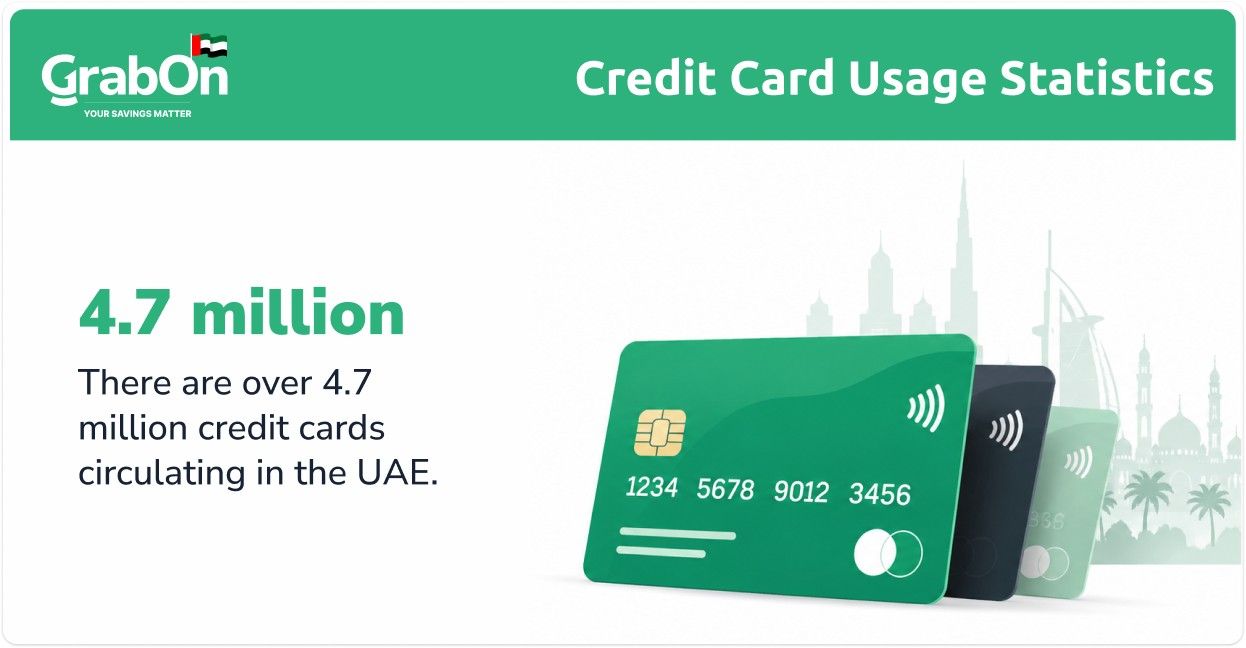
There were 4,706,279 credit cards in circulation in the UAE at the last official count. That works out to 536.6 credit cards for every 1,000 adults, or roughly 54 cards per 100 adults.
That number needs one important caveat. It counts cards, not people. Many UAE residents hold two or three cards, so the number of actual cardholders is meaningfully lower than the number of cards. There is no published figure for unique cardholders in the UAE.
The card count has grown steadily since the pandemic. It fell from 4.19 million in 2019 to 4.05 million in 2021 as banks pulled back, then recovered to 4.71 million by 2023. That is growth of about 16% in two years.
One more caveat, and it matters. The most recent official count is for 2023. No newer figure has been published by the IMF or the Central Bank. Applying the 2021 to 2023 growth rate forward gives an estimate of roughly 5.9 million credit cards in circulation in 2026, but this is a projection, not a reported number.
Credit Cards in Circulation in the UAE
| Year | Credit cards | Per 1,000 adults |
| 2023 | 4,706,279 | 536.6 |
| 2022 | 4,334,308 | 515.1 |
| 2021 | 4,053,192 | 507.0 |
| 2020 | 4,060,845 | 517.8 |
| 2019 | 4,194,351 | 532.7 |
| 2018 | 3,845,722 | 494.0 |
| 2017 | 4,101,635 | 528.4 |
| 2016 | 4,091,366 | 531.0 |
| 2015 | 3,802,227 | 497.7 |
| 2014 | 3,612,694 | 477.3 |
Source: IMF Financial Access Survey. Note: Latest available year is 2023. The 2026 figure of 5.9 million is an estimate based on the 2021 to 2023 growth rate, not a reported figure.
Credit Card Demand in the UAE
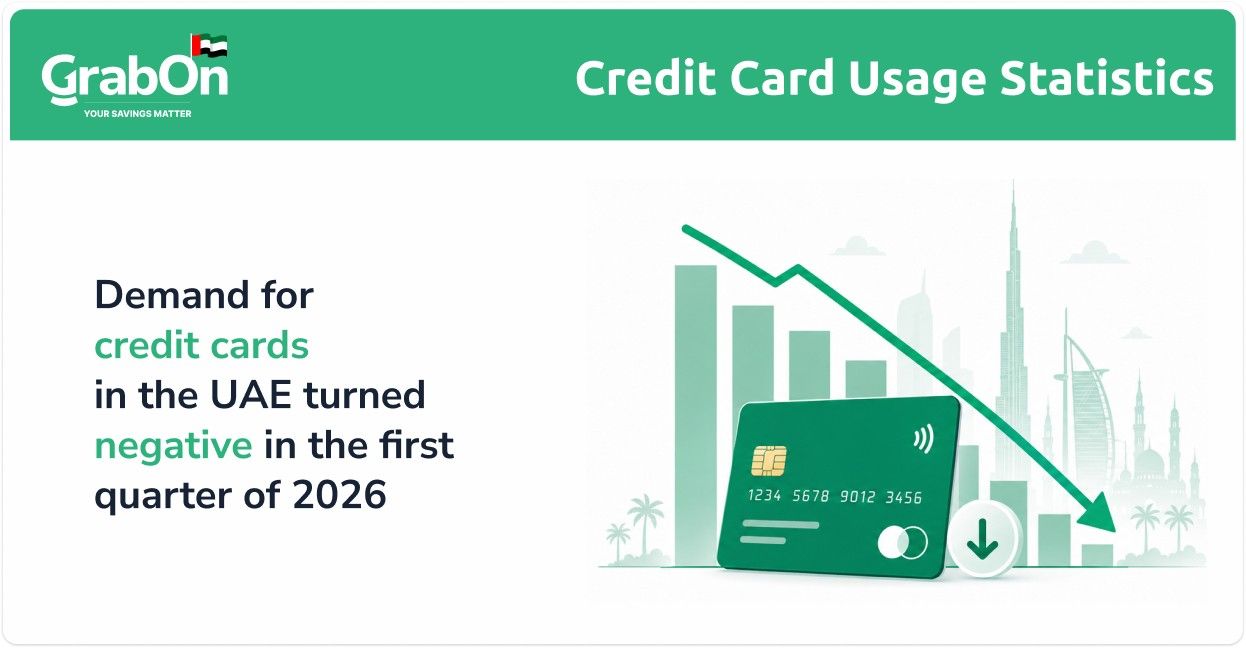
Demand for credit cards in the UAE turned negative in the first quarter of 2026. The net balance for credit card demand came in at -10.5 in Q1 2026, which means more banks reported a drop in demand than a rise. This is the weakest reading since Q2 2020, when the pandemic pushed the figure down to -48.1.
The fall is a sharp turn from where things stood just months earlier. In Q4 2025, credit card demand stood at +14.4, and in Q3 2025 it hit +25.3, one of the strongest readings in the survey’s history. Across 2025 as a whole, demand averaged +20.0, and 2023 was the strongest full year on record at +21.9.
Looking further back, credit card demand in the UAE has moved in clear cycles. The years 2014 to 2017 saw steady but modest positive demand. Demand then turned negative through 2018 as the market cooled. The pandemic year of 2020 brought the deepest fall on record. From 2021 onwards, demand recovered strongly and stayed high for four straight years, before the sudden reversal in early 2026.
Credit Card Demand by Quarter
| Quarter | Net Balance (Demand) |
| Q1 2026 | -10.5 |
| Q4 2025 | +14.4 |
| Q3 2025 | +25.3 |
| Q2 2025 | +17.3 |
| Q1 2025 | +22.8 |
| Q4 2024 | +20.1 |
| Q3 2024 | +20.1 |
| Q2 2024 | +17.2 |
| Q1 2024 | +19.4 |
| Q4 2023 | +13.6 |
| Q3 2023 | +22.3 |
| Q2 2023 | +19.5 |
| Q1 2023 | +32.2 |
Credit Card Demand by Year (Full History, Average of Quarters)
| Year | Average Net Balance |
| 2026 (Q1 only) | -10.5 |
| 2025 | +20.0 |
| 2024 | +19.2 |
| 2023 | +21.9 |
| 2022 | +13.8 |
| 2021 | +11.4 |
| 2020 | -8.9 |
| 2019 | +1.9 |
| 2018 | -4.6 |
| 2017 | +6.2 |
| 2016 | +6.7 |
| 2015 | +8.6 |
Notable single quarters: the strongest reading on record is Q1 2023 at +32.2. The weakest is Q2 2020 at -48.1, during the pandemic.
Banks’ Willingness to Issue Credit Cards
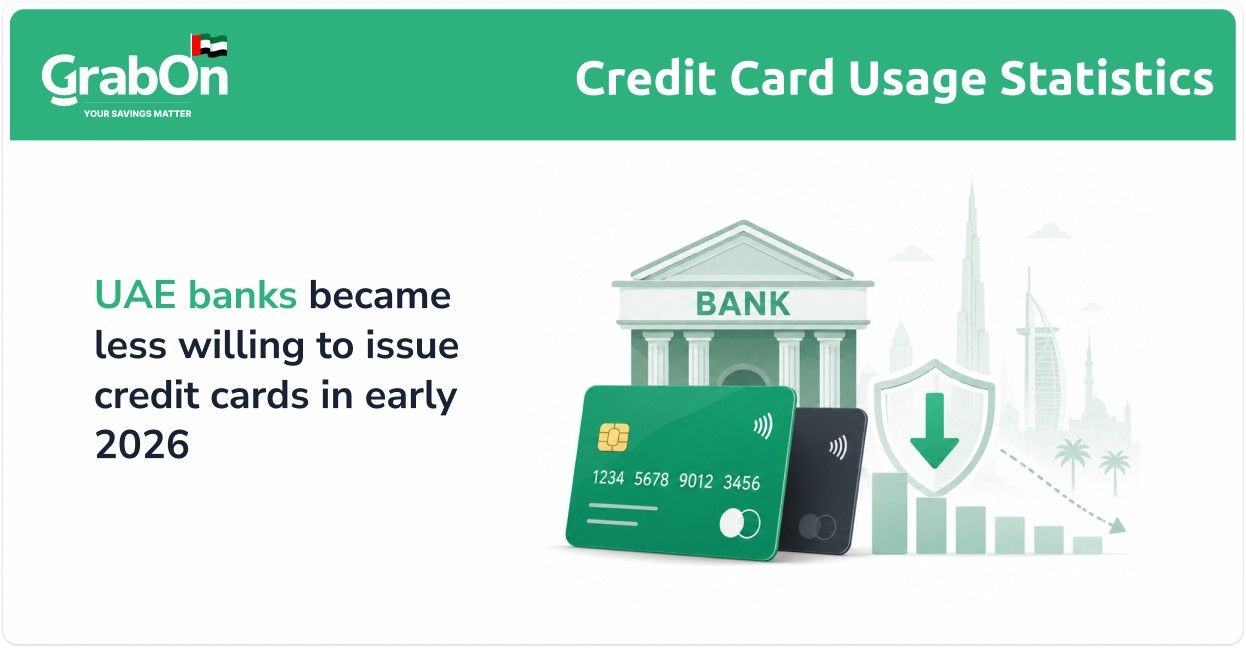
UAE banks became less willing to issue credit cards in early 2026. The net balance for banks’ appetite to extend credit cards fell to -4.5 in Q1 2026. This is the first negative reading since this measure was introduced in the survey in Q1 2022, meaning more banks tightened than loosened for the first time in four years.
This follows a long stretch of openness. In Q4 2025, appetite stood at +13.3, and through 2023 it ran above +19 in every quarter, peaking at +24.0 in Q3 2023. In simple terms, from 2022 to 2025 banks were consistently keen to put more cards in customers’ hands. That changed in the first quarter of 2026.
Banks’ Appetite to Issue Credit Cards by Quarter
| Quarter | Net Balance (Appetite) |
| Q1 2026 | -4.5 |
| Q4 2025 | +13.3 |
| Q3 2025 | +13.4 |
| Q2 2025 | +12.3 |
| Q1 2025 | +14.7 |
| Q4 2024 | +13.2 |
| Q3 2024 | +20.2 |
| Q2 2024 | +20.7 |
| Q1 2024 | +22.2 |
| Q4 2023 | +19.3 |
| Q3 2023 | +24.0 |
| Q2 2023 | +22.1 |
| Q1 2023 | +23.0 |
| Q4 2022 | +8.8 |
| Q3 2022 | +6.3 |
| Q2 2022 | +17.2 |
| Q1 2022 | +16.5 |
Source: Central Bank of the UAE.
Credit Cards Versus Debit Cards in the UAE
The UAE is a card country, but it is a debit card country first. There were 9,127,576 debit cards in circulation in 2023 against 4,706,279 credit cards. That is close to two debit cards for every credit card.
The gap has widened sharply over the past decade. In 2014 the ratio was about 1.46 debit cards per credit card. By 2023 it had reached 1.94. Debit cards nearly doubled over that period while credit cards grew by around 30%.
The main reason is the Wage Protection System. Employers in the UAE must pay salaries electronically through licensed institutions, which means almost every worker needs an account and gets a debit card with it. Credit cards, by contrast, require a minimum salary and a credit check, so a large part of the workforce is simply outside the credit card market.
This matters for how you read the rest of the data. When you see headlines about UAE card payments growing, most of that growth is debit, not credit.
Debit Cards Versus Credit Cards
| Year | Debit cards | Credit cards | Debit per credit card |
| 2023 | 9,127,576 | 4,706,279 | 1.94 |
| 2022 | 8,876,156 | 4,334,308 | 2.05 |
| 2021 | 8,292,101 | 4,053,192 | 2.05 |
| 2020 | 7,263,714 | 4,060,845 | 1.79 |
| 2019 | 7,403,183 | 4,194,351 | 1.77 |
| 2014 | 5,274,603 | 3,612,694 | 1.46 |
Source: IMF Financial Access Survey.
Share of Credit Cards in the UAE Payments System
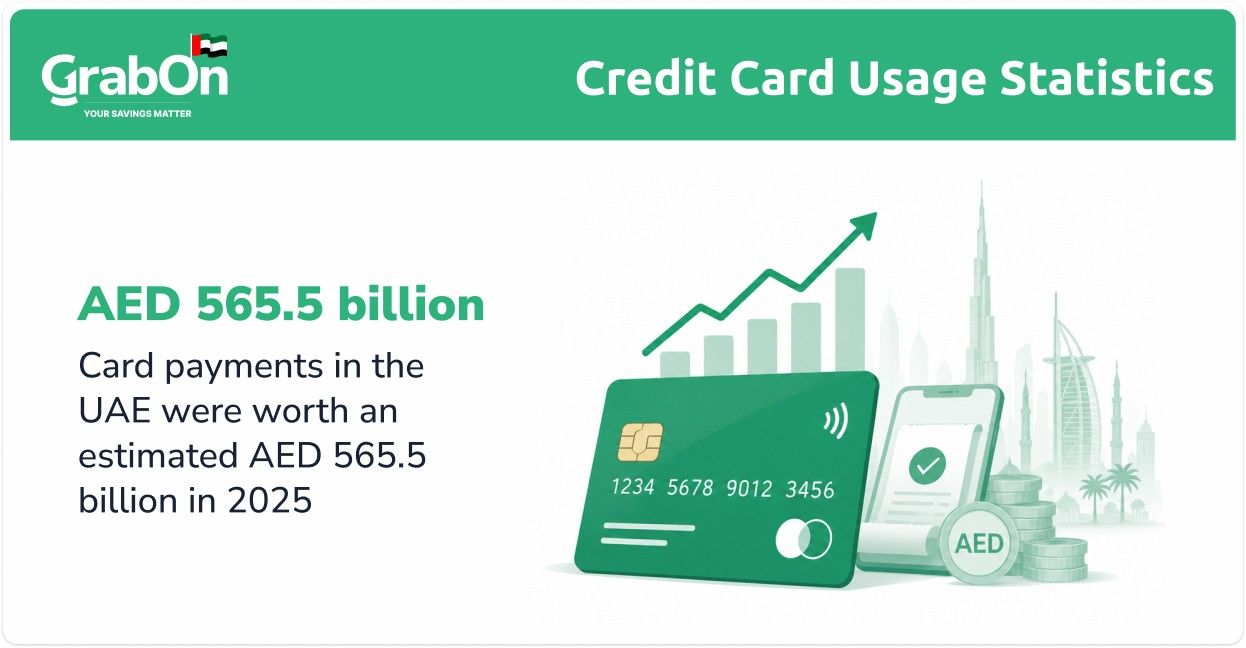
Card payments in the UAE were worth an estimated AED 565.5 billion in 2025, up 10.6% on the AED 511.4 billion recorded in 2024. Card payments had already grown 13.3% in 2024, 14.6% in 2023 and 17.7% in 2022. The market is forecast to reach AED 814.7 billion by 2029.
Within that total, credit cards are the smaller half. The clearest evidence comes from the domestic switch. UAESWITCH, which routes local card transactions, processed 560.7 million point-of-sale transactions in 2025. Of those, 522.6 million were on debit cards, and 38.1 million were on prepaid cards. Credit card transactions route through international schemes rather than the domestic switch, so they sit outside this count, but the scale of debit volume tells you where everyday spending sits.
The practical read is this. Credit cards in the UAE are used for larger, more considered purchases: travel, electronics, furniture, anything where rewards or instalment conversion matters. Debit cards carry the day-to-day volume of groceries, fuel and small retail.
UAE Card Payments Value
| Year | Value | Annual growth |
| 2029 (forecast) | AED 814.7bn | 9.6% CAGR from 2025 |
| 2025 (estimate) | AED 565.5bn | 10.6% |
| 2024 | AED 511.4bn | 13.3% |
| 2023 | AED 451.4bn | 14.6% |
| 2022 | Not stated | 17.7% |
Source: GlobalData, UAE Cards and Payments reports, Central Bank of the UAE.
Card Payments at Shops and ATMs in the UAE
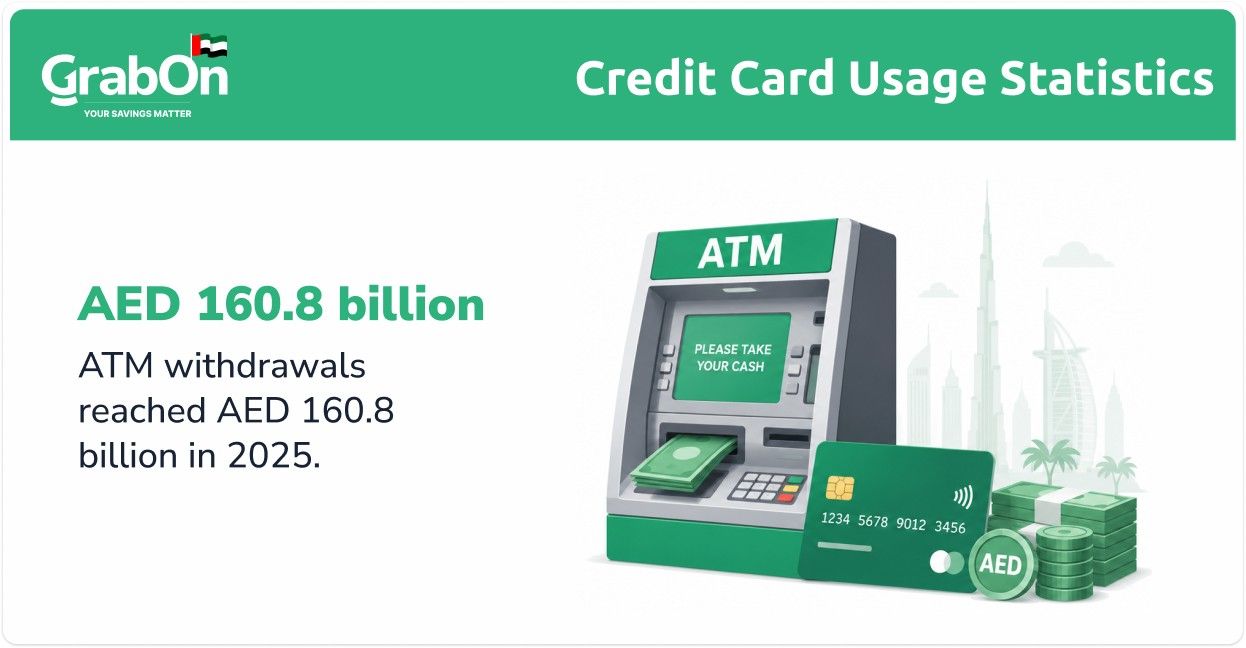
Card use in shops keeps growing while cash withdrawals grow more slowly. In 2025 the domestic switch handled 560.7 million point-of-sale transactions and 102.9 million ATM transactions.
ATM withdrawals reached AED 160.8 billion in 2025, up 7.99% in value and 9.05% in volume on 2024, when the figures were AED 148.9 billion across 94.3 million transactions. So cash is still being withdrawn in large amounts, but the growth is modest compared with the shift towards paying by card at the till.
Debit card transactions at point of sale rose 4% by count in 2025. Prepaid cards accounted for 38.1 million transactions, a segment driven heavily by wage cards and transport cards rather than by ordinary retail shoppers.
One number gives useful context for the size of the banked population. The Wage Protection System had 7.26 million registered employees in 2025, up from 6.06 million in 2024, with 79.5 million salary payments worth AED 409 billion processed during the year.
UAE Domestic Switch Activity
| Measure | 2025 | 2024 |
| POS transactions | 560.7 million | Not directly comparable |
| Of which debit cards | 522.6 million | Approx 502 million |
| Of which prepaid cards | 38.1 million | Not stated |
| ATM transactions | 102.9 million | 94.3 million |
| ATM value | AED 160.8bn | AED 148.9bn |
Source: Central Bank of the UAE. Note: The 2024 debit POS figure is derived from the reported 4% increase.
Credit Card Interest Rates in the UAE
UAE credit cards carry some of the highest interest rates you will find in a developed market. Rates are quoted monthly rather than annually, which makes them look smaller than they are.
Emirates NBD publishes monthly finance charges of 3.25% and 3.69% depending on the card and the customer, effective 5 March 2026. Annualised, that is 39% and 44.28%. United Arab Bank publishes 3.19% per month on its Titanium card, an annualised rate of 38.28%.
Two rules shape the real cost. First, if you settle the full statement balance by the due date, no finance charge applies on purchases. Cash advances are the exception and start accruing immediately. Second, the minimum payment is typically 5% of the balance or AED 100, whichever is greater, and paying only the minimum is expensive. Emirates NBD’s own worked example shows an AED 2,000 balance at 39.00% taking 32 months to clear on minimum payments, with roughly AED 1,200 of interest on top.
Some banks also apply a penalty uplift. Emirates NBD’s schedule raises the finance charge by 0.5% per month if the account has been past due at least twice in the last six months.
A note on a common myth. You will see claims online that the Central Bank caps credit card APR at 36%. Published bank Key Facts Statements show rates well above that, so treat that claim with caution.
Published Credit Card Rates at UAE Banks
| Bank | Monthly rate | Annualised rate |
| Emirates NBD (higher tier) | 3.69% | 44.28% |
| Emirates NBD (standard, and all UAE nationals) | 3.25% | 39.00% |
| United Arab Bank (Titanium) | 3.19% | 38.28% |
Source: Emirates NBD Key Facts Statement for credit cards, United Arab Bank Key Facts Statement, conventional credit cards.
Note: Rates vary by product and applicant, so always check the current Key Facts Statement.
Credit Cards in UAE Online Shopping
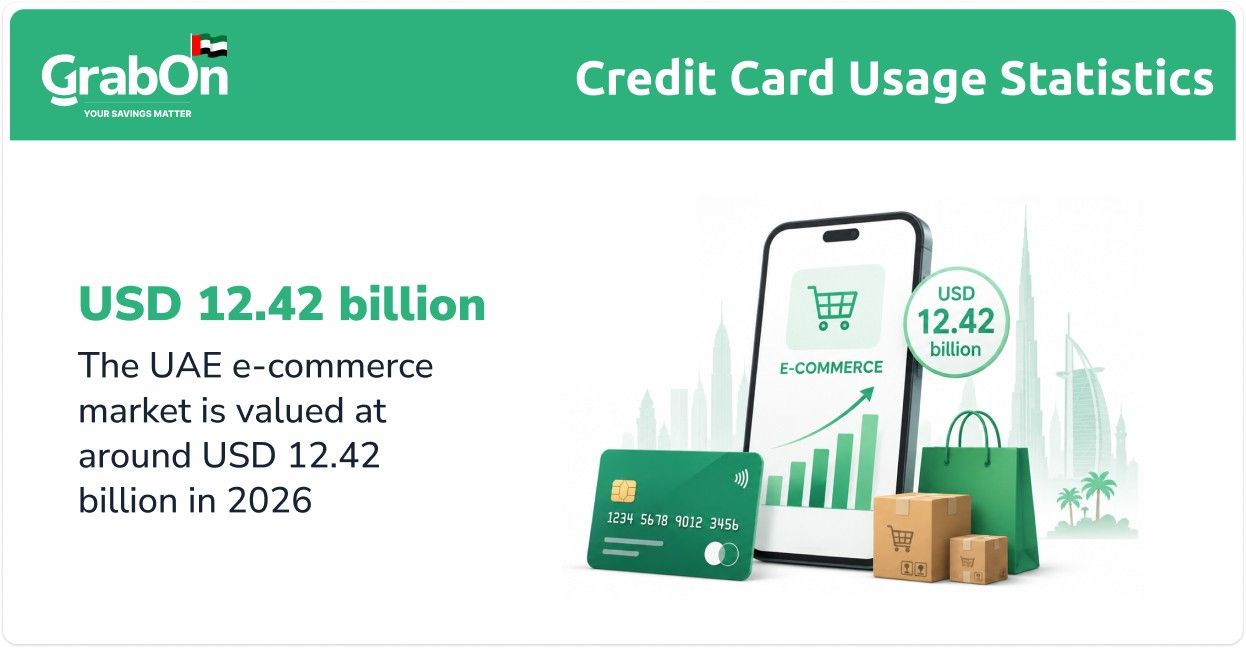
The UAE e-commerce market is valued at around USD 12.42 billion in 2026 and is forecast to reach roughly USD 20.5 billion by 2030, growing at about 11.3% a year.
Digital wallets have overtaken cards as the largest single payment method online in the UAE, taking roughly 44% of e-commerce transaction value in 2025. Cards remain almost universally accepted, and a very large share of those wallet payments are themselves funded by a card sitting behind Apple Pay, Google Pay or Samsung Pay.
Cash on delivery is still present but shrinking. It survives mainly among first-time buyers and in lower-value categories.
For credit cards specifically, online is where the product competes hardest. Rewards, cashback, purchase protection and instalment conversion at checkout are all reasons a UAE shopper reaches for a credit card rather than a debit card on a large online purchase.
Source: Mordor Intelligence, United Arab Emirates E-commerce Market report.
Buy Now, Pay Later Is Competing With Credit Cards
Buy now, pay later has become the most direct competitor to the UAE credit card, especially for younger shoppers.
The UAE BNPL market was valued at around USD 1.17 billion in 2025 and is forecast to reach about USD 3.92 billion by 2031. Other estimates put the 2025 figure higher, at close to USD 2.84 billion, so the range is wide, but every source agrees on rapid growth.
The market is concentrated. Tabby and Tamara dominate, with Tabby reporting more than 15 million users and over 40,000 merchants across Saudi Arabia, the UAE and Kuwait after a USD 160 million funding round in February 2025 valued it at USD 3.3 billion. Spotii, Cashew and Postpay make up much of the rest.
Two things have changed recently. First, BNPL has moved from being an online-only add-on to a standard in-store option, which puts it in direct competition with a card at the till. Second, UAE banks have stopped treating it as someone else’s business. Emirates NBD, FAB and RAKBANK now push card-linked instalment conversion and pre-approved credit, which is BNPL delivered through a credit card.
The Central Bank brought BNPL providers into a licensing framework in 2023, which raised barriers to entry and concentrated the market among licensed players.
Source: ResearchAndMarkets, Central Bank of the UAE.
What All of This Means for the Q1 2026 Slowdown
The Credit Sentiment Survey shows credit card demand turning negative in the first quarter of 2026, at a net balance of minus 10.5, with banks’ willingness to issue cards also turning negative for the first time since the measure began. The volume data above helps explain why that is more than a blip.
Three pressures are stacking up at once.
The first is competition from BNPL. A shopper who would have put an AED 1,500 purchase on a credit card in 2022 now has a free, four-instalment alternative at the same checkout, and increasingly at the physical till too.
The second is competition from debit and wallets. Debit cards now outnumber credit cards nearly two to one, and digital wallets have overtaken cards as the largest single online payment method. Both take volume that would once have defaulted to a credit card.
The third is cost. At 39% to 44% annualised, UAE credit card interest is expensive by any standard. When an interest-free instalment plan sits next to it, revolving a balance becomes a harder sell.
None of this means credit cards are shrinking. Card lending still grew 14.7 % in 2024 and retail credit grew 16.2% in 2025. It means the credit card is becoming a more specialised product in the UAE, used for rewards, travel and larger purchases, while everyday spending moves elsewhere.
Source: Central Bank of the UAE, Credit Sentiment Survey.
Credit Card Application Rejections in the UAE
Credit card rejections in the UAE were flat in Q1 2026. The net balance for the share of rejected credit card applications came in at 0.0, meaning as many banks reported rejecting more applications as reported rejecting fewer.
Rejection levels have stayed fairly stable over the past four years. The highest reading was Q2 2023 at +12.4, when banks were turning away noticeably more applicants. The lowest was Q4 2022 at -5.0, when approvals were getting easier. Most quarters have sat in a narrow band close to zero, showing that banks have not sharply changed how strict they are with card applications.
Rejected Credit Card Applications by Quarter
| Quarter | Net Balance (Rejections) |
| Q1 2026 | 0.0 |
| Q4 2025 | +1.7 |
| Q3 2025 | +3.6 |
| Q2 2025 | -1.9 |
| Q1 2025 | +5.8 |
| Q4 2024 | +8.5 |
| Q3 2024 | +0.5 |
| Q2 2024 | -0.5 |
| Q1 2024 | +5.8 |
| Q4 2023 | +3.5 |
| Q3 2023 | +8.4 |
| Q2 2023 | +12.4 |
| Q1 2023 | -0.6 |
| Q4 2022 | -5.0 |
| Q3 2022 | -0.5 |
| Q2 2022 | +5.8 |
| Q1 2022 | -1.0 |
Note: a positive number means more banks rejected a bigger share of applications. It does not give the actual rejection rate.
What Banks Expect for Credit Card Demand
For the first time in nearly six years, UAE banks expect credit card demand to fall in the coming quarter. The expected demand reading for Q2 2026 came in at -5.8. The last negative expectation was in mid 2020, during the pandemic.
This is a big shift in mood. Just one quarter earlier, in Q4 2025, banks expected demand to keep rising at +32.6, close to the record. Through 2023, 2024 and 2025, banks were consistently optimistic, with expected demand readings regularly above +30. The record high for this measure is +35.7, set in Q1 2024.
Expected Credit Card Demand (Next Quarter) by Quarter
| Survey Quarter | Expected Demand (Net Balance) |
| Q1 2026 | -5.8 |
| Q4 2025 | +32.6 |
| Q3 2025 | +30.5 |
| Q2 2025 | +23.1 |
| Q1 2025 | +33.5 |
| Q4 2024 | +29.8 |
| Q3 2024 | +34.6 |
| Q2 2024 | +21.1 |
| Q1 2024 | +35.7 |
| Q4 2023 | +34.6 |
| Q3 2023 | +33.7 |
| Q2 2023 | +27.4 |
| Q1 2023 | +28.3 |
What Banks Expect for Credit Card Issuance
UAE banks also expect to pull back on issuing credit cards. The expected appetite reading for the next quarter came in at -6.4 in Q1 2026, the first negative figure since this measure began in Q1 2022.
Until this quarter, banks had planned to keep expanding card issuance every single quarter. Expected appetite stood at +27.3 in Q4 2025 and peaked at +29.8 in Q3 2023. The Q1 2026 reading marks a clear change of plan across the banking sector, with both demand expectations and issuance plans turning negative at the same time.
Expected Appetite to Issue Credit Cards (Next Quarter) by Quarter
| Survey Quarter | Expected Appetite (Net Balance) |
| Q1 2026 | -6.4 |
| Q4 2025 | +27.3 |
| Q3 2025 | +22.0 |
| Q2 2025 | +18.2 |
| Q1 2025 | +25.6 |
| Q4 2024 | +21.8 |
| Q3 2024 | +19.5 |
| Q2 2024 | +22.7 |
| Q1 2024 | +26.0 |
| Q4 2023 | +29.0 |
| Q3 2023 | +29.8 |
| Q2 2023 | +28.8 |
| Q1 2023 | +26.1 |
| Q4 2022 | +12.4 |
| Q3 2022 | +9.5 |
| Q2 2022 | +12.6 |
| Q1 2022 | +17.5 |
Quick Facts From This Post
- Credit card demand in the UAE fell to a net balance of -10.5 in Q1 2026, the weakest since the pandemic quarter of Q2 2020 (-48.1).
- Q3 2025 recorded one of the strongest demand readings ever at +25.3, so the swing to negative happened within two quarters.
- 2023 was the best full year for credit card demand since the survey began in 2014, averaging +21.9.
- Banks’ willingness to issue cards turned negative (-4.5) in Q1 2026 for the first time since the measure began in 2022.
- Banks’ expectations for next-quarter card demand swung from +32.6 to -5.8 in a single quarter, the sharpest mood reversal in the survey’s history.
- Credit card application rejections have stayed broadly stable since 2022, mostly hovering near zero.
- The survey is run quarterly by the Central Bank of the UAE and has covered credit cards since Q2 2014.

I go the core of any topic and combine the best so that users don’t have to look elsewhere once they are on my blog.