


The Filipino community is one of the largest expatriate groups in the UAE. As of 2026, an estimated 780,000 Filipinos live across the seven emirates, making up roughly 6.8% of the UAE’s total population of approximately 11.5 million.
Within Dubai alone, around 450,000 Filipinos reside, representing about 21.3% of the emirate’s population. This makes Filipinos the fourth-largest nationality group in the UAE, behind Indians, Pakistanis, and Bangladeshis.
The UAE is the second-largest employer of overseas Filipino workers (OFWs) globally, after Saudi Arabia. The community has grown steadily over the past five decades, driven by the UAE’s tax-free salaries, strong job market, and friendly visa policies.
This article covers the Filipino population in the UAE as of 2026, including population trends, gender and age demographics, top employment sectors, salary data, remittance flows, and residential distribution across the emirates.
Top Picks From The Report
- Around 780,000 Filipinos live in the UAE as of 2026, forming 6.8% of the total population.
- 450,000 of them are based in Dubai alone, making up 21.3% of Dubai’s population.
- The UAE is the second-largest destination for OFWs worldwide, after Saudi Arabia.
- Construction and engineering is the top employment sector for Filipinos in the UAE at 17%.
- 75% of Filipinos in the UAE earn more than AED 5,000 per month.
- OFW remittances globally hit a record $35.63 billion in 2025, with the UAE among the top sources.
- Filipino domestic workers in the Gulf received their first minimum wage hike in nearly 20 years in October 2025, rising from $400 to $500 per month.
Filipino Population in the UAE (2026)
| Metric | Value |
| Total Filipinos in the UAE | 780,000 |
| Share of the UAE total population | 6.8% |
| Filipinos in Dubai | 450,000 |
| Share of Dubai’s population | 21.3% |
| UAE total population (2026) | 11.5 million |
| Dubai population (2026) | 4.6 million |
| Rank among UAE expat groups | 4th (after India, Pakistan, Bangladesh) |
Filipinos are the fourth-largest nationality group in the UAE. Indians lead with approximately 4.39 million residents (37.96%), followed by Pakistanis at 1.94 million (16.72%) and Bangladeshis at 840,000 (7.38%).
The Filipino community of 780,000 accounts for 6.89% of the country’s population. Iranians (540,000), Egyptians (480,000), Nepalese and Sri Lankans (360,000 each) follow.
Dubai hosts the largest concentration, with roughly 58% of all Filipinos in the UAE living in the emirate. Abu Dhabi and Sharjah account for the majority of the remaining population.
Filipino Population in the UAE Over The Years
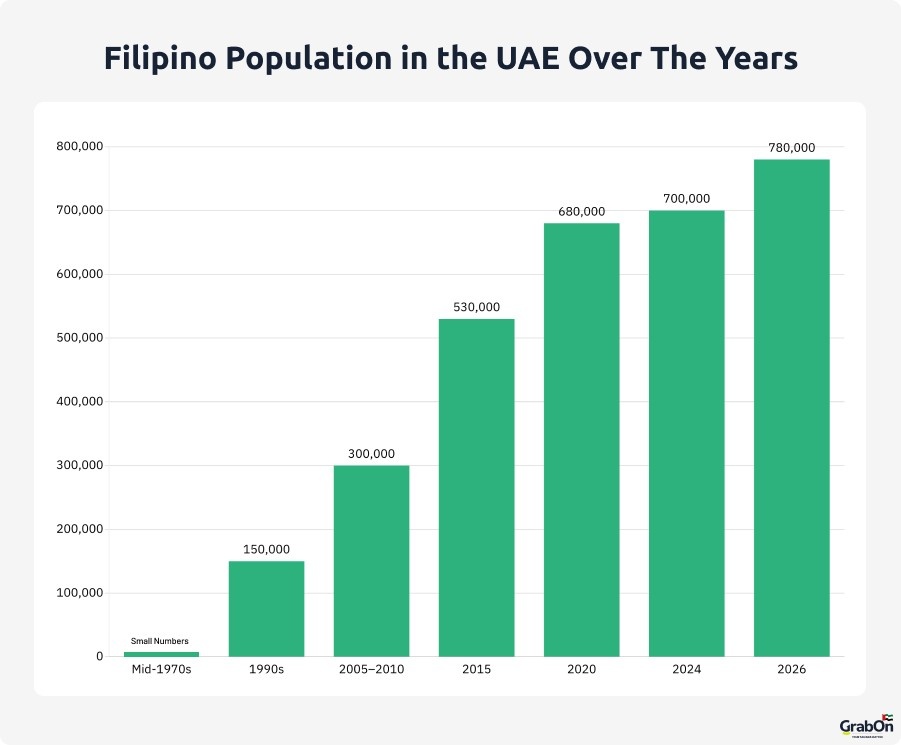
| Period | Estimated Filipino Population | Key Driver |
| Mid-1970s | Small numbers | Early oil boom; initial labour migration begins |
| 1990s | 150,000 | Construction boom; Philippines institutionalises overseas deployment |
| 2005–2010 | 300,000 | Major infrastructure projects (Dubai Metro, Burj Khalifa era) |
| 2015 | 530,000 | Expo 2020 preparation; service sector expansion |
| 2020 | 680,000 | COVID-19 slowdown; some temporary departures |
| 2024 | 700,000 | Post-pandemic recovery; new visa categories |
| 2026 | 780,000 | Sustained economic growth; long-term visa options |
Filipino migration to the UAE started in the mid-1970s, coinciding with the UAE’s oil-fuelled economic expansion and the Philippines’ Labour Code of 1974, which formalised overseas worker deployment.
Growth accelerated significantly in the 2000s during Dubai’s infrastructure boom. Large projects in construction, hospitality, and free zones attracted skilled and semi-skilled Filipino workers in large numbers.
The community saw a brief slowdown during 2020–2021 due to COVID-19 travel restrictions, but recovered quickly post-2021 as economic activity resumed and new visa categories, including the golden visa and remote work visa, made longer stays more accessible.
Filipino Workers in the UAE By Employment Sector
| Sector | Share of Filipino Workers |
| Architecture, Engineering & Construction | 17% |
| Tourism & Hospitality | 16% |
| Customer Service | 13% |
| Healthcare | 10% |
| Domestic Work | 29% |
| Retail, IT, Finance & Other | 15% |
Architecture, engineering, and construction is the top sector employing Filipinos in the UAE, accounting for 17% of Filipino-held jobs. Roles include labourers, welders, electricians, and site supervisors working on the UAE’s ongoing infrastructure projects.
Tourism and hospitality follow at 16%. Filipinos hold positions as hotel staff, waiters, front-desk personnel, and tour operators, supported by the UAE’s position as a global tourism hub.
Customer service employs 13% of Filipino workers. The community is well-regarded for English proficiency and service orientation, which makes them a preferred hire in call centres and retail support roles.
Healthcare accounts for 10%. Filipino nurses, medical technicians, and care workers form a significant share of the UAE’s healthcare workforce. This sector continues to grow as the UAE expands its hospital and clinic network.
Domestic work remains a major employment category. Over 200,000 Filipino domestic workers are employed in the UAE, handling household duties including cleaning, childcare, and elderly care. This group is predominantly female.
Gender Split of Filipinos in the UAE
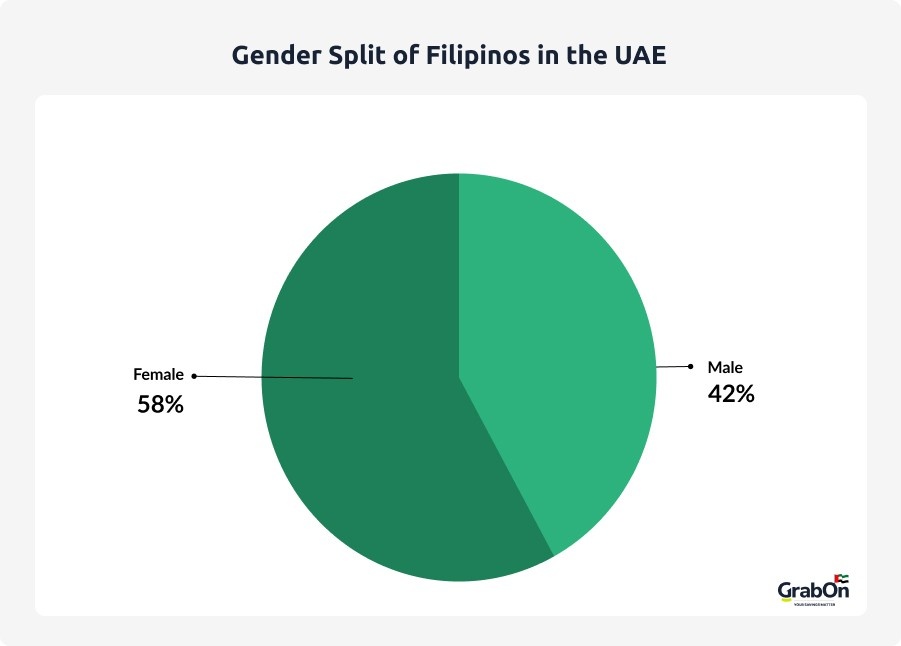
| Gender | Estimated Share |
| Female | 58% |
| Male | 42% |
The gender composition of Filipinos in the UAE is notably different from the overall UAE population, where men make up around 70%. Among Filipino OFWs globally, women constitute approximately 57.2% of all overseas workers as of 2024, according to the Philippine Statistics Authority.
This female-majority split is driven by high demand for Filipinas in domestic work, caregiving, healthcare, and hospitality. Among female Filipino OFWs globally, 68.4% are engaged in elementary occupations (household work, cleaning, caregiving), followed by 12.5% in service and sales roles.
Among male Filipino OFWs, the most common occupation is plant and machine operations (32.8%), followed by craft and trades (14.8%) and service and sales roles.
The UAE is a particularly significant destination for Filipina workers. Data from 2023 shows that 15.9% of all female OFWs globally were deployed to the UAE, making it the second-largest destination for Filipina workers after Saudi Arabia (21.6%).
Age Profile of Filipinos in the UAE
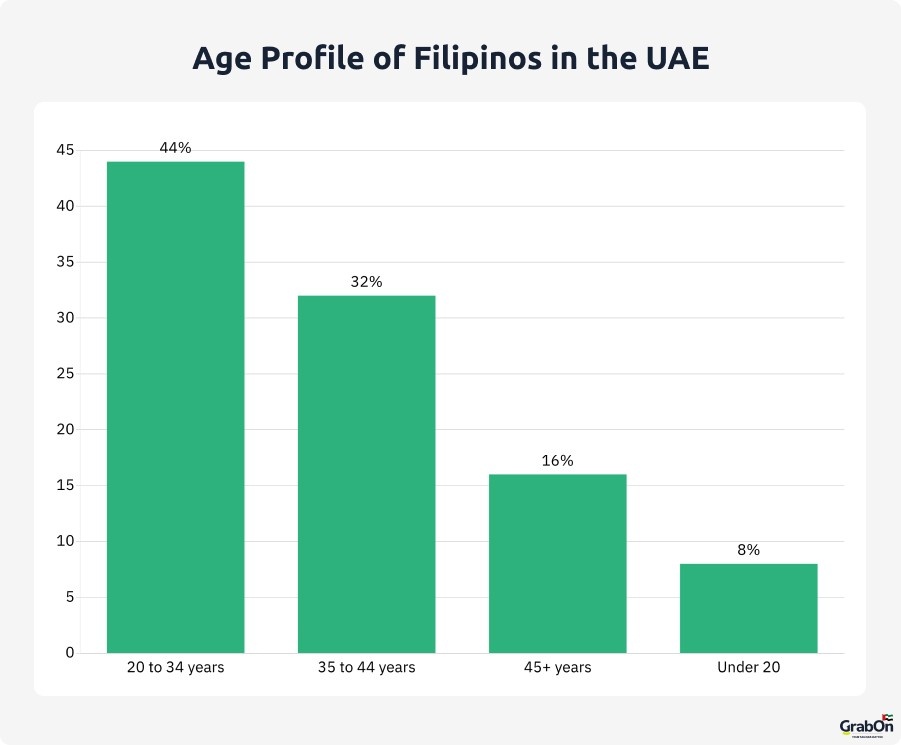
| Age Group | Estimated Share |
| 20 to 34 years | 44% |
| 35 to 44 years | 32% |
| 45+ years | 16% |
| Under 20 | 8% |
The age profile of Filipinos in the UAE skews heavily toward working-age adults, similar to Dubai’s overall age structure where 73% of residents are between 20 and 49.
Philippine Statistics Authority data for 2024 shows that the 30–34 age group is the single largest segment among all OFWs (21.3%), followed by those aged 35–39 (19.2%) and 45+ (25.8%). The 45+ share has been growing, indicating longer overseas careers.
The relatively small under-20 share reflects the fact that most Filipinos come to the UAE as working professionals, often leaving families behind. However, a growing segment of Filipino families are settling long-term, supported by new visa categories and approximately 8–10 Philippine-curriculum schools operating across Dubai, Abu Dhabi, and Sharjah.
Salary and Income Trends
| Income Bracket (Monthly) | Share of Filipinos in UAE |
| Above AED 5,000 | 75% |
| AED 5,001 to AED 10,000 | 56% |
| AED 10,000 to AED 40,000 | 20% |
| Below AED 5,000 | 25% |
Three-quarters of Filipinos in the UAE earn above AED 5,000 per month. The majority (56%) fall in the AED 5,001–10,000 bracket, which covers mid-level positions in hospitality, customer service, and technical trades.
One in five Filipinos reports earning between AED 10,000 and AED 40,000 per month. This group includes healthcare professionals, engineers, IT specialists, and mid-to-senior management roles.
Over the past five years, 63% of Filipinos in the UAE reported receiving salary increases, reflecting the broader post-pandemic economic recovery and tightening labour market.
A notable development in October 2025 was the first minimum wage increase for Filipino domestic workers in nearly 20 years. The Philippine Ministry of Migrant Workers raised the minimum monthly salary from $400 to $500 (approximately AED 1,835), applicable to both new recruits and returning workers.
Among the Filipino workforce, 64% are university or college graduates and 6.7% hold postgraduate degrees, indicating a relatively well-educated community.
Remittances: Economic Impact
| Metric | Value |
| Total OFW cash remittances (2025) | $35.63 billion (record high) |
| Year-on-year growth (2025 vs 2024) | 3.3% |
| Remittances as % of Philippine GDP | 7.3% |
| Remittances as % of Gross National Income | 6.4% |
| UAE rank as remittance source | Top 6 (after US, Singapore, Saudi Arabia, Japan, UK) |
| Filipino remittances from UAE (est.) | $1.5 billion annually |
Remittances from overseas Filipinos hit a record $35.63 billion in 2025, up 3.3% from $34.49 billion in 2024. This money powers a significant share of the Philippine economy, accounting for 7.3% of GDP.
The UAE is consistently among the top six sources of OFW remittances globally. The United States leads at approximately 40% of total flows, followed by Singapore, Saudi Arabia, Japan, the United Kingdom, and the UAE.
December 2025 saw the single highest monthly remittance on record at $3.52 billion, driven by Christmas-season sending patterns.
The Philippines ranks as the world’s fourth-largest remittance recipient, behind India ($135 billion), Mexico ($66 billion), and China ($50 billion). The UAE-Philippines remittance corridor is also noted for being among the least expensive in the region for transfer fees.
Where Filipinos Live in the UAE
Dubai
| Area | Key Characteristics |
| Bur Dubai | Oldest Pinoy hub; Filipino restaurants, shops, community centres |
| Al Karama | Affordable housing; close to metro; budget-friendly dining |
| Al Satwa | Cultural diversity; sari-sari stores; hosts annual Pinoy Fiesta |
| Deira / Al Rigga | Close to Dubai Creek; metro connected; remittance centres |
| Al Nahda | Family-friendly; affordable apartments |
| International City | Low rents; growing Filipino presence |
| Al Qusais | Affordable residential area; good transport links |
| Al Quoz | Industrial and residential mix; labour accommodation |
Bur Dubai is the oldest and most established Filipino neighbourhood in the emirate. It is home to numerous Filipino restaurants, retail shops, and community centres.
Al Satwa is known for its annual Pinoy Fiesta, a street event celebrating Filipino culture through food, music, and dance. The neighbourhood has a high density of Filipino-owned small businesses.
Al Karama and Al Rigga offer affordable rents and strong metro connectivity, making them popular with Filipino workers who rely on public transport.
Abu Dhabi
Popular areas include Al Mushrif, Al Khalidiya, and Khalifa City. Many Filipinos in Abu Dhabi work in government services, healthcare, and aviation.
Sharjah
Al Nahda, Al Majaz, and Al Yarmook are the main Filipino residential clusters. Sharjah appeals to Filipino families due to lower rents and a family-friendly atmosphere.
Filipino Schools in the UAE
Around 10 schools across the UAE follow the Philippine K-12 Basic Education Curriculum. These schools cater to Filipino families who want their children to maintain continuity with the Philippine education system for an easier transition if they return home.
The Philippine School Dubai enrolls approximately 2,300–2,500 students from KG1 to Grade 12. UIPS Dubai, established in 1992, was the first Philippine school in the UAE.
These schools offer instruction in Filipino and English, alongside mandatory UAE subjects including Arabic Studies, Islamic Education, Moral Education, and Social Studies as required by the UAE Ministry of Education.
Community and Cultural Life
The Filipino community in the UAE is supported by a dense network of organisations, religious institutions, and cultural events that function as informal social infrastructure for a population far from home.
The Filipino Social Club (FilSoc), licensed by Dubai’s Community Development Authority (CDA) in 2019, is the first and only government-regulated non-profit organisation for the Filipino community in Dubai. It coordinates community programmes including sports tournaments, recognition awards, and the annual Philippine Independence Day celebrations. Beyond FilSoc, the Philippine Consulate General in Dubai has historically recognised over 100 Filipino community organisations covering regional associations, professional groups, and cultural clubs.
St. Mary’s Catholic Church in Bur Dubai serves as a central gathering point. With over 350,000 registered parishioners, it is one of the largest Catholic parishes in the world, and Filipinos make up a significant share of its congregation. Masses are held in Filipino alongside Arabic, English, Malayalam, and other languages throughout the week.
The flagship cultural event is Kalayaan, the annual Philippine Independence Day celebration held at the Dubai World Trade Centre. In June 2026, the event drew an estimated 60,000 attendees across a 12-hour programme of performances, cultural showcases, fashion shows, esports, and food stalls. UAE Minister of Tolerance and Coexistence Sheikh Nahyan bin Mubarak Al Nahyan attended the 2026 edition, describing the Filipino community as an essential part of the UAE’s success. The event is free, open to all nationalities, and is recognised as the largest Philippine Independence Day celebration in the Middle East.
Filipino-focused media also has a notable presence. The Filipino Times, a Dubai-based publication, reaches readers in over 236 countries and serves as the primary news source for OFW communities in the Gulf. Dubai OFW and The Global Filipino Magazine provide additional digital coverage of community news, employment updates, and policy changes affecting Filipino workers.
Source: Philippine Consulate General Dubai, Filipino Social Club, St. Mary’s Catholic Church Dubai, Gulf News, The Filipino Times, Expatmedia.net.
Key Diplomatic and Policy Milestones
| Year | Milestone |
| 1974 | The Philippines enacts the Labour Code, formalising overseas worker deployment |
| 1976 | UAE-Philippines diplomatic relations established |
| 2006 | Minimum salary for Filipino domestic workers set at $400/month |
| 2021 | UAE enacts Federal Decree-Law No. 33 (new Labour Law) |
| 2025 | First domestic worker minimum wage hike in 20 years ($400 to $500) |
| 2026 | 50th anniversary of UAE-Philippines diplomatic relations |
The year 2026 marks the 50th anniversary of diplomatic ties between the Philippines and the UAE. The relationship has deepened over the decades, with bilateral agreements on labour protection, cultural exchange, and trade.
The UAE’s 2021 Labour Law strengthened protections for all private-sector workers, including requirements for written employment contracts approved by the Ministry of Human Resources and Emiratisation (MOHRE) and salary payments through the Wage Protection System.
The October 2025 domestic worker wage increase was a landmark policy change, addressing nearly two decades of stagnant minimum pay that had been eroded by inflation.

I go the core of any topic and combine the best so that users don’t have to look elsewhere once they are on my blog.