
White Friday is the Middle East’s version of Black Friday, and in the UAE, this year’s edition falls on November 27, 2026. The scale of the event has grown sharply in recent years: shopping app installs rose 38% year over year in 2025, and average spending in the UAE was 2.7 times the MENA average during the sale period. These numbers indicate that White Friday has morphed from a one-day sale to a full-fledged shopping event, embraced by both shoppers and retailers. The following breakdown covers how the UAE shops during White Friday and what the numbers suggest for the year ahead.
Key Stats: White Friday UAE at a Glance
- App installs across the UAE increased 38% YoY on both Android and iOS.
- Buyers in the UAE spent 2.7 times more than the MENA average during White Friday.
- White Friday total conversions jumped 68% overall, fueled by a massive 95% surge on iOS, more than double Android’s 45% increase.
- Average order value (AOV) in the UAE climbed from $95 (AED 349) to $103 (AED 378) during White Friday.
- 61% of shoppers across the GCC now choose Buy Now, Pay Later over cash or card at checkout.
- UAE shoppers favored loyalty perks over discount codes, with cashback programs capturing 21% of purchases versus 14% for coupons.
- 84% of shoppers intend to use AI-driven shopping tools this year.
When Is White Friday in the UAE? (Past 5 Years + Next 5 Years)
White Friday always falls on the same date as Black Friday, the day after US Thanksgiving, which is the fourth Thursday of November. Retailers across the UAE have kept that same date every year, even though the sale period itself often stretches into a full week or longer around it.
White Friday 2026 falls on Friday, November 27.
| Year | White Friday Date |
| 2021 | November 26 |
| 2022 | November 25 |
| 2023 | November 24 |
| 2024 | November 29 |
| 2025 | November 28 |
| 2026 | November 27 |
| 2027 | November 26 |
| 2028 | November 24 |
| 2029 | November 23 |
| 2030 | November 29 |
History of White Friday in the UAE
White Friday began in 2014, when Souq.com, now Amazon.ae, introduced it to the region as a localized alternative to Black Friday. Ronaldo Mouchawar, the company’s founder, led the rebrand, adapting a US retail tradition into something that fit regional sensibilities rather than importing it unchanged.
Why “White” instead of “Black”
The naming shift was deliberate. In Arab and Islamic culture, black can carry negative associations, while white represents purity and positivity. Friday also holds religious weight in Islam as a day of communal prayer, so a name tied to celebration fit the day better than one borrowed directly from the US calendar. The choice worked: competitors adopted similar naming conventions, including noon’s “Yellow Friday,” before White Friday became the standard term across the region.
From a single day to a multi-week event
The earliest editions ran closer to the American model. It was a short, high-intensity sales window tied to a single date. By 2018, retailers including Souq.com and noon.com had already extended their campaigns into multiple days. That pattern has continued to expand: modern White Friday campaigns start promoting offers 1 to 4 weeks ahead of the date itself, turning what began as a single-day sale into a month-long retail season across the UAE.
UAE Shopping App Behavior During White Friday
During White Friday, consumer shopping in the UAE shifts towards high-intent mobile browsing and early deal exploration. Shoppers prefer shopping on mobile apps for a better experience, wherein they can explore better, shop easily, and apply deals or offers without any hitch.
App installs jumped 38% year over year
Shopping app installs across the UAE rose 38% YoY in 2025, with growth recorded on both Android and iOS. The increase reflects how much of White Friday activity now happens through mobile apps rather than desktop browsing or in-store visits, a shift that has been building steadily as UAE retailers invest more heavily in app-based loyalty and shopping experiences.
Conversions surged 68%, led by iOS
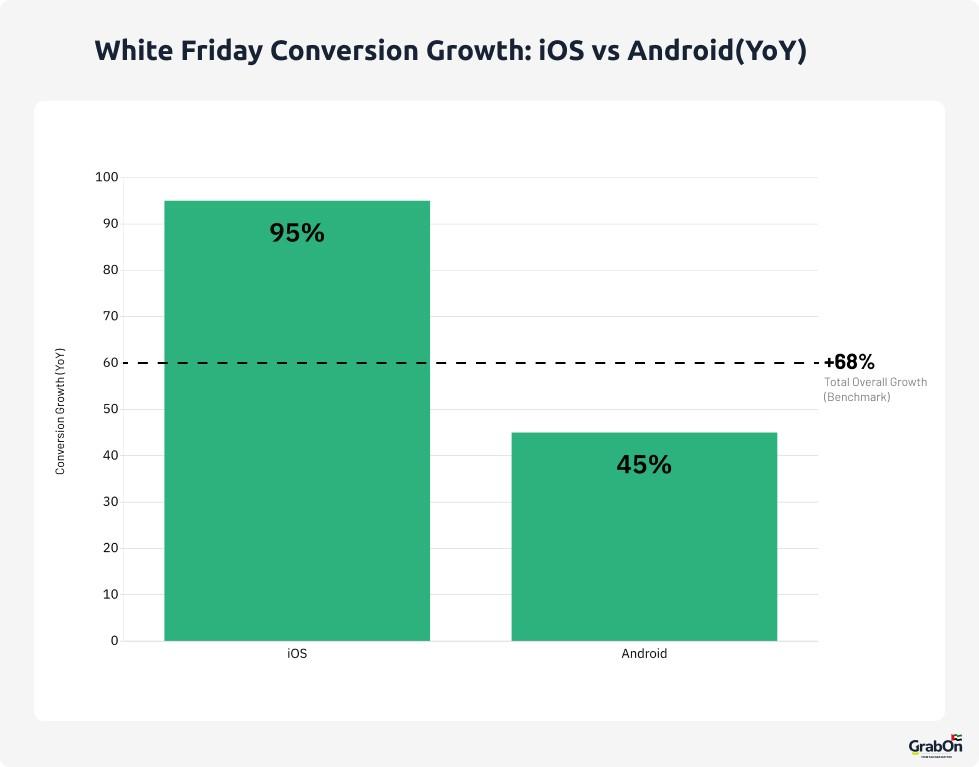
Total conversions climbed 68% during the White Friday, but the growth wasn’t even across platforms. iOS conversions rose 95%, more than double the 45% increase recorded on Android. The gap suggests iOS users in the UAE convert at a notably higher rate once they’re in-app, which matters for how retailers prioritize ad spend and app experience investment across platforms.
In-app purchases and ad spend climbed too
In-app purchase volume rose 10% YoY while in-app purchase revenue increased 22% on Android and 21% on iOS compared to the day before White Friday. The share of paying users grew as well, up 28% on Android and 11% on iOS, and advertisers responded accordingly, with delivered ad spend rising 21% on Android and 18% on iOS.
Source: Khaleej Times (based on report from AppsFlyer)
Spending Power Of UAE Consumers During White Friday
Average spending in the UAE during White Friday reached 2.7 times the wider MENA average, driven by a meaningful jump in average order value (AOV). The number of orders increased by 20% in the MENA region during the White Friday window.
| Market | AOV Before | AOV During White Friday |
| MENA (regional average) | $33.5 (AED 123) | $38 (AED 140) |
| UAE | $95 (AED 349) | $103 (AED 378) |
The UAE’s baseline AOV was already close to three times the regional figure before White Friday even began, and the gap held steady through the sale period rather than narrowing.
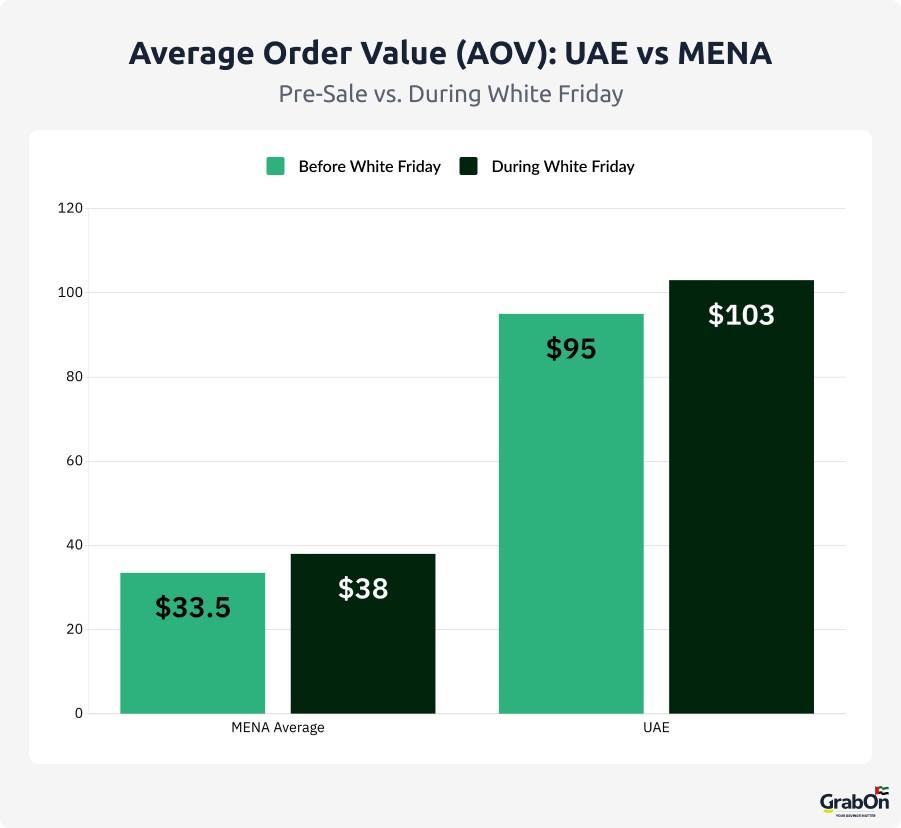
This shows that in the UAE market, higher spending isn’t just an event-driven spike; it reflects the UAE’s higher disposable income and cost of living standards relative to the MENA region. For retailers and marketers, it signals that UAE campaigns can be priced and positioned differently from pan-regional MENA campaigns without losing conversion volume.
Source: Gulf News, Flowwow/Admitad research cited by Adgully
What UAE Consumers Are Actually Buying
Category-level data from White Friday last year shows a clear pattern: growth is concentrated in everyday categories tied to daily life rather than impulse-driven purchases.
Everyday-life categories led growth
Electronics led category spending with a 22% increase, followed closely by fashion at 21% and home and garden purchases at 18%. These three categories point to a pattern of practical buying rather than one-time unplanned purchases confined to the sale window.
The steady-growth categories included toys and hobbies
A second tier of categories posted more modest but still notable gains: toys and hobbies (6.5%), automobiles, parts and accessories (6%), children’s goods (5.5%), beauty and health (5.4%), and sports and entertainment (5%).
| Category | YoY Growth |
| Electronics | 22% |
| Fashion | 21% |
| Home & Garden | 18% |
| Toys & Hobbies | 6.5% |
| Automobiles, Parts & Accessories | 6% |
| Children’s Goods | 5.5% |
| Beauty & Health | 5.4% |
| Sports & Entertainment | 5% |
A close look at these numbers together suggests UAE buying behavior during White Friday is more about upgrading/restocking everyday essentials rather than chasing discount-driven novelty items. Categories built around long-term utility like electronics, home goods, family and children’s products outperformed narrower, purely discretionary categories, indicating a more deliberate, value-oriented approach to the sale period.
Source: Gulf News, Flowwow/Admitad research cited by Adgully
How UAE Consumers Saved During White Friday
Discount codes weren’t the primary savings method used during last year’s White Friday Sale. Cashback and loyalty rewards outpaced traditional coupons, with 21% of transactions involving cashback or loyalty programs compared to 14% using coupon codes.
The gap shows how value-conscious buying works in the UAE. Rather than hunting for a discount code before checkout, a growing share of the population relies on loyalty programs and cashback platforms that apply savings automatically or accumulate over time. This change in consumer behavior is one of the least talked-about online shopping trends in the UAE, where reward-based savings have become more popular than coupons.
Source: Gulf News
Growing Usage Of BNPL During White Friday
Split payments are changing how the UAE shops during White Friday. The numbers below support this claim.
61% of shoppers now choose BNPL over cash or card
More than six in ten shoppers across the GCC now reach for Buy Now, Pay Later at checkout instead of paying upfront, according to Tamara’s regional shopper survey, making BNPL the preferred payment method during the sale, ahead of both cash and card.
BNPL usage climbs highest on purchases over $1,000
E-commerce sites offering BNPL saw a sharp jump in traffic for orders above $1,000, the price range where electronics and big-ticket home purchases typically land. Mid-range purchases between $200 and $1,000 saw a smaller but still noticeable growth in traffic and conversions.
Adding BNPL lifted merchant AOV by 50%
For Tamara’s merchant partners, offering BNPL as a checkout option pushed average order value up by roughly 50%. Splitting the cost into installments lowers the upfront barrier, making it easier for shoppers to commit to a higher-value item instead of trading down.
Source: Tamara (White Friday shopper survey, GCC), Statista
What is the UAE’s Shopper Mindset before Buying
The consumer data from White Friday shows that shoppers like to plan their sale purchases rather than make rash purchasing decisions. Here are some specific behavioral patterns that shape how UAE consumers approach White Friday before they ever open a checkout page.
Planning and budgeting behavior
A third of respondents (33%) reported creating detailed shopping lists or budgets ahead of the sale, and 38% said they plan to shop primarily during major sales events like White Friday rather than throughout the year. Both figures point toward intentional, pre-planned buying rather than spontaneous browsing once the sale begins.
What builds confidence in buying online
Trust factors ranked high alongside price. 82% said easy returns and responsive customer service made online buying feel safer, while 80% pointed to fast, reliable delivery as a factor that reduced purchase anxiety. Together, these figures suggest that logistics and post-purchase support now carry nearly as much weight as the discount itself in the decision to buy.
Growing appetite for AI-assisted shopping
Interest in AI-driven shopping tools has increased in the UAE. 84% of respondents indicated they were likely to use AI-driven features going into the sale. A figure that puts AI-assisted discovery and recommendation tools ahead of most other purchase-influencing factors measured in the study.
Source: Khaleej Times, citing Amazon commentary from Stefano Martinelli
Gifting Trends During White Friday
Gifting emerged as one of the fastest-growing purchase categories during the White Friday sale period. On Flowwow, the UAE-based gifting marketplace, gross merchandise value climbed 96%, and order volume grew 72%, with an average spend of AED 350 per order.
The growth wasn’t spread evenly across gift types. Gourmet gift sets led by a wide margin at 285% growth, followed by non-floral gifts, a category spanning edible bouquets and balloon arrangements, at 180%. Beauty gifting rose 150%, indoor plants 83%, confectionery 70%, and edible bouquets specifically grew 61%.
| Gifting Subcategory | Growth |
| Gourmet Gift Sets | +285% |
| Non-Floral Gifts (edible bouquets, balloons) | +180% |
| Beauty | +150% |
| Indoor Plants | +83% |
| Confectionery | +70% |
| Edible Bouquets | +61% |
The data here showcases that White Friday is more than a discount event for electronics and fashion. It has become the pre-gifting season where consumers stock up on gifts for the year-end season.
Source: Gulf News, Flowwow platform data covered by Adgully
A Case Study: Sony’s White Friday Campaign Results
Sony’s UAE campaign during the 2023 White Friday period offers a concrete example of what strong execution looks like in practice, beyond the aggregate industry figures covered above.
The brand posted a 33% revenue increase year over year, beating its internal growth target by 120%. On the advertising side, Amazon DSP delivered a return on ad spend (ROAS) of 40, a 42% improvement over the prior year, while the overall campaign ROAS reached 10, meaning every dirham spent on advertising returned ten in revenue. Click-through rate came in at 1.5 times the UAE industry benchmark, and category-level ROAS outperformed benchmarks across the board: TVs (+82%), headphones (+97%), soundbars (+91%), and cameras (+47%).
The result wasn’t accidental. Amazon’s audience data showed that television buyers were 2.1 times more likely to also purchase soundbars or home audio equipment on Amazon.ae than elsewhere, and headphone buyers were 2.3 times more likely to add a digital camera to their basket. Sony’s campaign took advantage of that cross-category buying pattern rather than marketing each product line in isolation, which is a large part of why the ROAS numbers came in as high as they did.
| The takeaway for retailers: Sony’s ROAS numbers came from spending smartly on pairings the data already showed were working. If your own purchase data shows two products getting bought together, bundle them in the same campaign instead of running separate ads for each. It’s a low-effort trick and can work better than a big ad budget. White Friday’s high-intent traffic is the right moment to test it. |
Source: Amazon Ads (Sony 11/11 and White Friday case study, UAE, 2023 campaign data)
How Is White Friday 2026 Looking Like
Actual performance data for White Friday this year won’t exist until the sale period itself concludes in late November, but the surrounding indicators point toward continued growth rather than a slowdown.
Regional e-commerce was already projected to reach $80 billion by 2029, with UAE-specific gross merchandise value forecast to grow 14% and gifting GMV specifically forecast to grow 65% year over year. Separately, Dubai Chamber of Commerce analysis has projected the UAE’s total e-commerce market to reach $9.2 billion by 2026, with online sales accounting for 12.6% of total retail activity in the country, a larger share than in prior years.
Consumer sentiment heading into the year was also positive. An Ipsos survey on UAE expectations for 2026 found that 87% of respondents believe the year will be better than 2025 on a personal level, with a similarly large majority expecting a stronger national economy. Combined with the AI-adoption appetite already noted earlier, the overall picture suggests White Friday 2026 is positioned to be a success. Brands such as Under Armour, Adidas, and Ralph Lauren have already begun their pre-sale.
Source: Gulf News/Adgully (Flowwow-Admitad forecast); Dubai Chamber of Commerce; Ipsos Predictions 2026 (UAE Edition)
Wrapping Up
White Friday in the UAE has grown from being a single-day discount event to being a week-long shopping festival that is a precursor to the year-end sales. Shoppers are spending more, but with more intention. They are favoring cashback over coupon codes, financing bigger purchases through BNPL, and planning everyday essential purchases. White Friday shopping is planned, decisive, and practical. For retailers, the numbers and shopping habits point to the same conclusion: shoppers prefer value over bigger discounts. Offering discounts on essentials, big-ticket items, and finessing payment methods & loyalty programs can work wonders for retailers..

Ankita is a weathered writer, who has been writing since she could read. Her unabashed love for words, can make her devour an entire book in one night. Besides being a book nerd, she is a caffeine junkie who likes chasing PRs in the gym.